
· Travel · 5 min read
The Oldest Library in the World Is in Fez - You Can Walk In
The oldest library in the world sits in Fez: 4,000 manuscripts, a 14th-century library chamber and its own entrance on Place Seffarine.
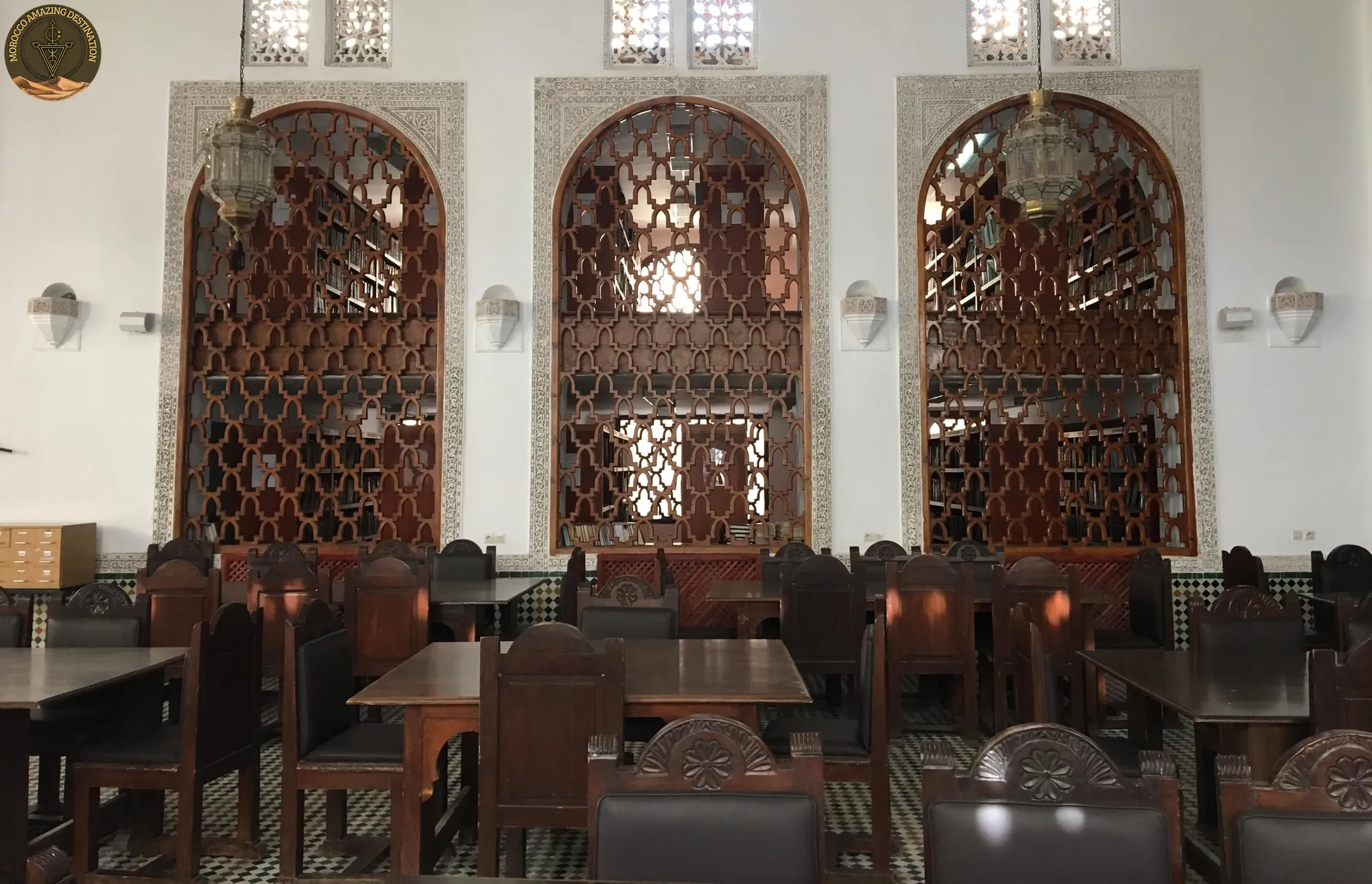
Behind a plain wooden door on Place Seffarine, a small room holds manuscripts copied by hand centuries before printing reached this coast. The oldest library in the world sits in Fez, and the arithmetic behind that claim deserves care. The mosque dates to 859, the first purpose-built library chamber to the mid-14th century, and the formal record belongs to the university attached to them. For a visitor, one fact matters more than the rest: the library keeps its own entrance on the square, and anyone can walk up to it.
In this guide, we will look at the woman who paid for the building, what is actually on the shelves, how the room nearly rotted away, and what you see when you reach that door.
The Woman Behind the Door
Fatima al-Fihri arrived in Fes from Kairouan as a child, part of a merchant family that settled in the new Idrisid capital and prospered. When her father and husband died, she inherited enough to build. She bought a plot near the spice market, and the account says she laid the foundation on the first day of Ramadan. Around two years later the mosque stood finished.
Her sister Mariam is credited with the matching mosque on the opposite bank, the Andalusiyyin, which gives the story a pleasing symmetry. Historians raise an eyebrow at how neat it is. The fullest early account of both women comes from a chronicle compiled four hundred years after her death, and a Kufic foundation inscription uncovered during 20th-century repairs names a different patron.
What “Oldest Library in the World” Really Means
Three separate facts usually travel together in one sentence, and separating them changes what you are looking at.
- The mosque and the teaching: 859, the complex where scholars taught, and the institution recognised as the oldest continually operating centre of higher learning.
- The library itself: a purpose-built chamber added in the mid-14th century under the Marinid sultan Abu Inan Faris, with the present reading room arriving in a 1940s expansion.
- The title: a claim repeated for generations with no certificate behind it. St Catherine’s Monastery in Sinai has never closed its collection either, so careful writers say “widely believed”.
The al-qarawiyyin library therefore inherits a record held by its parent institution, occupies a room built in the mid-14th century, and has served readers without a long break for six centuries.
Inside the Collection
Roughly four thousand manuscripts are catalogued here in Arabic and consulted by researchers from across the region. The showpieces have names and stories.
- A 9th-century Quran: Kufic script on gazelle parchment, among the oldest copied texts in North Africa.
- Imam Malik’s Al-Muwatta: several volumes on the same parchment, foundational to Maliki law.
- Ibn Ishaq’s biography of the Prophet: an early life of Muhammad.
- Ibn Khaldun’s Kitab al-Ibar: the copy containing the Muqaddimah, said to have been placed here by the author himself.
A Quran given by the Saadian sultan Ahmad al-Mansur and Ibn Rushd’s commentary on Maliki law sit alongside them. Reaching that room once took four men with four separate keys, all required to be present. The chamber is climate-controlled now, and scanning continues so fragile pages can be studied without being touched.
The Rescue
By the turn of the last decade the building was in trouble. Sewage backed up beneath the lower shelves, ceilings cracked, beams split, wiring sat exposed, and the manuscript rooms held no control over heat or damp.
The Ministry of Culture brought in Aziza Chaouni, an architect born in Fes and practising from Toronto who, by her own account, had not known the library existed. Her problem was structural as much as cosmetic. The library had grown as a cluster of connected buildings stepping down a steep slope across three different levels.
What reopened in 2016 held a reading room, stacks, a conference room, exhibition space in an older vaulted chamber, a manuscript restoration and digitisation laboratory, a café, and new drainage and solar infrastructure. Chaouni described her aim as public access as well as preservation.
Getting In: Place Seffarine and the Medina Lanes
Expectations matter more than directions: the two buildings follow different rules. The mosque is an active place of worship and non-Muslims do not enter. Look through the open doorways on the Derb Boutouil and Bab al-Ward sides, but do not step over the threshold or photograph anyone at prayer.
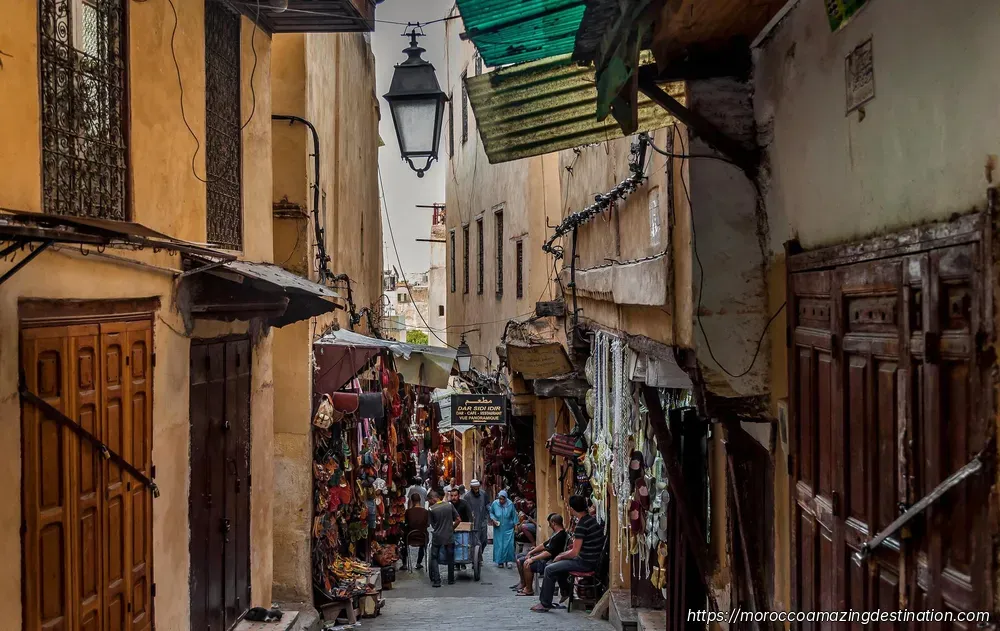
The library in Fez medina is the exception. Its entrance opens onto Place Seffarine, the square you find by ear from the hammering of the coppersmiths. A 1940s expansion under Mohammed V created that outside door so non-Muslims could reach the collection without crossing a prayer hall.
- What you see: the reading room and exhibition spaces.
- What you do not: the manuscripts, which stay behind researcher credentials and prior arrangement.
- When to go: opening days shift without notice and no schedule is published, so confirm on the day.
- How to walk it: Bab Bou Jeloud down Talaa Kebira, fifteen to twenty-five minutes to the Attarine area, or a taxi to Place R’cif and ten minutes uphill.
Add the Attarine and Bou Inania madrasas, open to everyone and carved in the same idiom. Our Fes el Bali guide covers the wider layout, and the medina walking tour covers the loop. Our guides Hassan, Hamid and Andrea know which unmarked turn leads to the coppersmiths.
A room of hand-copied books is reason enough to give the medina a full day. Our 7-Day Morocco Tour from Fes begins in the old city and continues to the Sahara, Meknes and Chefchaouen, and the 4-Day Desert Tour from Fes to Marrakech carries you south over the Atlas.
We can customize a tour to match your needs - design your perfect itinerary
If you found this helpful, add us as your preferred source on Google.
Frequently Asked Questions
Is the Al-Qarawiyyin library really the oldest in the world?
It holds the strongest claim, though not a formal record. The recognised record for the oldest continually operating centre of higher learning belongs to the university attached to the mosque, and the library's first purpose-built chamber dates to the mid-14th century. St Catherine's Monastery in Sinai also claims unbroken use, which is why careful accounts say 'widely believed'.
Can non-Muslims go inside the library in Fes?
Yes. A separate entrance on Place Seffarine was created in the 1940s so non-Muslims could reach the library without crossing a prayer hall. The mosque itself stays closed to non-Muslims, and you view it from the doorways on Derb Boutouil and Bab al-Ward or from a rooftop.
Can visitors see the manuscripts?
Not normally. The manuscript store is reserved for researchers with academic credentials and a prior appointment. Visitors reach the reading room and the exhibition spaces, and digitisation lets fragile volumes be consulted on screen instead of in the hand.
How long does a visit take and where do you enter?
You enter from Place Seffarine, the square of the coppersmiths. Most people spend 45 to 60 minutes and pair it with the Attarine and Bou Inania madrasas nearby. Opening days change without notice, so confirm on the day.
Ready for an Adventure?
Have questions? Feel free to contact us using the form below. We're here to help!