· Travel · 10 min read
Fes el Bali: The Ultimate Guide to Morocco's Ancient Medina
Discover Fes el Bali, Morocco's ancient walled medina and UNESCO site. Explore tanneries, madrasas, souks, and hidden riads in this complete travel guide.
Step through Bab Bou Jeloud, the iconic Blue Gate, and you cross a threshold into another world. Fes el Bali — Old Fes — is not simply a neighborhood or a tourist attraction. It is a living, breathing medieval city where more than 150,000 people still live, work, pray, and trade within walls that have stood for over a thousand years. The air carries the scent of cedarwood, curing leather, freshly baked bread, and spices ground by hand. Donkeys laden with goods squeeze past you in alleyways barely wide enough for two people. A muezzin’s call echoes off stone walls. This is Fes el Bali, the oldest walled part of Fes and arguably the most authentic cultural experience anywhere in the Arab world. If you are planning a trip to Morocco, skipping Fes el Bali is not an option — it is the country’s spiritual and intellectual heart.
What Is Fes el Bali?
Fes el Bali is the original medina of Fes, founded between 789 and 808 AD by Idris I and later expanded by Idris II. It is often described as the largest contiguous car-free urban zone on Earth, a title that does not fully capture its complexity. The medina spans approximately 300 hectares and is crisscrossed by an estimated 9,400 streets — a number that includes dead ends, covered passages, and staircases so narrow you can touch both walls at once.
Designated a UNESCO World Heritage Site in 1981, Fes el Bali is universally recognized as one of the best-preserved examples of a medieval Islamic city. Its urban fabric remains remarkably intact: traditional crafts are still practiced in the same workshops, families live in the same houses their ancestors built centuries ago, and the rhythms of daily life follow patterns that would be familiar to a visitor from the 14th century.
Two key factors distinguish Fes el Bali from Morocco’s other famous medinas:
- Authenticity: While Marrakech’s medina has been heavily shaped by tourism and Essaouira’s by its coastal location, Fes el Bali remains fundamentally a working city. The tanneries, pottery kilns, and weaving workshops you see are not staged for visitors — they are the beating heart of a local economy that has functioned this way for generations.
- Scale: The sheer size and density of Fes el Bali are overwhelming in the best possible way. It can take days to feel even slightly oriented, and weeks to know it well. This is not a place you “see” in an afternoon; it is a place you experience slowly, on its own terms.
Top Things to Do in Fes el Bali
Every corner of Fes el Bali holds something worth discovering, but certain landmarks and experiences deserve a special place on your itinerary.
Al-Qarawiyyin Mosque and University
Founded in 859 AD by Fatima al-Fihriya, Al-Qarawiyyin is recognized by UNESCO and the Guinness World Records as the oldest continuously operating university in the world. Non-Muslims cannot enter the mosque, but you can admire its magnificent courtyard and minaret from several vantage points, including the rooftop terraces of nearby restaurants and riads. The adjoining library — one of the oldest in the world — houses a collection of priceless Islamic manuscripts and was beautifully restored in recent years.
Bou Inania Madrasa
Of all the madrasas (Islamic schools) in Fes, Bou Inania Madrasa is the undisputed masterpiece. Built between 1350 and 1357 under the Marinid dynasty, it is one of the few religious buildings in Morocco open to non-Muslim visitors. The central courtyard is a symphony of zellij tilework, carved cedarwood, and intricately carved stucco. Look up at the green-tiled minaret and the mashrabiya balconies, then step inside the prayer hall to admire the marble mihrab and the elaborate wooden minbar. Entry costs approximately 20 MAD (EUR 2).
Chouara Tannery
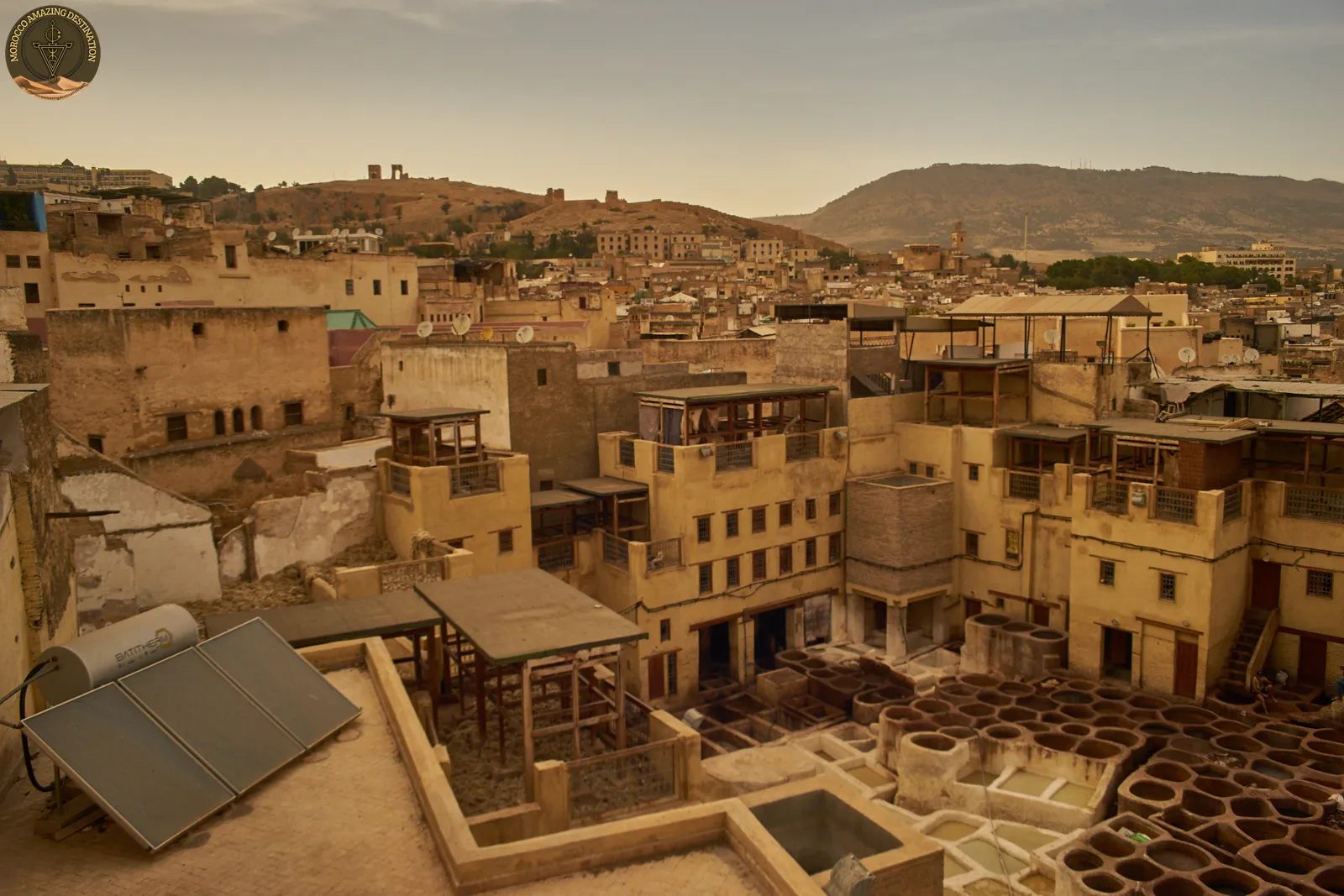
The Chouara Tannery is the image most people associate with Fes — rows of stone vats filled with vibrant dyes, where workers treat animal hides using methods unchanged since the Middle Ages. The best views are from the leather shop terraces that surround the tannery; simply ask a shopkeeper and they will lead you upstairs. Mint leaves are typically offered to mask the strong smell of the tanning pits. Morning is the best time to visit, when the vats are full and the light is ideal for photography. Entry is free, though tipping the shopkeeper (10-20 MAD) is courteous.
Explore the Souks
The souks of Fes el Bali are organized by craft — a medieval zoning system that still functions today. Wander through:
- Souk el Henna for traditional cosmetics and natural remedies
- Souk el Attarine for spices, perfumes, and oils
- Place Seffarine for brass and copperware, where artisans hammer intricate patterns into metal trays
- Nejjarine Square for woodwork and the beautifully restored Fondouk Nejjarine, now a museum of wooden arts and crafts
- Cherratine Madrasa area for leather goods, woven blankets, and traditional clothing
Bargaining is expected. Start at roughly half the asking price and negotiate with a smile. It is part of the culture, not a confrontation.
Bab Bou Jeloud
The Blue Gate is the main entrance to Fes el Bali and the best starting point for any exploration. The side facing the outside is decorated with cobalt blue zellij tiles, while the inner side — visible only after you cross through — is green, the color of Islam. The gate itself dates from 1913, but it stands on the site of a much older entrance. The square just inside is a lively gathering point with juice stalls, cafes, and food vendors.
Attarine Madrasa
Smaller and more intimate than Bou Inania, the Attarine Madrasa is a jewel of Marinid architecture. Built in 1325, its courtyard is a study in perfect proportions — a square reflecting pool, a finely carved cedar dome, and walls covered in geometric zellij patterns and calligraphic stucco. It is a quiet, contemplative space that rewards slow observation. Entry is around 20 MAD (EUR 2).
Nejjarine Museum of Wooden Arts and Crafts
Housed in a beautifully restored 18th-century fondouk (caravanserai), this museum celebrates Morocco’s rich tradition of woodworking. The building itself — with its three-story galleried courtyard — is worth the visit alone. Exhibits display intricately carved doors, musical instruments, prayer beads, and furniture from across the country. The rooftop cafe offers one of the best panoramic views over Fes el Bali.
The Tanneries Quarter
Beyond Chouara, the tanneries of Fes el Bali include Sidi Moussa and Ain Azliten, though Chouara is the oldest and most photogenic. The process has remained essentially unchanged for centuries: hides are first soaked in a mixture of water, lime, and pigeon droppings to soften them and remove hair, then transferred to vats of natural dyes — indigo for blue, poppy for red, saffron for yellow, and henna for orange. After dyeing, the leather is dried in the sun on the rooftops surrounding the tannery quarter.
Where to Stay in Fes el Bali
Staying inside Fes el Bali is far more immersive than lodging in the Ville Nouvelle (the modern French-built district). You will wake to the sounds of the medina, step directly into its alleyways, and experience its rhythms after the day-trippers have departed.
Riads — traditional courtyard houses converted into guesthouses — are the quintessential Fes el Bali accommodation. Most are architectural gems in their own right, with central fountains, zellij-tiled courtyards, and rooftop terraces with views across the medina. Prices range from budget-friendly (200-400 MAD / EUR 19-37 per night) to ultra-luxury (1,500-3,000+ MAD / EUR 140-280+ per night).
Book well in advance — the best riads in Fes el Bali fill up quickly, especially during spring and autumn. Most riads are tucked deep in the alleyways, so arrange for someone from the property to meet you at the nearest medina gate on arrival.
What to Eat in Fes el Bali
Fes is widely considered Morocco’s culinary capital, and eating well in Fes el Bali is both easy and affordable. The medina’s food scene spans street stalls, hole-in-the-wall eateries, and elegant riad restaurants.
Must-try dishes in Fes el Bali:
- Fassi pastilla: A flaky pastry pie filled with spiced pigeon or chicken, almonds, and eggs, dusted with cinnamon and powdered sugar. The Fassi version is the definitive take on this iconic dish.
- Rfissa: A celebratory dish of shredded msemen (layered flatbread) topped with chicken, lentils, and fenugreek-infused broth.
- Fassi couscous: Unlike other regional versions, Fassi couscous is fine-textured and often features seven vegetables, caramelized onions, and raisins.
- Harira: The classic Moroccan soup of tomatoes, lentils, chickpeas, and herbs — served everywhere, but Fassi harira is particularly rich and aromatic.
For street food, head to the area around Bab Bou Jeloud in the evening, where vendors serve brochettes, grilled merguez sausages, and freshly squeezed juices. For a more refined experience, many riads offer multi-course tasting menus that showcase Fassi cuisine at its best.
Practical Tips for Visiting Fes el Bali
Navigating Fes el Bali can be challenging, but the right preparation makes all the difference.
- Hire an official guide: For at least a half-day on your first full day. This investment transforms confusion into understanding and gives you the confidence to explore independently afterward. Book through your riad or the official tourist office near Bab Bou Jeloud.
- Wear comfortable walking shoes: You will walk — a lot. The streets are uneven cobblestones, often sloping up and down, and there are countless steps. Leave the sandals at your riad.
- Dress respectfully: Fes is conservative. Both men and women should cover shoulders and knees. Women may feel more comfortable with a light scarf, though head covering is not required.
- Carry small change: For tips, small purchases, and taxi rides. Breaking large notes can be difficult in the medina.
- Use offline maps: Google Maps works reasonably well in Fes el Bali, but download the area offline before you go — signal can be patchy in the narrow streets. Maps.me and Maps of Morocco are useful alternatives.
- Be aware of faux guides: Unofficial guides offering “help with directions” are common, especially near the gates. A firm but polite “la, shukran” (no, thank you) is usually enough. If someone persists, step into a shop or cafe.
- Visit the tanneries in the morning: The vats are full, the light is at its best, and the heat has not yet intensified the smell.
- Allow enough time: Two full days is the minimum to appreciate Fes el Bali. Three to four days allows you to explore at a more relaxed pace, take a cooking class, visit a hammam, and make a day trip to nearby Meknes or Volubilis.
- Respect photography boundaries: Always ask before photographing people, especially women. Some craftsmen and shopkeepers are happy to be photographed, but others prefer not to be. A smile and a polite gesture go a long way.
The Deeper Layers of Fes el Bali
Beyond the major sights, the true magic of Fes el Bali lies in its quieter moments — watching a craftsman embroider a caftan by hand in a doorway workshop, following the scent of fresh bread to a hidden community oven, sitting on a rooftop terrace as the sunset call to prayer washes over the city, or discovering a courtyard where children play football among centuries-old walls. These are the experiences that stay with you long after you have left Morocco.
Fes el Bali does not reveal itself to those in a hurry. It rewards patience, curiosity, and a willingness to get lost. Every wrong turn leads somewhere interesting, and every dead end has a story. In a world of increasingly homogenized city centers and predictable tourist experiences, Fes el Bali stands as a glorious, chaotic, utterly authentic exception.
Ready to explore beyond the medina? Our 7-Day Morocco Tour from Fes takes you from the ancient alleyways of Fes el Bali to the Sahara Desert, Meknes, and the blue streets of Chefchaouen — a complete Moroccan journey in one week. For a shorter adventure, the 2-Day Desert Tour from Fes to Merzouga is the perfect way to experience the magic of the Sahara while keeping Fes as your starting and ending point.
Looking for something tailored to your interests? We can design a custom itinerary that includes Fes el Bali and any other destination in Morocco — contact us to create your personalized tour.
If you found this helpful, add us as your preferred source on Google.
Frequently Asked Questions
What makes Fes el Bali different from other Moroccan medinas?
Fes el Bali is the largest car-free urban area in the world and one of the best-preserved medieval cities on the planet. Founded in the 9th century, it is a UNESCO World Heritage Site with over 9,000 narrow alleyways, centuries-old madrasas, tanneries, and souks. Unlike other medinas that have been heavily modernized, Fes el Bali retains its authentic, labyrinthine character and is home to the world's oldest continuously operating university — Al-Qarawiyyin. Walking through its streets genuinely feels like stepping back in time.
Do I need a guide to explore Fes el Bali?
While not strictly necessary, hiring a local official guide (approximately 200-400 MAD / EUR 19-37 for a half-day) is highly recommended. The medina's 9,000-plus winding alleyways are notoriously disorienting, with many unmarked dead ends. A knowledgeable guide not only helps you navigate but also provides invaluable historical context, takes you to hidden gems you would likely miss on your own, and helps you avoid persistent faux guides and tourist traps. Always hire guides through your riad or the official tourist office.
What is the best time of day to visit Fes el Bali?
Early morning (8:00-10:00) is the best time to explore Fes el Bali. The light is beautiful for photography, the air is cooler, and the medina is waking up — you will see artisans setting up workshops, bread being delivered, and donkeys transporting goods through the alleyways before the crowds arrive. Late afternoon (16:00-18:00) is also pleasant, especially for rooftop views at sunset. Midday can be very hot in summer and more crowded, so plan indoor activities or rest at your riad during peak hours.
How do I get to Fes el Bali from Fes Saiss Airport?
Fes Saiss Airport is about 15 kilometers from Fes el Bali. The most convenient option is a pre-arranged airport transfer (150-250 MAD / EUR 14-24), which your riad or hotel can organize. Taxis from the airport cost approximately 100-150 MAD (EUR 10-14). If you are arriving by train, Fes train station is about 3 kilometers from the medina, and a petit taxi will cost around 15-25 MAD (EUR 1.5-2.5). Note that cars cannot enter Fes el Bali — your driver will drop you at one of the medina gates, and from there you will walk to your accommodation.
Ready for an Adventure?
Have questions? Feel free to contact us using the form below. We're here to help!