
· Travel · 10 min read
Fes Medina Tour: Guided Walking Tour of Fes el-Bali & the World's Largest Car-Free Medina
Explore Fes el-Bali on a guided walking tour — tanneries, madrasas, souks and hidden alleys with a licensed local guide.
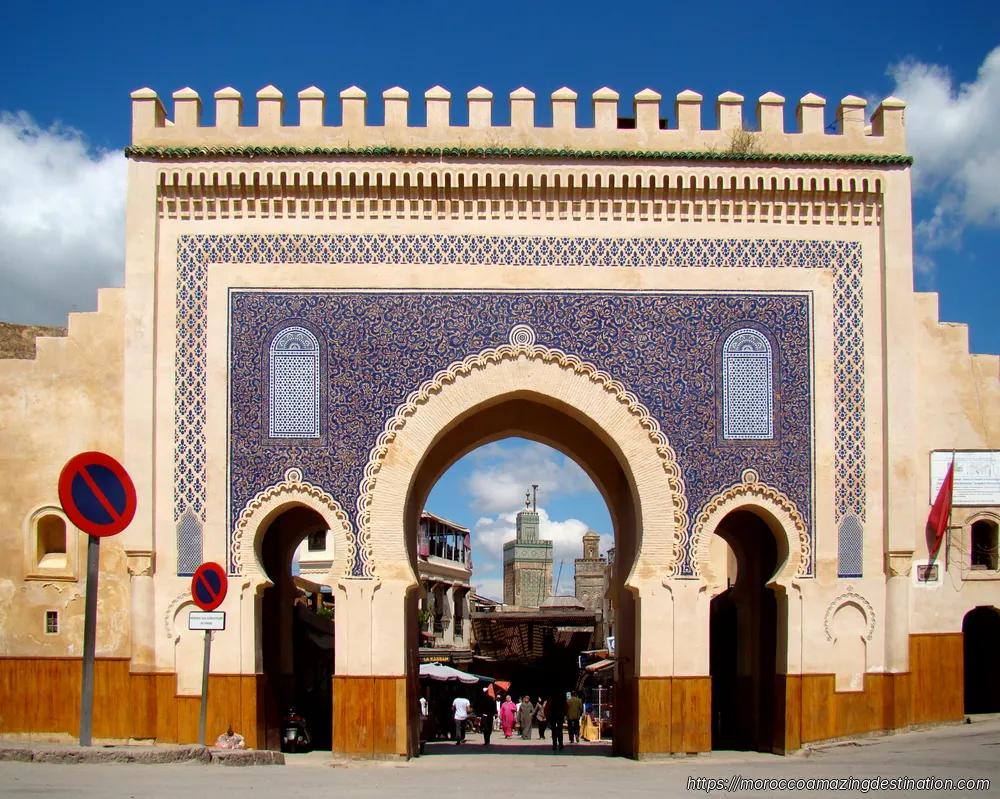
Fes Medina Tour: Guided Walking Tour of Fes el-Bali & the World’s Largest Car-Free Medina
Step through Bab Bou Jeloud and the noise of modern Fes falls away. Inside the walls of Fes el-Bali, donkeys carry leather and bread through alleys barely wide enough for two people, copper hammers ring on Seffarine Square, and the scent of cedar, spices and tanning pits hangs in the air. A fes medina tour is the most rewarding way to read this living medieval city without getting lost in its maze.
Travellers often search for the same experience spelled a different way. A fez medina tour refers to exactly the same city and the same UNESCO-listed medina — Fes and Fez are simply two English spellings of Arabic Fās — and the advice in this guide applies equally to both.
Fes el-Bali is widely described as the world’s largest car-free urban area and one of the best-preserved historic towns of the Arab-Muslim world, according to UNESCO. The walled medina sprawls over roughly 280 to 300 hectares and is threaded with more than 9,000 alleys — often cited as some 9,400 — ranging from broad souk arteries to covered derbs only shoulder-wide. Only one vehicular road reaches Place R’cif; inside, everything moves on foot or by mule. That scale is precisely why a guided walk matters.
Why a Guide Is Essential in Fes el-Bali
Fes el-Bali was founded over twelve centuries ago under the Idrisid dynasty and grew organically without a grid. The result is beautiful and bewildering:
- Maps and GPS struggle. Blue-and-white plaques mark some streets, but many alleys are unmarked, dead ends are frequent, and slopes can disorient even careful navigators. Locals often orient by gradient: downhill generally leads toward the river and the Al-Qarawiyyin heart, uphill back toward Bab Bou Jeloud.
- Cultural translation. A good guide explains what you are seeing — why a fondouk has a massive cedar door, how zellij tilework encodes geometry, or why the tanneries use natural dyes and a lime-and-pigeon-dung soak.
- Access. Workshops, rooftop terraces over the tanneries, and quiet madrasa courtyards often open only through relationships. Guides unlock doors that remain closed to independent wanderers.
- Protection from hassle. Official guides shield you from persistent faux guides near the gates who offer unsolicited directions and then demand payment. Politely declining with “la, shukran” and stepping into a shop is usually enough, but a licensed guide removes the issue entirely.
In short, the medina rewards curiosity but punishes guesswork. A half-day with a professional turns confusion into context, after which you can confidently revisit favourite corners on your own.
What a Guided Tour Includes
A typical private or small-group walk begins at Bab Bou Jeloud, the Blue Gate built during the French protectorate period. Its outer face glows with cobalt zellij, while the inner face is green, the colour associated with Islam. From the gate square — juice stalls, drummers, and pastry carts — you dive straight into the medina’s two great arteries: Talaa Kebira and Talaa Seghira.
Many travellers compare options before booking a fez medina guided tour that matches their pace and interests, from private photography walks to small-group cultural circuits.
A separate search might lead you to book a fes medina guided tour that is private, family-friendly, or focused on crafts — the format is flexible, but the core loop is remarkably consistent.
Core highlights usually include:
- Bou Inania Madrasa — the only historic madrasa in Fes that also served as a Friday mosque, with a full minaret. Its courtyard is a masterclass in Marinid art: zellij, carved cedar and stucco, and a marble courtyard that stays cool even on warm afternoons. Non-Muslim visitors can admire the courtyard and prayer hall antechamber.
- Souk corridors and craft quarters — Attarine for spices and perfumes, Seffarine for coppersmiths hammering trays and lanterns, and the area around Nejjarine for woodwork and woven textiles.
- Al-Qarawiyyin — founded by Fatima al-Fihri and regarded by UNESCO and Guinness World Records as the oldest continuously operating degree-granting university in the world, though scholars note its later modern reorganisation. Non-Muslims view the courtyard and library exterior from nearby vantage points.
- Nejjarine Square and Fondouk — a historic caravanserai beautifully restored as the Museum of Wooden Arts and Crafts, with a rooftop café that offers a superb panorama over the medina.
- Chouara Tanneries — the largest and most photographed tannery, with stone vats of natural dyes: indigo for blue, poppy for red, saffron for yellow, henna for orange. The best views are from surrounding leather-shop terraces; mint leaves are often offered to offset the odour from the tanning pits. The smaller Sidi Moussa and Ain Azliten tanneries offer quieter alternatives.
- Attarine Madrasa, Seffarine Square and hidden fondouks — where caravans once unloaded goods and now artisans still work in arcaded courtyards.
Expect a half-day highlights loop of about 3 to 4 hours or a full-day immersion of 5 to 7 hours that adds the Mellah (historic Jewish quarter), the tanneries’ back streets, and viewpoints from the hills outside the walls, such as Borj Nord. Tours typically run in English, French or Spanish, with private tours offering more language options.
What is usually included and what is not:
- Included: licensed guide, walking route, cultural interpretation, terrace access arranged by the guide.
- Often extra: monument entries (a modest cash fee of around 20 to 30 MAD per site, though amounts vary and should be confirmed locally), food and shopping, and tips.
- Group tours often charge per person, while private tours charge per group — confirm whether the price quoted is per person or per group, what languages are covered, and whether entries are bundled.
On Foot: What to Expect From the Walking Format
A dedicated fes medina walking tour is entirely on foot — there is no other way to see Fes el-Bali, since vehicles cannot enter the core medina beyond Place R’cif.
Here is how the rhythm typically feels:
- Pace and terrain. Expect cobbles, steps and gentle slopes. Streets narrow from five metres on the Talaa arteries to less than a metre in residential derbs. Distances are short but cumulative, so closed, comfortable shoes with grip are essential.
- Timing. Morning starts around nine to eleven o’clock are ideal. Tanneries are active, workshops are open, light is soft for photography, and the medina is lively without the midday crowd. Late afternoon is also atmospheric, especially from rooftop terraces.
- Climate and dress. Fes is conservative. Cover shoulders and knees; a light scarf is useful for both sun and modest dress. Bring water, a hat and small denominations of Moroccan dirham for entries and tips. Street widths and shade keep the medina cooler than the Ville Nouvelle, but summer afternoons still warrant a slow pace.
- Photography and etiquette. Always ask before photographing people, especially artisans in workshops. A smile and gesture go a long way. If a shop terrace is used for a tannery view, a small purchase or modest tip is courteous, but never obligatory.
- Accessibility. Steps, uneven stones and narrow passages make the medina challenging for wheelchairs and strollers. Tell your guide about mobility needs in advance so the route can avoid the steepest staircases.
Because the medina is a living neighbourhood rather than an open-air museum, you will share alleys with residents carrying groceries, children heading to school, and craftsmen delivering brass trays on shoulder poles. The walking format lets you pause for those moments — a bread oven opening its ash-black door, an embroiderer stitching a caftan in a doorway, a courtyard fountain catching light.
How to Choose Your Guide
Selecting the right fes medina guide matters more than any other decision you make for your time in Fes. Credentials, clarity and chemistry count.
Check these fundamentals:
- Official licensing. Ministry of Tourism-licensed guides carry a brass badge or card and are regulated by the local Tourist Brigade. Book through your riad, the tourist office near Bab Bou Jeloud, or a reputable Fes-based operator rather than accepting offers on the street.
- Reviews and language. Look for recent, specific reviews mentioning knowledge, patience and language fluency. Confirm the guide speaks your preferred language and whether you want history-heavy commentary, craft-focused visits, or food stops.
- Pricing transparency. Half-day private tours are often quoted per group, with a range that varies by season and group size; full-day tours cost more. Some sources cite modest per-group figures, while specialist operators quote higher rates for fully private, tailor-made walks for up to six guests. Treat any published range as indicative and confirm the total in MAD before you start, including whether monument entries and terrace access are included.
- Itinerary clarity. Agree on a rough loop — Bab Bou Jeloud, Bou Inania, souks, Qarawiyyin exterior, Nejjarine/Seffarine, Chouara — and on what you would like to skip or add, such as the Mellah, a fondouk visit, or a carpet or pottery demonstration without sales pressure.
- Group vs private. Private tours allow you to control pace, focus and photo stops. Small-group tours cost less per person but follow a fixed route. If you value flexibility or are travelling with children or elders, private is worth the premium.
- Tipping. A gratuity of around 50 to 100 MAD for good service is customary for a half-day private guide, more for a full day or larger groups, though always at your discretion.
A useful test: a trustworthy guide explains limits clearly, notes which religious interiors are not accessible to non-Muslims, never rushes you through shops, and gives you time to sip tea and simply watch the medina breathe.
Practical Tips for a Smooth Medina Day
- Start at a gate. Bab Bou Jeloud is the classic meeting point; Bab Guissa and Bab R’cif are quieter alternatives if your riad lies nearer those gates. Your guide will suggest the closest entry to minimise backtracking.
- Carry essentials. Small cash for entries, an offline map downloaded before you enter (signal can be patchy), a power bank, and a reusable water bottle. Many riads lend a local SIM or advise on data.
- Shop wisely. Haggling is expected and should be polite. Start around half the initial ask and negotiate with a smile. The medina organises souks by craft, so compare two or three stalls before committing, and ask your guide for a no-pressure introduction to artisans you actually want to meet.
- Respect prayer times. Mosques are not open to non-Muslims, but you will hear the call to prayer wash over rooftops — a powerful moment to pause on a terrace rather than rushing to the next site.
- Combine thoughtfully. After a morning walk, consider the Mellah’s lanes and historic synagogues just outside Fes el-Bali, or a taxi to Borj Nord and the Merenid Tombs for a panoramic sunset over the medina. For food, try Fassi specialities such as pastilla, harira and seasonal tagines near Bab Bou Jeloud or in your riad.
- Safety. Fes el-Bali is generally busy and welcoming, yet crowds require usual city awareness. Keep valuables close, agree prices before accepting services, and use your guide’s introduction to navigate shop terraces comfortably.
Stay Curious: Secrets Between the Landmarks
Between the headline sights lies the medina’s quiet magic. Watch bread dough stamped and carried to the communal ferran oven on a wooden board, peek into a fondouk where brass is still hammered by hand, or linger on a rooftop as dusk settles and lights flicker on across the dense urban bowl. The medina does not reveal itself to those in a hurry. Every wrong turn has a story, and every courtyard invites you to slow down.
If you are weighing how Fes fits into a wider journey, two private itineraries pair a medina walk with the country’s other icons. The 7-Day Morocco Tour from Fes is a round-trip that links a fully guided Fes el-Bali day with a luxury Sahara camp at Merzouga, the imperial city of Meknes, the Roman ruins of Volubilis and the blue streets of Chefchaouen before returning to Fes. For a one-way crossing, the 3-Day Desert Tour from Fes to Marrakech trades the medina’s alleys for dunes, gorges and the High Atlas, finishing in Marrakech.
We can customize a tour to match your needs — design your perfect itinerary
If you found this helpful, add us as your preferred source on Google.
Frequently Asked Questions
Do I need a guide for the Fes medina or can I explore alone?
For a first visit a licensed guide is highly recommended. The medina has more than 9,000 alleys that defeat phone maps, and a guide provides navigation, cultural translation and access to workshops and terraces you would likely miss alone. Many travellers do a guided morning and then explore solo in the afternoon.
What does a Fes medina guided tour include?
A typical half-day loop starts at Bab Bou Jeloud and follows Talaa Kebira to Bou Inania Madrasa, through the spice and brass souks, past the exterior of Al-Qarawiyyin, to Nejjarine Square and Seffarine, with terraces over the Chouara Tanneries. Full-day tours add the Mellah, fondouks and panoramic viewpoints. Monument entries are usually paid separately.
How long is a Fes medina walking tour?
A highlights walking tour takes about 3 to 4 hours. A full-day version runs 5 to 7 hours with a break for lunch and more time in workshops and madrasas. The entire experience is on foot, so comfortable shoes are essential.
How do I choose a reliable Fes medina guide?
Look for an official Ministry of Tourism badge, clear per-group pricing agreed in advance, multilingual ability and strong reviews via your riad or a reputable Fes-based operator. Avoid paying the full amount upfront and confirm what is included before you start.
Ready for an Adventure?
Have questions? Feel free to contact us using the form below. We're here to help!