· Travel · 4 min read
Meknes Architecture: Monuments of the Imperial City
Discover Meknes architecture: Bab Mansour, the Mausoleum of Moulay Ismail, Heri es-Souani and Roman Volubilis, and what to see there.
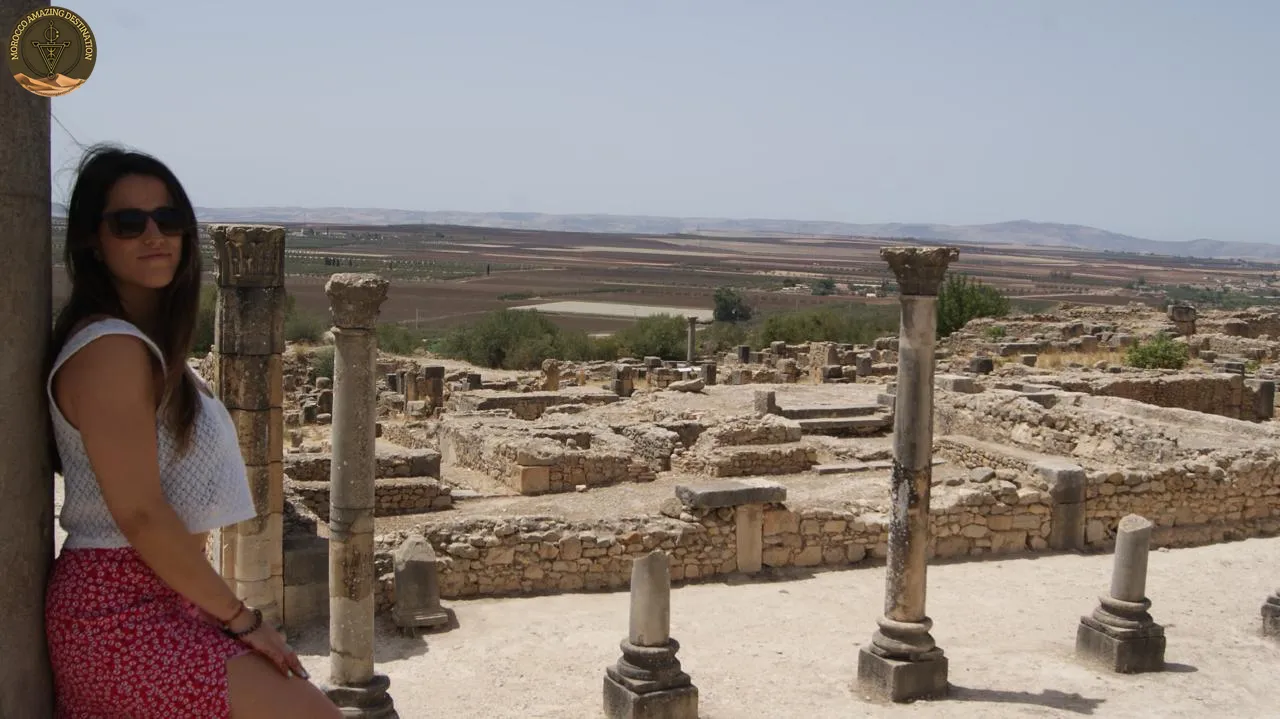
Meknes is the imperial city most travelers drive past on the way to Fes, and the one that rewards a slow half-day most. Sultan Moulay Ismail rebuilt it as his capital and kept building for fifty-five years, so Meknes architecture reads as one long royal project: gates, granaries, a reservoir and a tomb you can walk into.
Meknes holds some of Morocco’s finest monumental architecture, from the gate of Bab Mansour to the medina’s Marinid madrasa and the Roman ruins at Volubilis. In this guide, we will break down each monument and explain how you can visit them in a single day.
Meknes Medina: The Old City and Its Monuments
Moulay Ismail gets the credit, but the medina he inherited is the older half of Meknes. The Almoravids founded it as a military settlement, and Marinid sultans added the religious buildings that still stand.
Four medina monuments are worth the detour:
- Medersa Bou Inania: a 14th-century Marinid madrasa with cedar carving and zellij, built under Abu al-Hasan.
- Grand Mosque: founded in the 12th century by the Almoravids, with eleven gates.
- Dar Jamai: a late-19th-century palace on Place el-Hedim, now the Museum of Moroccan Art and Ethnography.
- Bab Berdaine and Bab el-Khemis: the monumental medina gates; Bab el-Khemis means “Thursday Gate” after its market day.
Start at Place el-Hedim, whose name means “the rubble”. Ismail cleared the square in front of his palace, and the medina and the imperial city meet there.
Moulay Ismail’s Imperial City and Bab Mansour
Bab Mansour is the gate everyone photographs, and it explains why Meknes matters. Ismail ruled from 1672 to 1727 and moved the capital here, then spent his reign walling and stocking the city.
The historic city is credited with 45 km of outer walls, twenty gates and more than fifty palaces. Ramparts rise as high as 15 metres, and the medina joined the UNESCO World Heritage list in 1996.
The gate was finished in 1732, five years after Ismail died, under his son Moulay Abdallah. It takes its name from the architect Mansour el-Aleuj, its columns were reused from Volubilis, and the horseshoe arch is framed in zellij.
The Mausoleum of Moulay Ismail
The Mausoleum of Moulay Ismail is one of the very few Islamic religious monuments in Morocco that non-Muslim visitors can enter. That access is why it appears on so many itineraries.
Inside, three courtyards lead to the tomb chamber:
- Zellij and carved stucco: mosaic tile and plasterwork in the Andalusian-Moroccan style.
- Painted cedar ceilings: cedar beams, painted and gilded.
- The sultan’s tomb: Ismail lies in the central chamber, viewed from the doorway.
- Two tall clocks: said to be gifts from King Louis XIV of France.
Much of the interior dates from a mid-20th-century restoration, so read it as a careful reconstruction. Dress modestly; the compound takes under an hour.
Heri es-Souani, the Agdal Basin and the Qara Legend
Heri es-Souani is a hall of repeated arches, and the most photogenic interior in Meknes. It measures roughly 182 by 104 metres and holds 22 rows of thick piers.
- Heri es-Souani: historians read it as a granary and storehouse, built to feed the imperial city through a siege. Popular tradition calls it the royal stables for 12,000 horses.
- Agdal Basin: a reservoir of about 319 by 149 metres, fed by the House of the Ten Norias next door.
- Qara: underground vaulted chambers that tradition calls a prison for thousands of captives and historians read as a storage cellar. The Portuguese architect story is legend.
The 1755 Lisbon earthquake left the granary largely roofless, so you can see the arches from above. Qubbat al-Khayyatine, the Pavilion of the Ambassadors, is where Ismail received foreign envoys.
Volubilis and the Roman Plain
Volubilis sits about 30 km north of Meknes, which is 30 to 45 minutes by road. There is no train, so a private car or a guided day trip is the realistic way to get there. A grand taxi works too if you agree on the wait.
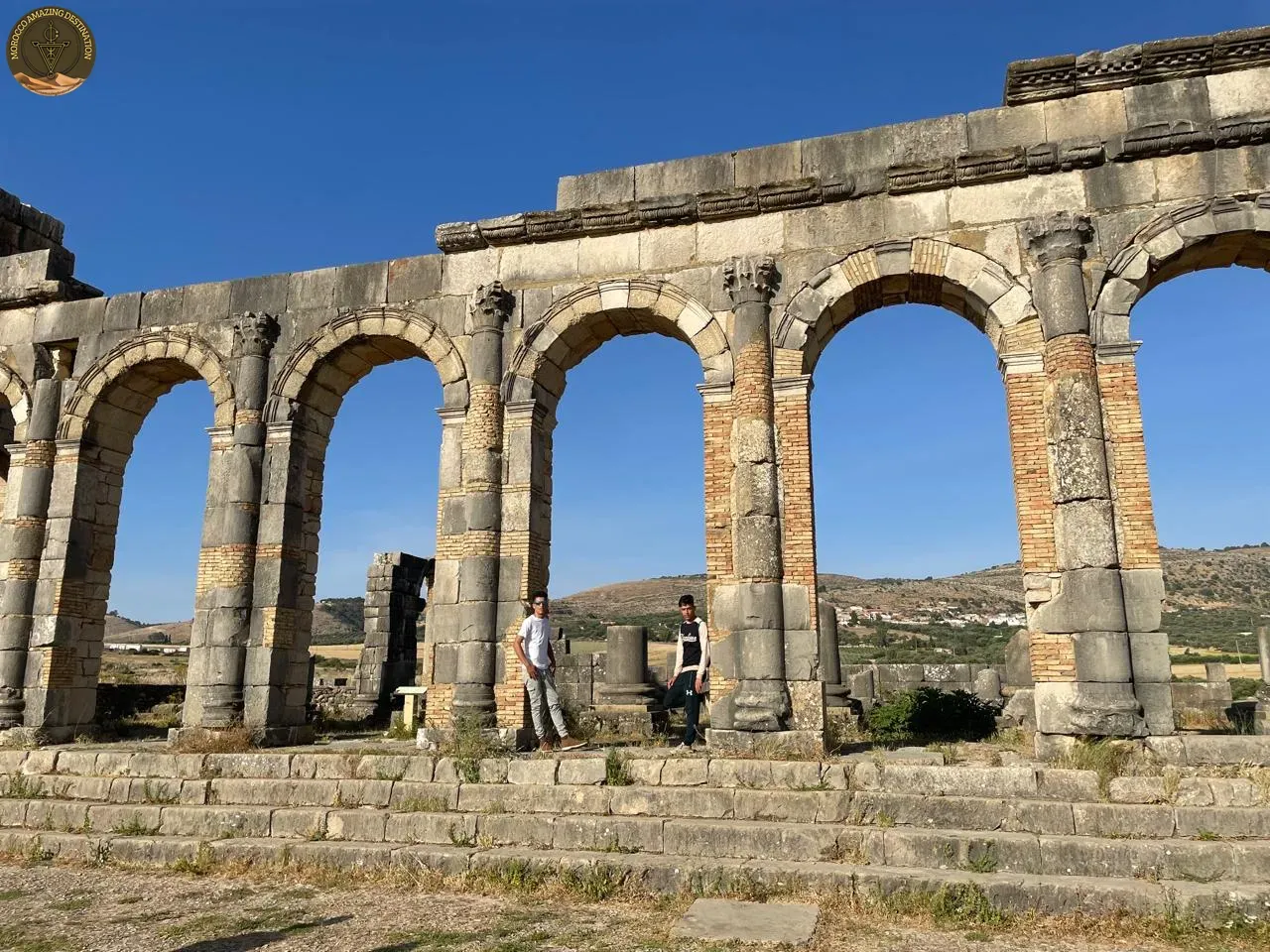
The site has been a UNESCO World Heritage site since 1997, and its mosaics survive in place. The Arch of Caracalla is dated to 217 CE.
Much of Volubilis was stripped in the 18th century to build Meknes, which is where Bab Mansour’s columns came from. Plan Meknes as a compact half-day and Volubilis for the afternoon, and you can see both without rushing.
Both tours below give Meknes a full monument day. Our 7-day Morocco tour from Fes spends a night in Meknes between the Sahara and Chefchaouen, and the 8-day imperial cities itinerary from Casablanca includes a Fes day trip to Meknes and Volubilis. For how the city fits with Fes and Marrakech, see our imperial cities of Morocco overview.
We can customize a tour to match your needs - design your perfect itinerary
If you found this helpful, add us as your preferred source on Google.
Frequently Asked Questions
What is the most important monument to see in Meknes?
Bab Mansour is the one travelers remember most, and it sits inside Moulay Ismail's imperial city. From there you can reach the sultan's mausoleum, the granaries of Heri es-Souani and the Agdal Basin on foot in one afternoon.
Can non-Muslims visit the Mausoleum of Moulay Ismail?
Yes. It is one of the few Islamic monuments in Morocco open to non-Muslim visitors. You enter through a courtyard, and modest dress is expected.
Was Heri es-Souani a granary or the royal stables?
Historians read it as a vast granary and storehouse built to provision the imperial city through a siege. The 12,000-horse story comes from popular tradition, not from the evidence.
How far is Volubilis from Meknes, and can I see both in a day?
Volubilis is about 30 km north of Meknes, which is 30 to 45 minutes by road. Both sites fit into one day, with the Roman ruins saved for the afternoon.
Ready for an Adventure?
Have questions? Feel free to contact us using the form below. We're here to help!