
· Travel · 6 min read
Marrakech Mellah: A Walk Through the Hidden Jewish Quarter
Walk the Marrakech Mellah: the old Jewish quarter, its spice souks, Slat al-Azama synagogue and the Miaara cemetery, with local etiquette.
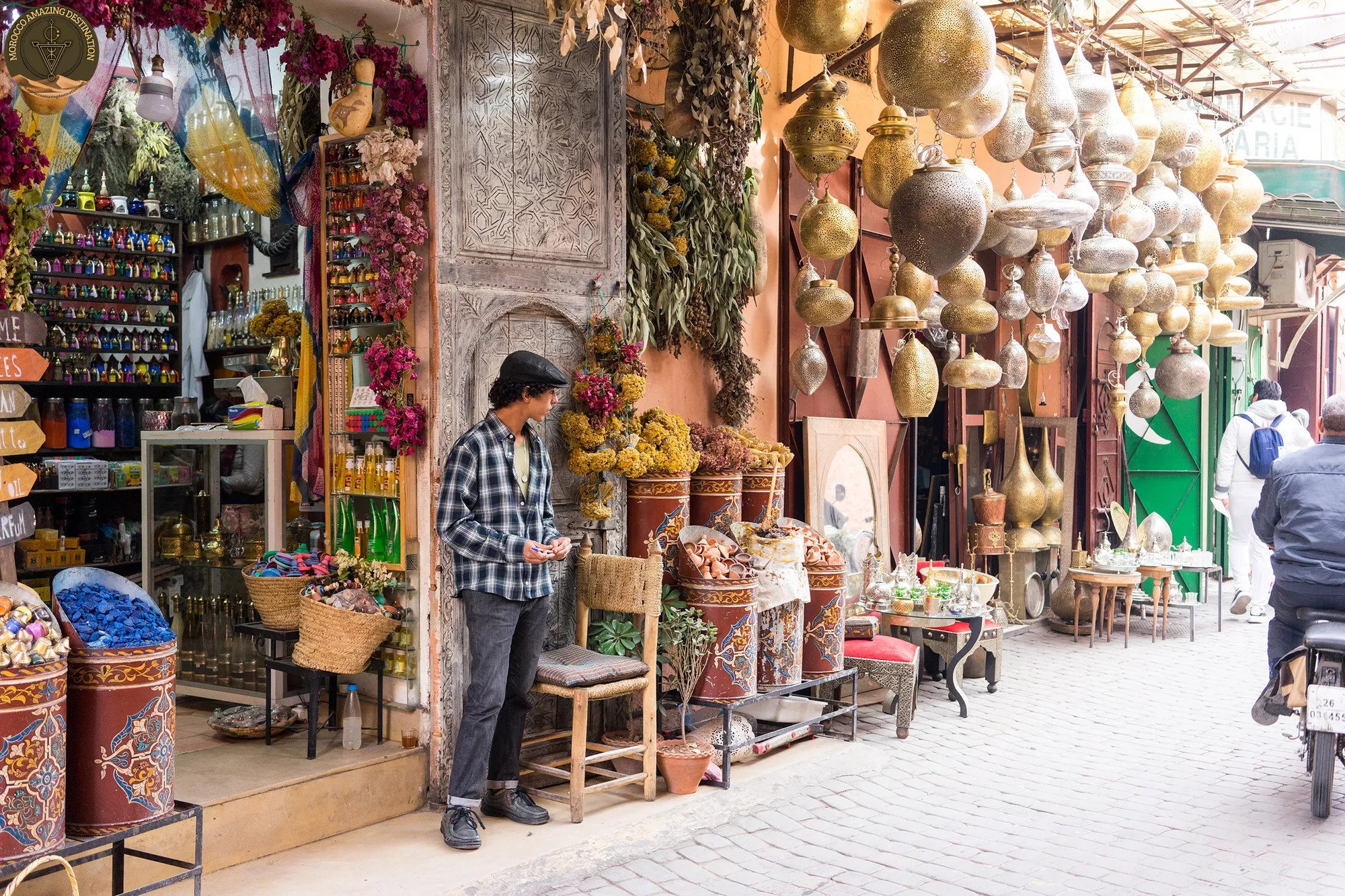
Most visitors cross the Mellah without knowing they have entered it. The streets south-east of Jemaa el-Fnaa look like the rest of the medina: ochre walls, a doorway every few metres, a handcart parked across the lane. The Marrakech Mellah is the old walled Jewish quarter of Marrakech, laid out beside the royal kasbah in the mid-sixteenth century and still lived in today.
In this guide we will break down what survives inside those walls, from the spice bins and the synagogue courtyard to the white field of graves at the eastern edge, and how to walk the quarter on terms that suit the people who live there.
The Mellah in Five Minutes
The name comes from the Arabic mallāḥ, a saline or salt-flats area. It was first used for the Jewish quarter of Fes, then carried to walled Jewish quarters across Morocco. Marrakech’s version was laid out under the Saadian sultans on ground that had held the royal stables. It was the second mellah in the country.
The quarter occupies the south-east corner of the medina, wedged between the kasbah, the Bahia Palace and the El Badi ruins, so one morning on foot can cover all four. Gates closed at night, and the community lived inside the sultan’s protection and his surveillance.
The lanes emptied through the mid-twentieth century, as families left for Israel, France and Canada. Elsewhere in the country the story runs the same way, and our guide to Jewish heritage in Morocco follows it city by city.
Outward-Facing Streets and the Mellah Souks
Architecture is the first clue that this was a different kind of quarter. The rest of the medina turns inward, with blank walls outside and a courtyard hidden behind them. Mellah houses face the street: five and six storeys, narrow frontages, wooden balconies on carved brackets, windows looking straight into the lane.
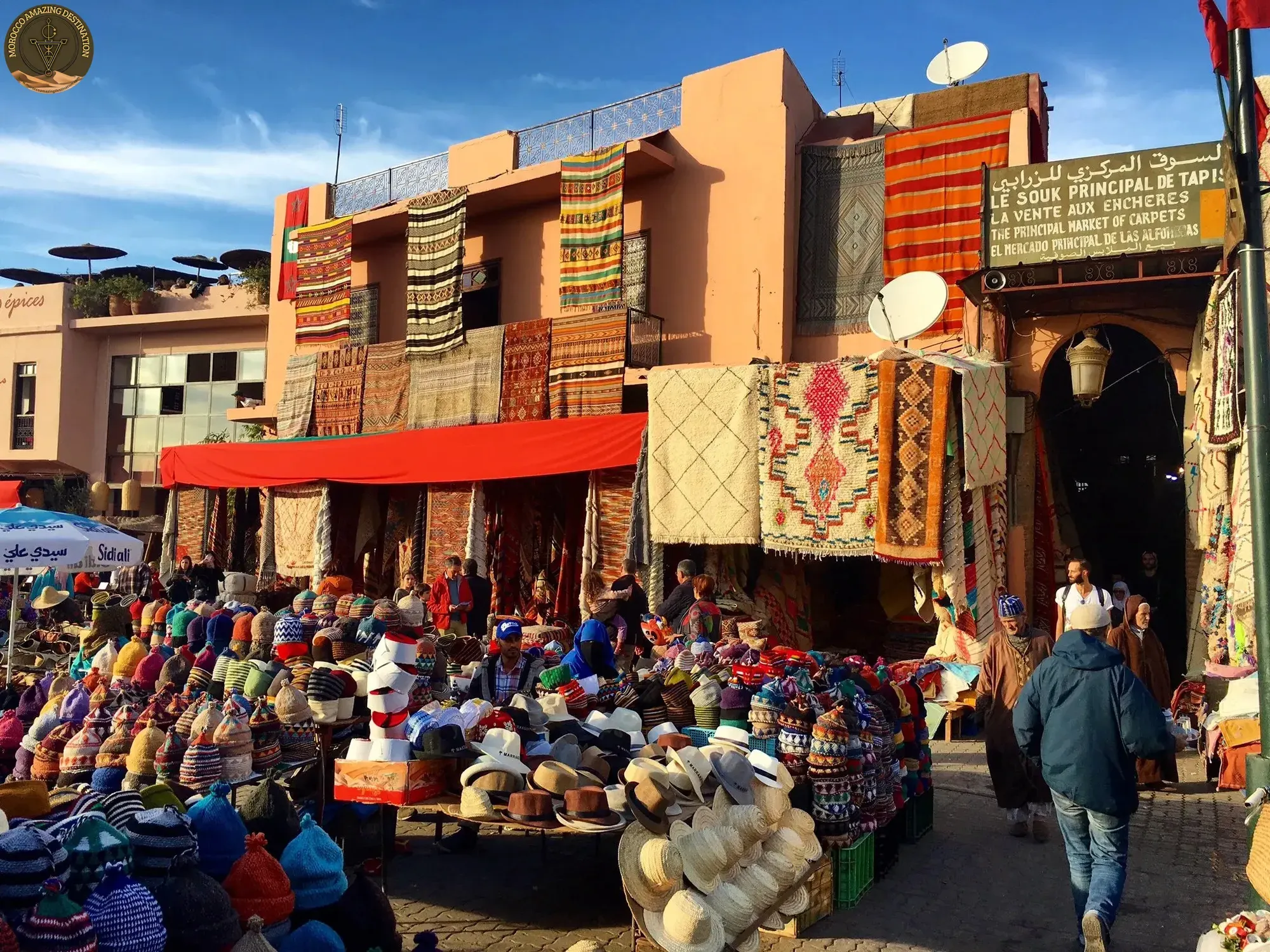
Space inside the walls was finite, so the quarter grew upward and packed tight. The balconies are usually explained as a memory of medieval Spain carried by Sephardic families. Scholars of the quarter trace the form to that Andalusian inheritance; the story that only Jews were allowed them is a simplification.
Three trades still run inside the walls.
- The covered spice market: cumin, paprika, saffron, ras el hanout, dried roses and preserved lemons, sold by the scoop to local kitchens.
- The jewellery arcade near Bab Mellah: gold weighed on small scales, next to silver filigree and khamsa pendants.
- The lantern and tin workshops: around Place des Ferblantiers, where metal is cut, hammered and soldered in the open.
Slat al-Azama: Behind the Blue Door
The Slat al-Azama Synagogue sits on Derb Talmud Torah, behind a door with no sign and no ticket window, and you could walk past it twice.
- The courtyard: small, tiled in blue and white, with a fountain at the centre and rooms on each side.
- The prayer hall: around eighty places, a marble ark against the eastern wall, a women’s gallery above.
- The side rooms: photographs, documents and ritual objects, arranged as a modest museum.
Tradition ties its founding to the Jews expelled from Spain at the end of the fifteenth century. The quarter itself did not exist for decades afterwards, and no document fixes a date. Much of the present fabric is restoration, including repair after the earthquake that struck the region.
It remains a working synagogue. A handful of regulars gather when they can, and a minyan is not always possible. Caretakers have looked after the building for years and will show you around. Men cover their heads, and a kippah is usually offered at the door. It closes on Shabbat and Jewish holidays.
Miaara: The White Field at the Edge
The Miaara cemetery lies at the eastern edge of the quarter, entered from Rue Taoualat el-Miâara. It is the largest Jewish cemetery in Morocco: more than twenty thousand low, lime-washed tombs in close rows on bare earth, with almost no shade and few standing stones.
The rows are divided, with separate sections for men, women and children. Near the gate, a cluster of graves painted blue is identified by tradition as those of kohanim, the priestly families. Eleven mausolea of revered rabbis line the perimeter, and pilgrims still arrive for the annual hilloula.
A caretaker opens the gate for a small contribution in cash. The cemetery is still in use, so you may share the paths with a family visiting a grave. Keep your voice low, stay off the tombs, and ask before photographing anyone. The gate is shut on Shabbat and Jewish holidays.
A Respectful Half-Day Route Through the Southern Medina
Come in the morning, Sunday to Thursday if you can. The market is best before the heat, the synagogue is quiet before groups arrive, and the white tombs read clearly in low light.
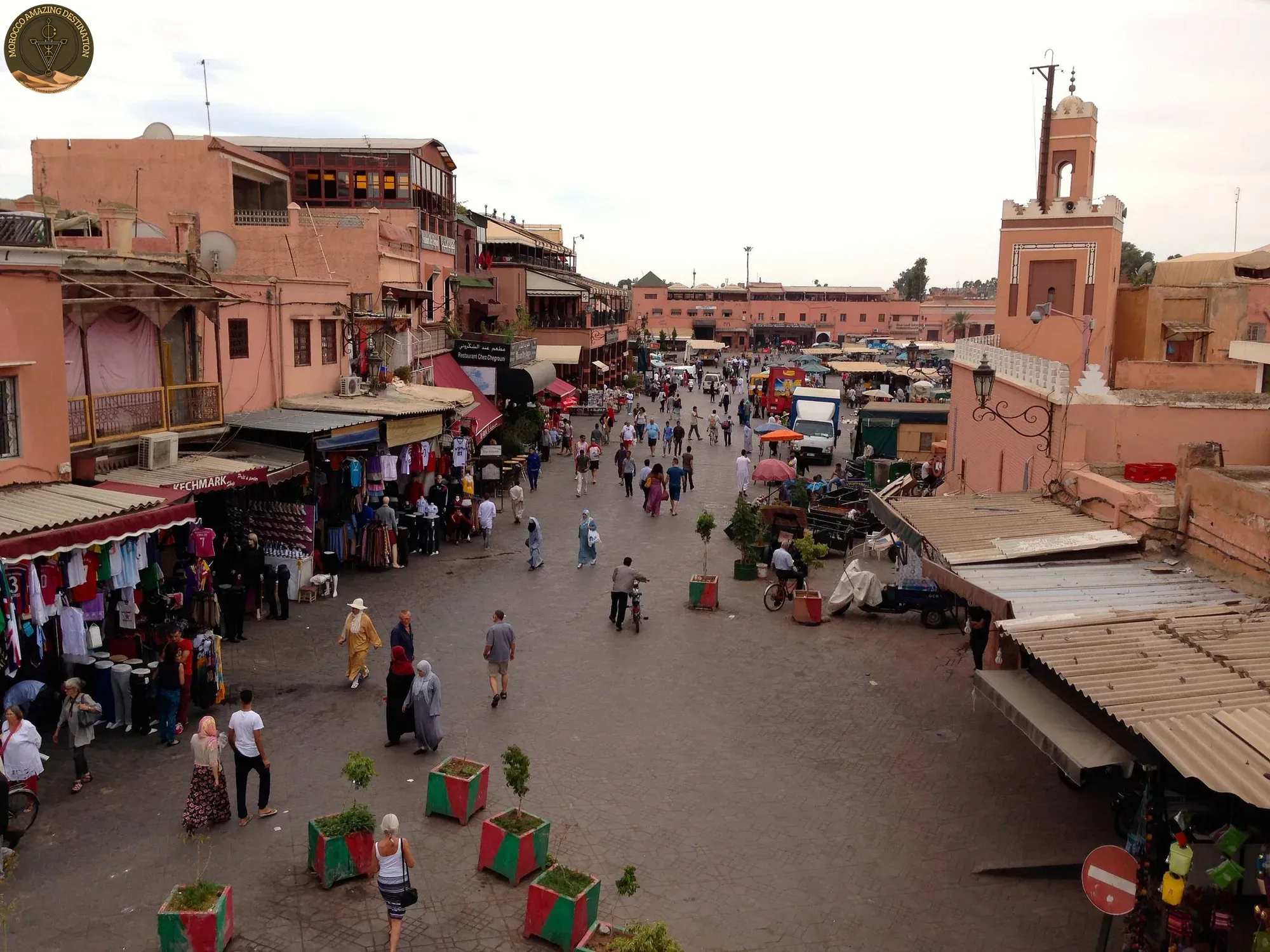
Walk in this order, entering from Place des Ferblantiers:
- Place des Ferblantiers: start with the metal workshops and a sense of the old quarter’s scale.
- The spice lanes: the covered market between the square and Bab Mellah.
- Slat al-Azama: Derb Talmud Torah, ten minutes on foot.
- The Miaara: east to the cemetery, then out past the Bahia Palace.
An hour covers the square, the spice lanes and the synagogue. Half a day lets you add the graves and the palace, with time for mint tea.
Dress for a religious site: shoulders and knees covered, a scarf in your bag, head covered at both Jewish sites. Bring small notes for the synagogue and the caretaker; hours and entrance contributions vary, so confirm on the day. If a stranger tells you the synagogue is closed and offers to walk you to a shop, he is running a well-worn routine. A licensed guide, who can show a card, will tell you what the inscriptions say.
Two of our tours pass this way with a guide who knows the quarter. The 9-day Morocco tour from Marrakesh gives you a full medina day beside the kasbah, and the 8-day imperial cities tour from Casablanca includes the Mellah on its Marrakech morning.
We can customize a tour to match your needs - design your perfect itinerary
If you found this helpful, add us as your preferred source on Google.
Frequently Asked Questions
What is the Mellah in Marrakech?
It is the historic walled Jewish quarter of Marrakech, laid out beside the royal kasbah around the mid-sixteenth century. The name comes from the Arabic mallāḥ, a salt-flats area, a term first used for the Jewish quarter of Fes.
Can you visit the Slat al-Azama Synagogue and the Miaara cemetery?
Yes, both receive visitors outside Shabbat and Jewish holidays. Hours and the entrance contribution vary, so confirm on the day. Men should expect to cover their heads at both sites.
How long does a Mellah walk take?
An hour covers Place des Ferblantiers, the spice lanes and the synagogue. Allow half a day to add the Miaara cemetery and the Bahia Palace, which sits a few minutes away.
Is it respectful to walk the Mellah as a tourist?
Yes, if you treat it as a neighbourhood rather than an attraction. Dress modestly, ask before photographing people or graves, keep your voice down in the cemetery, and avoid the lanes after dark.
Ready for an Adventure?
Have questions? Feel free to contact us using the form below. We're here to help!