· Travel · 5 min read
Morocco Lighthouses: Cape Stations Worth the Detour
Morocco lighthouses from Cap Spartel to Cap Rhir: which cape stations you can actually reach, and how to fold them into a private route.
Long before the ferries and the beach hotels, a ship approaching this country needed one thing first: a light. Morocco lighthouses still do that job, and they are one of the quieter pleasures of a coastal drive. Some are grand stone towers from the 1860s, with a keeper’s house attached and a garden behind a wall. Others are squat beacons on a harbour wall, painted white and green, blinking at a breakwater you would otherwise pass without slowing down.
Morocco has dozens of lighthouses along its Atlantic and Mediterranean coasts, but only Cap Spartel is set up for regular visitors; the rest are working stations best seen from a cape, a coastal road or a viewpoint. In this guide, we will break down where the light stations cluster along the shoreline and how you can visit them on a private route.
Tangier and the Strait: Cap Spartel and Cap Malabata
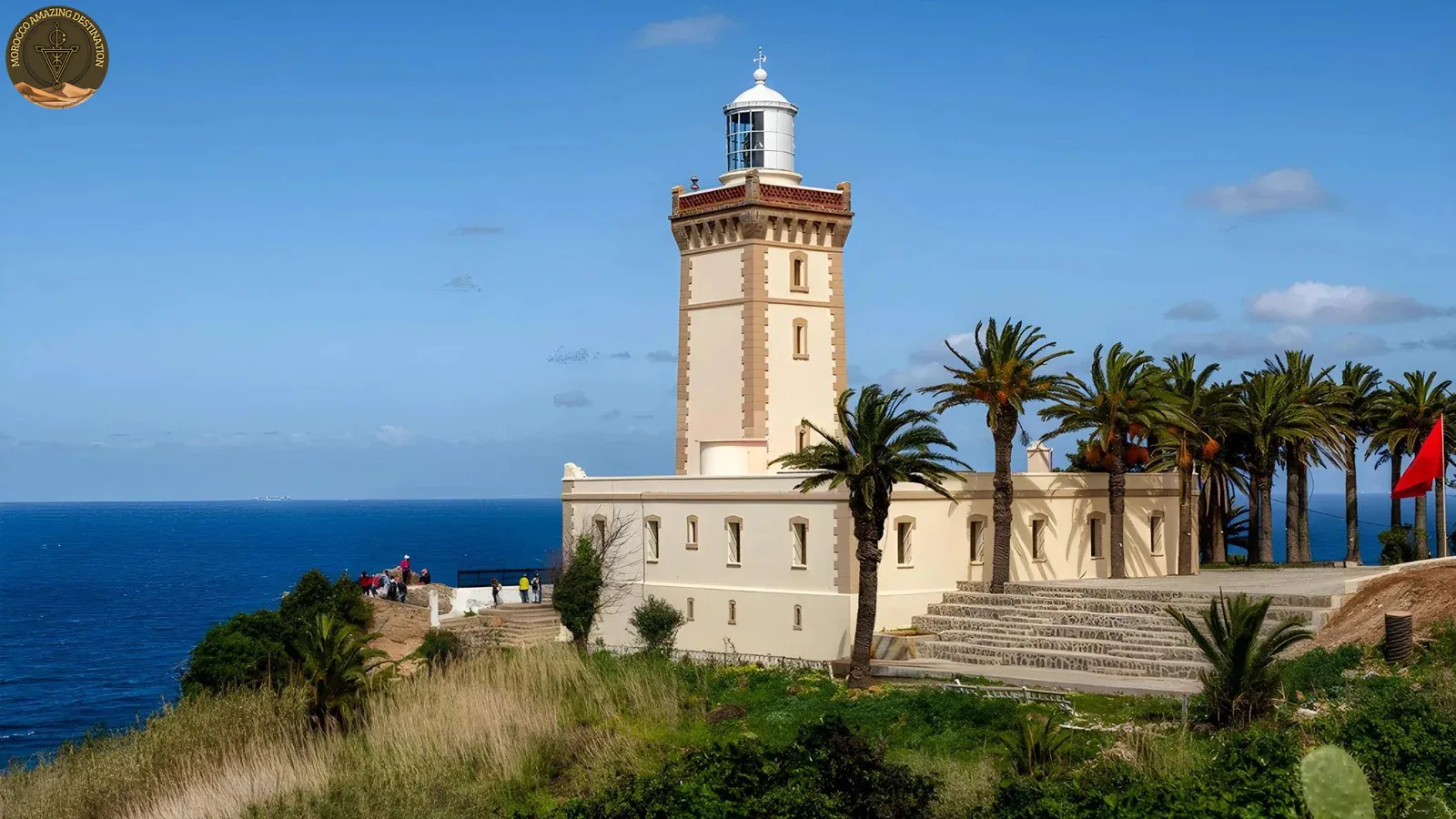
The two best-known lighthouses in Morocco face each other across the water at Tangier. Cap Spartel holds the corner where the Atlantic meets the Mediterranean, about 12 km west of the city. Its tower is a 24 m square masonry shaft with a castellated gallery and a first-order Fresnel lens, built beside a two-storey keeper’s house. The light stands roughly 90 m above the water, and navigators still take its longitude as the western limit of the Mediterranean.
Cap Malabata answers it from the far side of the Bay of Tangier: an 18 m tower with the lantern at 76 m, reached by car with no planning at all. At Cap Spartel, the walled park, the garden and a small maritime museum are the parts you can count on. Access to the tower varies, so ask on the day. The Caves of Hercules sit next door.
Casablanca to El Jadida: El Hank and Sidi Bou Afi
El Hank closes the western end of Casablanca, on the headland where the Corniche walk from the Hassan II Mosque runs out. The white tower is about 50 m and remains the tallest lighthouse in the country. You see it from outside; the door stays shut.
This is the densest stretch for Atlantic coast Morocco lighthouses, with four of them sitting within a half-day of each other:
- El Hank: about 50 m, on the headland at the western end of Casablanca.
- Rabat: about 24 m, on the ocean front at the mouth of the Bou Regreg, minutes from the Kasbah of the Udayas.
- Sidi Bou Afi: about 46 m, painted white with a dark stone gallery, a short walk from the ramparts of El Jadida.
- Cap Blanc: about 16 m at Jorf Lasfar, 24 km south-west of El Jadida, with an open site and a closed tower.
El Jadida’s Portuguese fortifications are a UNESCO World Heritage site, and Sidi Bou Afi is close enough to fold into the same walk.
The Southern Capes: Safi, Essaouira and Cap Rhir
South of El Jadida the towers get wilder and the tarmac gets thinner. Cap Beddouza stands inside a large square fort on the approach to Safi, with the light at 65 m. Safi’s own Pointe de la Tour sits inside a military base, so it stays off the itinerary.
Essaouira keeps two. Sidi Magdoul stands at the harbour mouth, white with gold trim and about 15 m tall, five minutes on foot from the fishing port. Cap Sim is the wilder one: about 20 m inside a fort 20 km south, light at 103 m, reached on a rough track.
Cap Rhir is the star of this stretch, a tower of about 41 m with the light at 85 m, planted beside the N1 roughly 40 km north-west of Agadir. Surf breaks below it and the Tamri estuary is close by. Keepers have reportedly let visitors climb, though not always.
Mediterranean Beacons: Al Hoceima and Cap des Trois Fourches
The Mediterranean holds fewer lights and packs them closer together. Heritage here leans Spanish rather than French, with Moroccan decorative detail throughout, and most of the buildings date from the early twentieth century.
The ones worth knowing:
- Ra’s El Aswad: above Cabo Negro near Mdiq, the first light east of the Strait.
- Sidi Abed: at the western entrance to the Bay of Al Hoceima.
- Cap Quilates: an octagonal tower of about 32 m east of Al Hoceima.
- Cap des Trois Fourches: about 18 m with the light at 112 m and a first-order lens, on the peninsula north of Nador.
Cap des Trois Fourches repays the effort it takes. The final stretch of road may call for a 4x4, and the peninsula sits a long way from the rest of your route.
Planning a Lighthouse Route: What to Expect on the Ground
Think of a Morocco lighthouse tour as a coastal drive with two or three stops a day. Most sites have no facilities, no interpretation and no fixed hours, and the drives between them are half the point.
- Access: sites are usually open, interiors almost never, and port jetties and military land are off limits.
- Light: morning haze softens the Atlantic, while late afternoon is best on white masonry.
- Wind: constant on the Atlantic, so a jacket earns its place in the bag.
For the towns between the capes, our guide to Morocco’s coastal charm from Essaouira to Agadir covers the road-trip side of this shoreline.
A driver who knows the turn-offs takes the guesswork out of it. Some of these lanes end at a locked barrier, and a local team can tell you which capes are worth the afternoon before you commit.
Two private routes put several of these lights on the way. Our 11-Day North Tour to Imperial Cities, Desert and Coast from Tangier opens with Cap Spartel and Cap Malabata, then closes on the Atlantic at Essaouira. If you are already in the south, the 3-Day Tour from Agadir to Tafraoute, Sidi Ifni and Tiznit passes Cap Rhir and ends at Sidi Ifni, where the light stands on the headland above town.
We can customize a tour to match your needs - design your perfect itinerary
If you found this helpful, add us as your preferred source on Google.
Frequently Asked Questions
Can you go inside Morocco's lighthouses?
As a rule, no. The towers are working navigation stations, so the interiors stay closed while the sites and the views are open. Cap Rhir's keepers have reportedly let visitors up, and the tower at Cap Spartel opens and closes depending on the day.
How many lighthouses are there in Morocco?
Dozens. Specialist lighthouse listings run to around eighty once every harbour beacon is counted, and no official figure is published. The notable towers were raised between the 1860s and the 1930s.
Is the Cap Spartel lighthouse open to visitors?
The walled park, the garden and a small maritime museum are the reliable visit, about 12 km west of Tangier next to the Caves of Hercules. Tower access is inconsistent, so ask on the day rather than counting on it.
What is the best way to see Morocco's lighthouses?
A private driver on the coastal roads, with two or three capes per leg and an early or late start for the light. Self-driving adds parking guesswork and tracks that end at a locked barrier.
Ready for an Adventure?
Have questions? Feel free to contact us using the form below. We're here to help!