· Travel · 5 min read
Tbourida Morocco: A Spectator's Guide to the Fantasia
Tbourida Morocco explained for spectators: what happens in the charge, where to watch a fantasia, and how to plan around it privately.
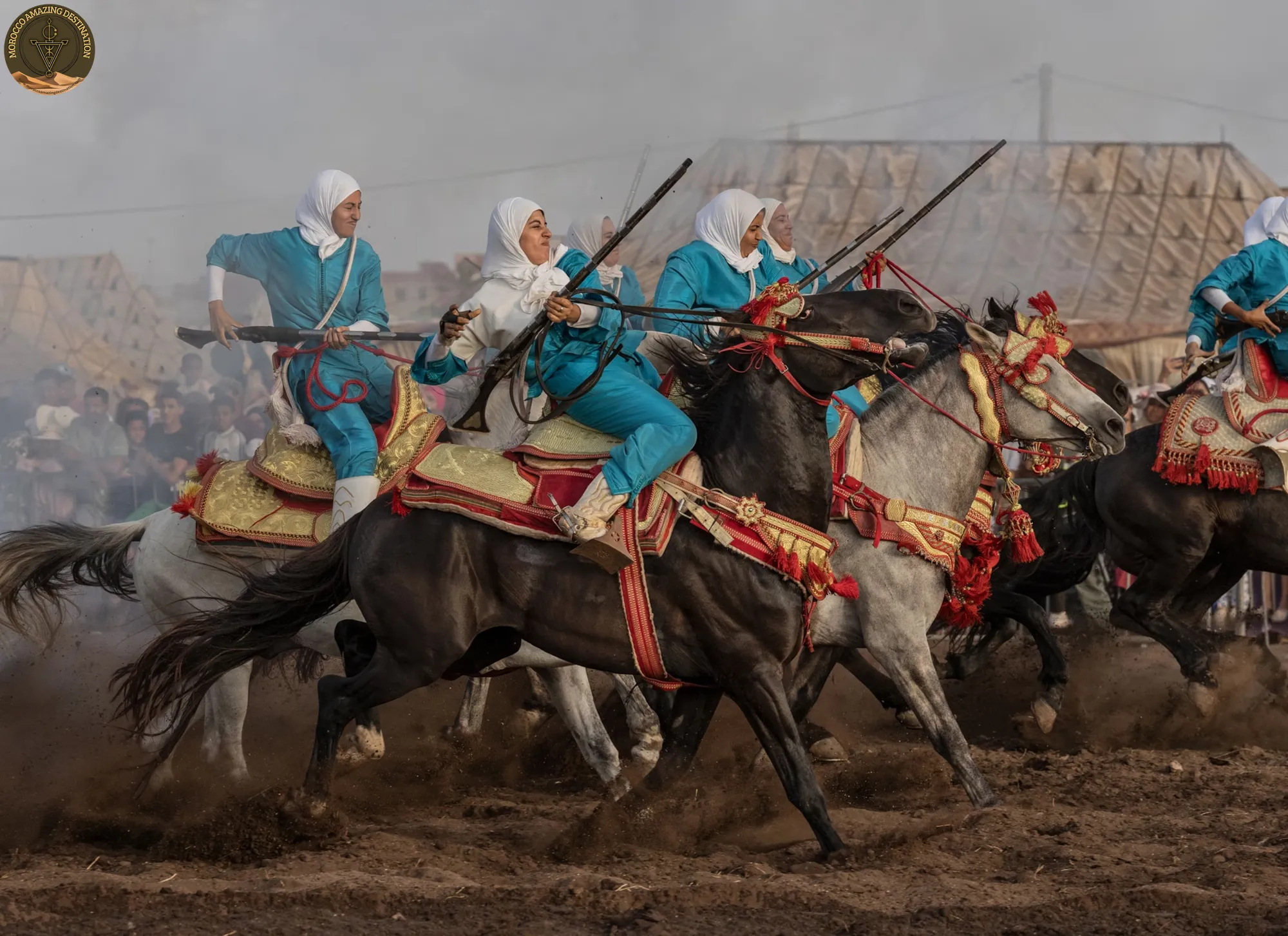
The crowd does not go quiet slowly. It drops all at once, a whole field holding its breath while twenty horsemen settle into a line, and then one flat crack of gunpowder rolls back over the grass. The tbourida morocco you are watching is a competitive charge: a troop of riders in ancestral dress gallops a set distance and fires a single blank volley from their muskets. Older guidebooks used the label fantasia morocco for the same performance, and the name stuck.
This guide covers what happens inside a charge, where in the year you can realistically watch one, and how to behave once you are standing at the rail.
Inside the Charge: Hadda, Talqa and One Single Shot
A run has two halves, and the first is slower than most visitors expect. The sorba enters at a trot on a straight line, spinning rifles overhead and catching them, then re-forms. This is the hadda, the mounted arms drill that opens the performance.
Then the mokaddem, the chief rider at the centre of the line, releases them. The troop walks up, breaks into a gallop, drops the reins and rides with both hands on the musket. Roughly 200 metres later the horses sit back on their hocks and the riders fire together. That stop is why the run is short.
Only Barb and Arab-Barb horses compete. Riders wear turbans, draped robes and slippers, and the saddlery is decorated. Women now ride in sorbas of their own and compete at national level. Judges look for four things:
- Simultaneity: the volley arrives as one sound, not a ripple of shots.
- The line: riders stay level; a sagging flank loses marks.
- Pace: one gallop rhythm from release to stop.
- The stop: horses sit down together, short of the crowd.
El Jadida: Morocco’s Horse Capital Every October
For a visitor locked to set dates, El Jadida is the most dependable stop in the tbourida year, and the one place where moroccan equestrian art has an arena built for it. The city’s horse show runs about six days in early-to-mid October at the Mohammed VI exhibition park, roughly 90 km south of Casablanca.
The King Mohammed VI Grand Prix closes the week with the strongest sorbas in the country, eighteen of them in a recent edition, plus non-competitive performances on the final day. Dates drift a little each year, so treat the month as fixed and the week as approximate.
August gives you a second chance. The Moulay Abdellah Amghar moussem, about 15 km south of El Jadida, brings more than 130 sorbas together across eight or nine days, with falconry, storytelling circles and tents beside the field. Entry is free. The Portuguese ramparts and cistern in the old town are a UNESCO World Heritage site, worth the same afternoon.
Moussems and Rose Valleys: The Variable Half of the Calendar
Part of the calendar holds still and part of it moves with harvests. The Hassan II Trophy, the national championship, runs at the Dar Es Salam complex in Rabat in late May or June, where the best sorbas in the country meet on a single ground.
Below that sits a ladder few visitors see. Regional rounds run from February to April and inter-regional rounds follow in May. Recent inter-regional rounds were held at Bouznika and Guelmim, ordinary towns with no tourist infrastructure and nobody at the rail.
Spring and autumn carry the rest:
- Rose Festival, El Kelaa M’Gouna: first half of May in the Valley of the Roses, with fantasia usually on the programme beside the floats and Ahidous dancing.
- Date Festival, Erfoud: October, often the third week, with parades, camel races and fantasia often included.
- Moussem of Tan-Tan: dates announced each year, with recent editions opening in early October.
No tbourida festival here comes with a date you can book around. Organisers confirm weeks ahead rather than months, and one tbourida is rarely reason enough for a trip.
Watching Well: Etiquette, Crowds and Photography
Stand behind the line the organisers keep clear. Horses stop short of it by design, and stepping onto the track for a cleaner angle is the mistake visitors make and locals never do.
The volley is loud enough to make small children cry. Pack ear protection, expect dust to reach your lens, and dress for a rural religious gathering: shoulders and knees covered. Put the camera down during prayer and during the washing that comes before it.
Ask before you photograph a face. A nod at the camera usually gets a yes, and a refusal costs nothing. Shoot low and slightly to the side of the line, in short bursts; flash is useless at that distance and rude up close.
Crowds gather at the finish line and thin out on the entry side, where you can watch the hadda without a shoulder in your frame.
Plan Your Tbourida Trip With a Local Team
Tbourida is hard to pre-book. Organisers confirm the week late, moussem towns have thin hotel stock, and the running order comes over a loudspeaker in Darija. A private driver-guide can hold a day open and move it when the date lands, which is how many of our guests end up at a rail they never planned for.
For the wider frame around the performance, our guide to Morocco’s history, culture and Amazigh heritage covers the festivals and the beliefs behind them.
Our 14-Day Morocco Tour from Casablanca begins in the city that puts El Jadida within easy reach, then adds a night at Erfoud and a day in the Valley of the Roses. The 15-Day Grand Cultural Tour from Tangier already stops at El Jadida and Erfoud, and it carries the widest date window we run.
We can customize a tour to match your needs - design your perfect itinerary
If you found this helpful, add us as your preferred source on Google.
Frequently Asked Questions
Is tbourida the same thing as fantasia?
Yes. Fantasia is the name foreign visitors gave to tbourida, and it stuck in older guidebooks and hotel brochures. Moroccans call the performance tbourida, from baroud, the Arabic word for gunpowder.
Where and when can visitors actually watch a tbourida in Morocco?
El Jadida is the surest bet, with a purpose-built arena at the horse show in early-to-mid October and a large moussem about 15 km south in August. Rabat hosts the national final in late May or June, and regional rounds run from February to April.
Is a tbourida free to watch, and do I need to book?
It depends on the event. The Moulay Abdellah Amghar moussem charges no entry and regional rounds are open to anyone standing behind the organisers' line. The El Jadida horse show requires an entry pass, and none of these events can be reserved months ahead.
Can I take photographs at a tbourida, and where should I stand?
Yes, photography is welcome at public events as long as you stay behind the organisers' line and never step onto the track. Shoot low and slightly to the side, skip the flash, and ask before photographing faces or anyone at prayer.
Ready for an Adventure?
Have questions? Feel free to contact us using the form below. We're here to help!