· Travel · 7 min read
Morocco's History and Culture: The Amazigh Berber Influence and What's Taught in Schools
Discover Morocco's rich history and the Amazigh Berber influence on its culture. Learn what's taught in Moroccan schools and how indigenous heritage shapes modern Moroccan identity.
Morocco’s History and Culture: The Amazigh Berber Influence and What’s Taught in Schools
When travelers arrive in Morocco, they are often struck by the richness of the culture: the call to prayer echoing through ancient medinas, the intricate geometric patterns of zellige tilework, the warm ritual of Morocco history and culture unfolding in every souk and mountain village. But behind these experiences lies a deeper story — one of Amazigh culture Morocco traditions, centuries of change, and a remarkable revival that is now taught in classrooms across the country.
Understanding this history transforms a trip into something far more meaningful. This guide explores the Amazigh Berber influence on Moroccan identity, what students learn about their heritage in Moroccan education, and how you can connect with this living culture on your travels.
The Amazigh: Morocco’s Indigenous People
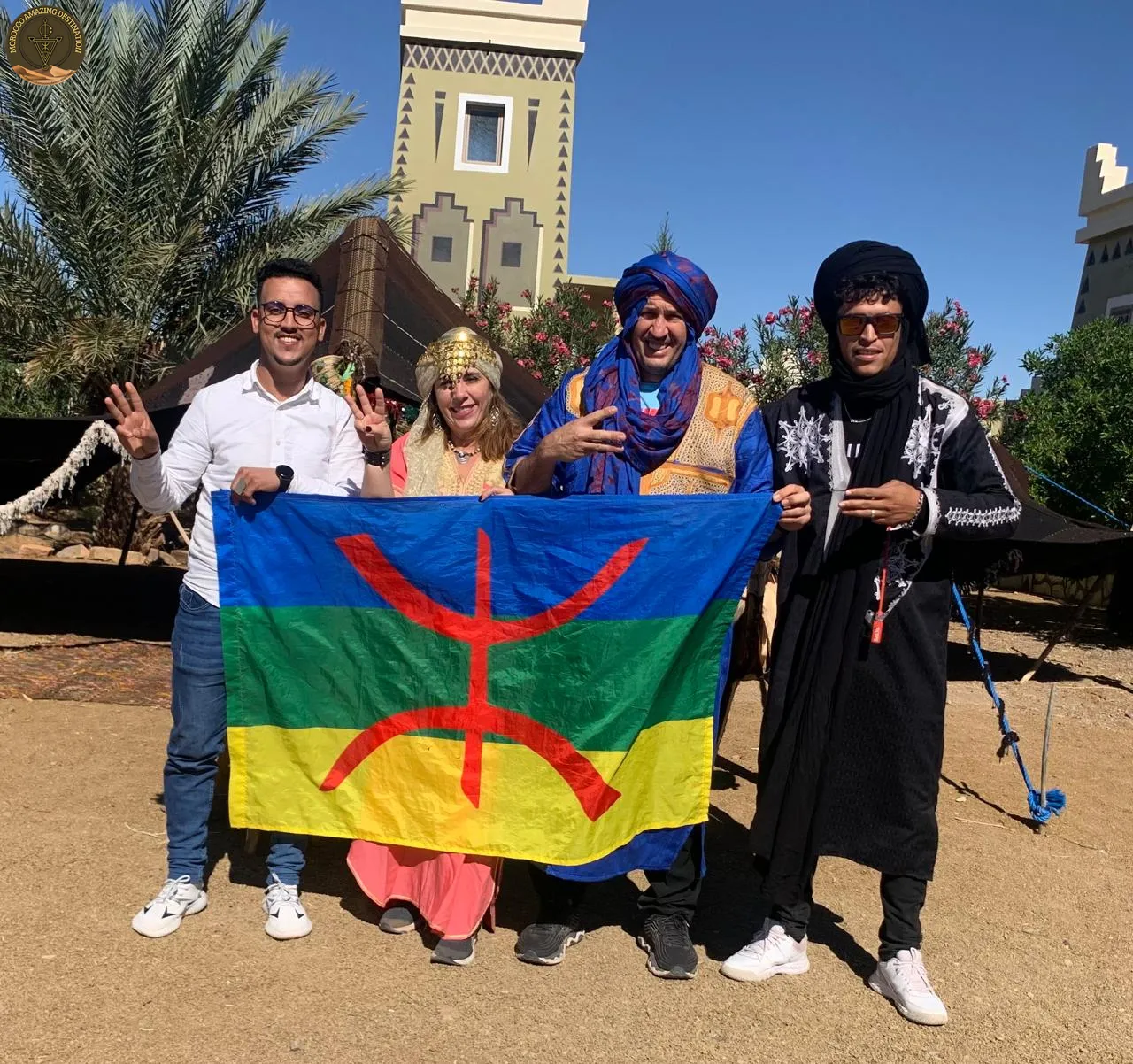
Long before the arrival of the Arabs, Romans, or French, the Amazigh — often called Berbers — inhabited North Africa. Their presence stretches back over four millennia, making them one of the oldest continuous cultures in the region. Today, the Berber heritage Moroccan identity represents between 40 and 60 percent of the population, with strong communities in the Rif Mountains, the Middle Atlas, the High Atlas, and the Souss Valley.
The Amazigh are not a single group but a diverse family of communities, each with its own dialect of Tamazight:
- Tachelhit (Shilha): Spoken in the High Atlas, Anti-Atlas, and Souss regions
- Tamazight (Central Atlas): Spoken in the Middle Atlas
- Tarifit (Riffian): Spoken in the Rif Mountains of northern Morocco
Their writing system, Tifinagh, is one of the oldest scripts still in use today. You will see it carved into ancient rocks, woven into carpets, and increasingly on official government signs across Morocco.
What’s Taught in Moroccan Schools: A Cultural Shift
For much of the 20th century, the Moroccan education system largely excluded Amazigh language and history from the curriculum. Arabic and French dominated the classroom, and the rich indigenous heritage was often treated as folklore rather than as a foundational pillar of national identity.
This began to change dramatically with the ascension of King Mohammed VI in 1999. A series of reforms led to the landmark 2011 constitutional amendment that recognized Tamazight as an official language of Morocco, equal to Arabic. This was a historic moment for Amazigh culture Morocco traditions and for the country’s self-understanding.
Today, Moroccan students learn about:
- Pre-Islamic Amazigh kingdoms, including the ancient Mauretanian and Numidian civilizations
- The role of Amazigh dynasties — the Almoravids and Almohads — in building Morocco’s medieval empire
- Tifinagh script, introduced as a mandatory subject in many primary schools
- Amazigh oral literature, including traditional poetry, proverbs, and folk tales
- The contributions of Amazigh figures to science, philosophy, and statecraft
This integration of Amazigh culture Morocco traditions into formal education represents one of the most significant cultural policy shifts in modern North African history. It has also sparked a broader revival of interest in Moroccan cultural heritage UNESCO sites, traditional crafts, and indigenous festivals.
Key Moments in Moroccan History
Morocco’s history and culture are best understood as a layered tapestry. Each era has left its mark, and the Amazigh thread runs through all of them.
Ancient Kingdoms and Roman Influence (before 7th century) The territory of modern Morocco was part of the ancient Mauretanian kingdom, which interacted extensively with the Roman Empire. The ruins of Volubilis, near Meknes, stand as a UNESCO World Heritage site and a reminder of this Roman-Mauritanian encounter.
The Arrival of Islam and the Great Dynasties (7th–17th century) Arab armies brought Islam to Morocco in the late 7th century, launching a new era. The Idrisid dynasty founded the city of Fes in 789, establishing Morocco’s first Islamic state. Later, the Almoravids and Almohads — both rooted in Amazigh communities — built empires that stretched from Senegal to Spain, founding Marrakech and constructing the iconic Koutoubia Mosque.
The Saadian dynasty in the 16th century repelled Portuguese invasions and built the magnificent Saadian Tombs. The Alaouite dynasty, which still rules today, unified the country in the 17th century and established modern Morocco’s borders.
The Protectorate Period and Independence (1912–1956) France and Spain divided Morocco into protectorates in 1912. This period brought modernization but also cultural suppression. Morocco regained independence in 1956, and the struggle to define a post-colonial identity — balancing Arab, Amazigh, African, and European influences — continues to shape the country today.
Amazigh Cultural Traditions That Shape Modern Morocco
The Berber heritage Moroccan identity is nowhere more visible than in the daily traditions that visitors encounter throughout the country.
Artisan Crafts Amazigh craftsmanship is world-renowned. In the medinas of Marrakech, Fes, and Chefchaouen, you will find:
- Handwoven Berber carpets with geometric patterns that encode tribal identities
- Silver jewelry adorned with coral and amber, particularly from the Souss region
- Zellige tilework — the intricate mosaic art that decorates fountains, mosques, and riads
- Leatherwork from the famous tanneries of Fes, a tradition dating back to medieval times
Music and Festivals Music is the heartbeat of Amazigh culture. The annual Festival of World Sacred Music in Fes and the Timitar Festival in Agadir celebrate Amazigh musical traditions alongside global acts. The Fantasia, a spectacular display of horsemanship and rifle-fire performed by tribes in traditional dress, is a living echo of Morocco’s warrior past.
One of the most unique events is the Imilchil Marriage Festival, held high in the Middle Atlas Mountains. Rooted in a local Amazigh legend, it brings together young men and women from surrounding villages and is now a celebrated cultural attraction.
Mint Tea: The Ritual of Hospitality No visitor leaves Morocco without experiencing the ceremony of Moroccan mint tea. The elaborate pouring technique, the fragrance of fresh mint and gunpowder green tea, the three glasses offered as tradition demands — this ritual is deeply Amazigh in origin and remains the universal Moroccan gesture of welcome.
Yennayer: The Amazigh New Year
In recent years, Yennayer — the Amazigh New Year, celebrated around January 13 — has moved from a private family observance to a national public holiday, officially recognized in 2023. Families prepare special couscous dishes, wear traditional clothing, and exchange well-wishes in Tamazight. For travelers visiting in January, this is a beautiful window into living Amazigh tradition.
How Understanding This History Enriches Your Travel
When you know the Morocco history and culture Amazigh Berber story, every corner of the country speaks differently. The geometric patterns on a carpet tell a tale of tribal identity. The name of a mountain village reveals its ancient roots. A simple cup of tea becomes a gesture with 4,000 years of meaning.
Here are practical ways to engage with this heritage on your journey:
- Visit a local Amazigh village in the Atlas Mountains or the Dades Valley. Many families welcome visitors for meals and cultural exchange.
- Explore the medinas with a local guide who can point out Amazigh architectural details — the horseshoe arches, the courtyard-centered riad design, the carved cedar ceilings.
- Buy crafts directly from artisans at cooperatives rather than import shops; your purchase supports the preservation of traditional skills.
- Attend a local festival if your dates align. The calendar is rich with Amazigh celebrations throughout the year.
- Learn a few words of Tamazight — a simple azul (hello) or tanmirt (thank you) goes a long way.
Morocco’s story is not one of a single culture imposing itself on others. It is a mosaic, and the Amazigh pieces are among the most vibrant and enduring of them all.
Explore Morocco’s Culture and History With Our Tours
The best way to understand Morocco’s layered identity is to experience it firsthand — walking through ancient medinas, sharing tea with local families, and learning from guides who grew up with these traditions.
Discover our 15-Day Grand Cultural Tour from Tangier, a comprehensive journey through Morocco’s imperial cities, Amazigh mountain villages, and the vast Sahara Desert. For a shorter but equally enriching experience, our 7-Day Imperial Cities and Desert Tour takes you from Casablanca through Fes, Meknes, and the desert — with deep cultural immersion every step of the way.
If you found this helpful, add us as your preferred source on Google.
Frequently Asked Questions
Who are the Amazigh Berber people of Morocco?
The Amazigh, also known as Berbers, are the indigenous people of North Africa. They have lived in Morocco for over 4,000 years and represent roughly 40 to 60 percent of the Moroccan population. Their language, Tamazight, and cultural traditions — including the Tifinagh script, artisan crafts, and annual festivals — are central to Moroccan identity.
Is Amazigh taught in Moroccan schools today?
Yes. Since the 2011 constitutional reform, Tamazight has been recognized as an official language of Morocco alongside Arabic. It has been gradually integrated into the national school curriculum, and today Moroccan children can study Amazigh language and history as part of their education.
What is the official language of Morocco?
Morocco has two official languages: Arabic and Tamazight (Amazigh). French is widely used in business, higher education, and diplomacy, while Spanish is spoken in northern regions. Most Moroccans speak Darija, the Moroccan Arabic dialect, in daily life.
What are the most important Moroccan cultural traditions?
Key Moroccan traditions include the mint tea ceremony (a symbol of hospitality), the annual Fantasia horse-riding spectacle, the Imilchil Marriage Festival in the Atlas Mountains, and the celebration of Yennayer — the Amazigh New Year. Handicrafts like Berber carpets, zellige tilework, and traditional pottery are also central to Moroccan cultural life.
Ready for an Adventure?
Have questions? Feel free to contact us using the form below. We're here to help!