
· Travel · 5 min read
Draa Valley Kasbahs: Ksour, Earth Walls and Caravan History
Draa Valley kasbahs explained: pise walls, the annual mud repair, caravan routes and the mellah quarter of the ksour.
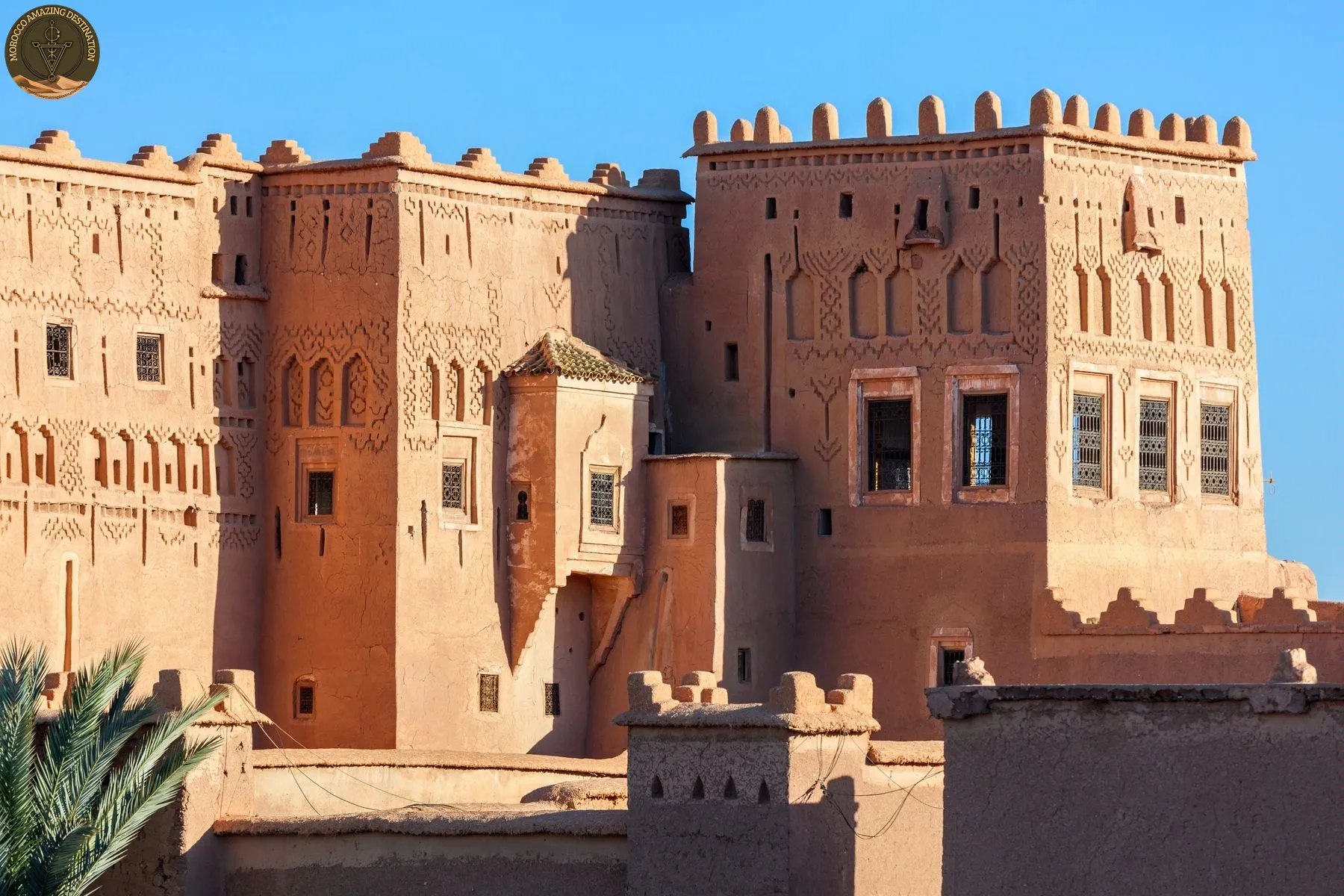
Between Agdz and Zagora the road runs through a green corridor of palms, and the slope above it is lined with earthen towers. The Draa Valley kasbahs are the reason most people stop the car, and they are also the part of the valley most often misread. A kasbah is the fortified house of a family or a local caid. It usually stands inside a ksar, the walled village that holds the lanes and the mosque.
This guide treats the Draa Valley ksour as one system. It covers who built them, how pise walls are made and kept standing, and what the caravan trade left behind. Road distances, the pass and the drive to M’Hamid are in our Draa Valley driving guide.
Fortified villages of the Draa, from Tamnougalt south
The ksour stand where the palm gardens meet the slope, on rising ground above the irrigation channels. That position kept them clear of the flood line and close to the fields. Each oasis had its own seat of power, and the pattern still shows in what survives.
- Tamnougalt holds the Kasbah des Caids, from which the Mezguita oasis was administered.
- El Caid Ouslim was the seat of the caids of Tamezmout.
- Amezrou faces Zagora across the river and keeps a mellah of its own.
From the sixteenth century the Ait Atta moved out of Jbel Saghro into the Draa basin. Their presence shaped where a village could safely sit and which families held the ground around it. Ksour from that period sit tight against the palm edge, houses packed inside the wall and the mosque near the middle.
Inside a kasbah: pise walls and the annual repair
A Draa wall is rammed earth, called tabia or pise. Builders mix soil with water and a little straw, then compact it in lifts inside wooden shuttering. The mass stands on a stone plinth that keeps the base clear of splash. Straw does most of its work in the mortar and plaster, and timber beams carry the roofs and floors.
The crenellated corner tower is the signature of the tighremt, the fortified house inside a kasbah. The same method builds the houses around it, so a whole ksar reads as one mass from the palm edge.
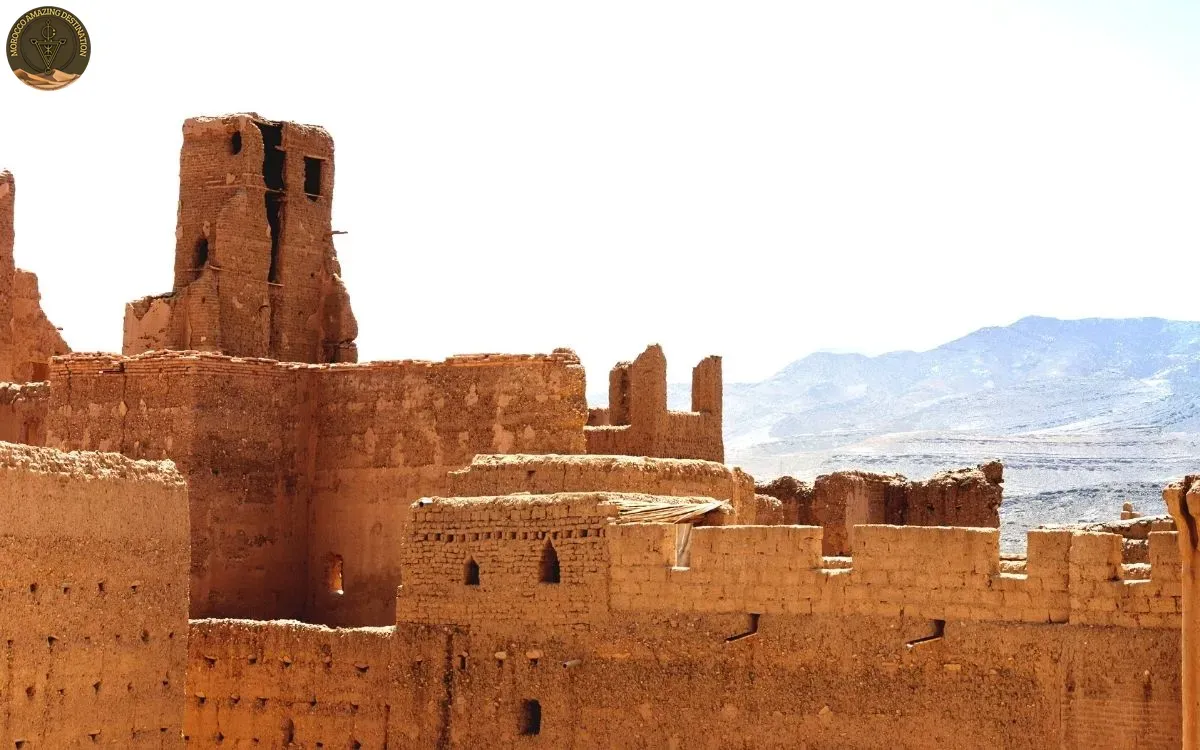
The render is part of the structure. A mud coat goes back on before the rains, usually at the end of winter. Miss two seasons and run-off cuts gullies at the wall foot, water works under the base, and the roof follows. Erratic rain and rural depopulation do more damage than age. Some ksour are still lived in, while others are held together by cooperatives or by families who come back for the rendering.
Caravans, the mellah and the road to Timbuktu
Draa Valley history is easier to read from Zagora than from any single monument. The town was a caravan station, and its sign still gives the old schedule. It reads 52 days to Timbuktu, at 30 to 40 km a day for a loaded camel train.
The trans-Saharan caravan routes met here, and the same valley carried traffic in both directions for centuries.
- Salt, dates, barley and goatskins went south toward the desert.
- Gold, silver and enslaved people came north in the same caravans.
- The trade peaked under the Saadians and thinned through the nineteenth century, as Atlantic and Mediterranean ports took the business.
Jewish families were central to it as financiers, traders and silversmiths. Mellahs are recorded at Agdz, Tamnougalt, Timesla, Akhellouf and Amezrou, each one a Jewish quarter attached to a ksar. At Amezrou the mellah and an earthen synagogue still stand just south of Zagora. The community left in the years after Moroccan independence, and the buildings stayed.
Foum Chenna and the markings under the palms
Near Tinzouline, at a site called Foum Chenna, more than 800 engravings are pecked into the rock. Riders, shields and camels are the figures you can pick out. The camels come last in the sequence, which suggests the panels were made over a long period by different hands. That order is the useful part of the site. It puts the images across a stretch of time rather than in a single moment.
Foum Chenna sits on the same stretch of road as several working ksour, so it fits into a day between Agdz and Zagora. Ask in the village before you walk out to the panels. The panels sit a short way off the road, and a local guide can point out the figures that are easiest to read.
Visiting the ksour today
Most ksour are private places. Families still live inside the walls, and the lanes work as courtyards. Visits are informal. Ask at the village, expect a small cash entry or a fee for a local guide, and accept that some houses stay shut.
- Ask at the village before you walk in, and take a local guide when one is offered.
- Expect a small cash entry or a guide fee; there is no fixed ticket.
- Stay off roofs and wall tops, especially where the render has gone.
- Look at the wall foot: gullies there are the first sign the render is failing.
What survives is whatever somebody still renders each year. A village with a cooperative, a returning family or a guide who brings visitors has a reason to keep the mud up. The empty ones lose their render first, then the roof.
Both tours below start in Ouarzazate, the last town before the palm corridor. The 4-Day Morocco Desert Tour from Ouarzazate - Merzouga & Cultural Highlights runs east to the dunes, and the 4-Day Guided Morocco Tour: Ouarzazate to Marrakech Desert Adventure crosses the Atlas on the way back to Marrakech.
We can customize a tour to match your needs - design your perfect itinerary
If you found this helpful, add us as your preferred source on Google.
Frequently Asked Questions
What is the difference between a kasbah and a ksar?
A ksar is the walled village, with the houses and the mosque inside one continuous wall. A kasbah is a fortified house or tower within it, usually the seat of a local caid. The two words describe different things and are not interchangeable.
Can you visit the ksour of the Draa Valley?
Many can be visited informally. Ask at the village first, expect a small cash entry or a fee for a local guide, and keep off roofs and wall tops where the render has failed. Some ksour are still lived in, so the lanes are not a museum.
Why do the kasbah walls need repairing every year?
They are rammed earth. A mud render goes back on before the rains, usually at the end of winter. Two missed seasons are enough for run-off to cut gullies at the wall foot, and once water reaches the base the roof follows.
How long was the caravan route from Zagora to Timbuktu?
Zagora's town sign gives 52 days at 30 to 40 km a day for a loaded camel train. Trade peaked under the Saadians and thinned through the nineteenth century as Atlantic and Mediterranean ports took the business.
Ready for an Adventure?
Have questions? Feel free to contact us using the form below. We're here to help!