· Travel · 12 min read
Gladiator Filming Locations: Morocco Guide to Ait Benhaddou
Discover Gladiator filming locations in Morocco — Ait Benhaddou & Atlas Studios — and visit them on a private, hassle-free tour.
Scattered blog posts, vague maps and half-remembered trivia make it hard to feel confident about where the desert scenes actually happened. You love the film, you want the real light and real walls — not a replica — and you want logistics handled so you can simply walk the sets with a local expert who knows the gates, the quiet lanes and the best light.
Gladiator filming locations let you do exactly that. This guide focuses on Morocco — the warm earth of Ait Benhaddou, the controlled sets at Atlas Studios and the desert corridors around Ouarzazate — with a clear comparison to the Malta and England shoots and a smooth plan to visit in a private vehicle with a licensed guide.
Gladiator Morocco filming locations are the North Africa sets for Ridley Scott’s epic, centered on the UNESCO World Heritage site of Ait Benhaddou as the fictional city of Zucchabar and on Atlas Studios and its desert surrounds near Ouarzazate for the slave and training sequences. Together they create the journey from sold captive to gladiator before the story shifts to the arena of Rome, which was built elsewhere as a full-scale replica.
This guide answers where was Gladiator filmed, which Gladiator Morocco filming locations you can walk today, what Gladiator Ait Benhaddou means on the ground, what Gladiator Atlas Studios built, how Gladiator Ouarzazate ties it together, and how to visit without hassle. For a deeper studio primer, see our Atlas Studios Ouarzazate guide, and to compare the sequel, see Gladiator II filming locations in Morocco.
What Are Gladiator Morocco Filming Locations?
Gladiator Morocco filming locations are the Ouarzazate-area sets and landscapes that stand in for the fictional North African province of Zucchabar, where Maximus is taken after being betrayed and sold into slavery. They combine a historic earthen ksar, a professional studio backlot and open desert roads within a tight radius, so you can visit the core world of that act in one unhurried day.
The original film follows General Maximus — played by Russell Crowe alongside Joaquin Phoenix, Connie Nielsen, Richard Harris, Oliver Reed and Djimon Hounsou — as he is stripped of rank, transported across the desert and forced to fight in a provincial gladiator school before facing Rome. The production spent roughly three weeks in the Ouarzazate corridor for those sequences, using the same ksar lanes and studio courtyard that still welcome visitors, according to Movie Locations and Almost Ginger.
That tight geography is good news for travelers. Base in Ouarzazate, add a private driver and you move between the two main hubs without wasted transit, with flexible timing and door-to-door ease that keeps the day relaxed.
Where Was Gladiator Filmed in Morocco? The Two Moroccan Hubs
Where was Gladiator filmed in Morocco has a focused answer: two hubs in the Ouarzazate basin that you can pair in a single day, with desert roads linking them. This is where Morocco provides more than sixty percent of the film-location story you came to see.
Gladiator Ait Benhaddou: Zucchabar on Real Ksar Lanes
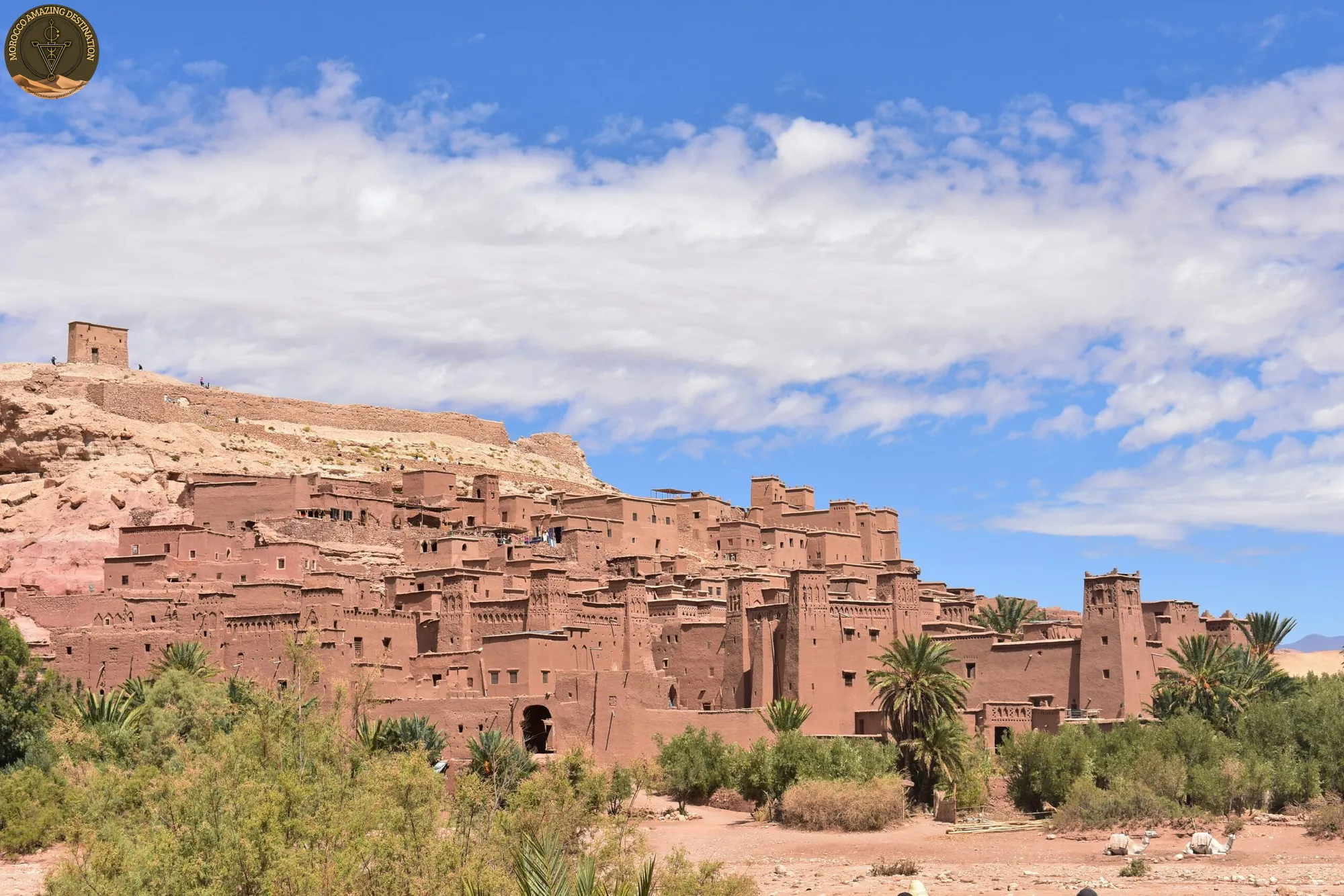
Gladiator Ait Benhaddou is the most cinematic and the most tangible. The UNESCO World Heritage site of Ait Benhaddou is a fortified ksar of pisé earth and clay on a historic caravan route, its crenellated towers and narrow lanes untouched by modern facades.
For the film, the lower village lanes and the gate area doubled for the slave market and the approach to the gladiator school of fictional Zucchabar. You enter through the same threshold, walk the same earthen alleys and see the same high walls that framed those scenes. Climbing to the agadir granary — the fortified storehouse at the summit — gives the classic panorama over the Ounila Valley and the palm corridor that sells the desert crossing without effects. The ksar lies about thirty minutes by road from Ouarzazate, and from Marrakech you reach it via the Tizi n’Tichka Pass, roughly two hundred kilometers and about four hours with scenic stops when driven by a private driver who knows the viewpoints.
Treat the ksar as a living place as well as a set. Families maintain homes and workshops behind its walls, and local artisans offer woven crafts and pigments. Walk softly, ask before photographing residents and support makers directly — that respect keeps the site authentic for the next crew and the next visitor.
Gladiator Atlas Studios: The Controlled Desert Sets
Gladiator Atlas Studios sits at Km 5 on the Route de Marrakech, on a desert backlot covering more than twenty hectares. Here the production built a controlled environment for the scenes that required repeatable light, choreographed combat and large-scale art direction. According to guides and travel reporting such as MoroccoTravelBase and Explore with Gaia, the studio’s team constructed a gladiator training courtyard, Roman-style facades and slave-market structures with plaster and timber finished to read as stone on camera.
A guided tour, typically forty-five to sixty minutes and often longer if you add the nearby Jerusalem set area, walks you through remaining courtyards, facades and open desert staging. Ticket levels are commonly described around seventy to eighty dirhams in cash with photography allowed, but prices and opening hours shift — flag uncertainty and confirm at the gate on the day. Wear sun protection, bring water and arrive early for quieter sets and softer light. Parts of the backlot may be closed during active shoots, which can be a bonus if you glimpse live construction and dressing.
Because Atlas Studios also supports CLA Studios nearby, the complex functions as a professional base where skilled local crews handle set building, dressing and logistics. That practical capacity is why large desert epics return here: infrastructure and craft sit right beside the landscape.
Gladiator Ouarzazate: Desert Corridors and Logistics Hub
Gladiator Ouarzazate is more than the city sign — it is the corridor that makes the doubling believable and the visit easy. The surrounding desert, rocky ridges backed by the High Atlas and palm corridors along the Ounila supply the travel shots between slavery and training, the approaches to Zucchabar and the wide horizons that place Maximus far from Rome.
Staying in Ouarzazate puts you at the center: Taourirt Kasbah for context on earthen architecture and the powerful Glaoui legacy, the Cinema Museum near the kasbah for a compact history of shoots in the region, and straightforward access to both filming hubs in a private air-conditioned vehicle. With a licensed local guide you read pisé walls, fortified ksar forms and oasis patterns that let this landscape double so convincingly for antiquity, and your driver handles parking, gates and timing so you linger where the light is best.
For a concise studio overview and ticket tips, bookmark the Atlas Studios Ouarzazate guide. To see how the same corridor was used differently for the follow-up film, read Gladiator II filming locations in Morocco.
Morocco vs Malta vs England: Where Each Part Was Filmed
Where was Gladiator filmed beyond Morocco is best understood as three specialized hubs, each playing a distinct role. Morocco built the North African world, Malta built Rome, England built the opening battle forests.
| Region | Role in the Original Film | Real-World Place | Can You Visit Today | Access Notes |
|---|---|---|---|---|
| Morocco – Ait Benhaddou / Ouarzazate desert | Fictional Zucchabar: slave market, gladiator training, desert journeys | UNESCO World Heritage site of Ait Benhaddou, desert tracks around Ouarzazate | Yes | Walk the lower lanes and gate, climb to the agadir; combine with studio in a private vehicle, about thirty minutes between hubs |
| Morocco – Atlas Studios backlot | Training courtyard, Roman facades, staging for Zucchabar | Atlas Studios at Km 5 Route de Marrakech, more than twenty hectares | Yes | Daily guided tour typically forty-five to sixty minutes; cash ticket commonly around seventy to eighty dirhams — confirm locally |
| Malta – Fort Ricasoli | Colosseum and arena interiors and exteriors | Fort Ricasoli in Kalkara, large replica roughly fifty-two feet high | Partial | Historic fort with limited public access; exterior views from approach roads and boat |
| England – Bourne Wood, Surrey | Opening battle in Germania forest | Bourne Wood near Farnham managed by Forestry England | Yes | Open woodland; no sets remain, landscape only |
| UK interiors | Palace and interior dialogue scenes | Shepperton and other studio interiors | No / Limited | Working studios, not open for casual visits |
This table keeps expectations accurate: you come to Morocco for warm earth and controlled studio craft you can walk, to Malta for the idea of Rome on a grand replica, and to England for forest light with no dressing left.
Why Morocco Was Chosen for Gladiator
Morocco was chosen for reliable desert light, compact geographic diversity and established studio infrastructure that lets a large production move quickly without losing authenticity. The Ouarzazate basin offers more than three hundred days of sun, crisp air and High Atlas horizons, while dunes, kasbahs and palm oases sit within short drives of each other.
Atlas Studios provides the operational anchor: expansive backlots, workshops and skilled local crews who can erect and dress large Roman sets to camera-ready quality. Sources such as Wikipedia and Movie Locations note that the combination of location and infrastructure — enhanced by incentive frameworks described at headline levels up to around thirty percent for qualifying spend, subject to minimums and caps — helps explain why major titles shoot here. Viewer guides also emphasize the practical memory left after months of preparation in the area, which made complex builds smoother.
For travelers the benefit mirrors the production logic. Your private vehicle and driver maximize sightseeing per transfer, skip navigation stress, keep timing flexible and let you choose sunrise or sunset at the ksar — the same window cinematographers prize.
By the Numbers: Production Landscape Behind the Locations
Understanding scale helps you decide where to spend time. The following sketch draws on reporting cited by name only, with soft figures where sources vary — flag uncertainty for exact box office, price and size claims.
- Five Academy Awards including Best Picture and Best Actor for Russell Crowe, from twelve nominations, according to awards summaries and Wikipedia listings.
- Atlas Studios described as covering more than twenty hectares, often noted among the largest studio backlots by area, with room for large temporary builds, according to studio and travel reporting such as Time Travel Turtle and Morocco Travel Base.
- The UNESCO World Heritage site of Ait Benhaddou presented as a caravan ksar whose pisé ensembles reflect centuries of earthen building along historic trade routes, according to UNESCO site interpretation.
- Ouarzazate to Ait Benhaddou typically about thirty minutes and about thirty kilometers, with Marrakech to Ouarzazate roughly two hundred kilometers and around four hours via the Tizi n’Tichka Pass when driven privately with photo stops — confirm timing locally.
Ticket figures at Atlas Studios are typically described around seventy to eighty dirhams for the studio and less for combined options, but prices shift. Flag uncertainty and confirm at the gate.
How to Visit Atlas Studios and Ait Benhaddou Without Hassle
You can cover both film hubs in one smooth day from Ouarzazate, or as a scenic extension from Marrakech with an overnight to avoid rushing. A private tour removes friction, keeps timing flexible and lets you linger where the light is best.
- Base in Ouarzazate or overnight there from Marrakech. If you start in Marrakech, cross the Tizi n’Tichka Pass with a private driver who knows the viewpoints and pace. Overnighting lets you catch sunrise or sunset at the ksar without a long return drive.
- Tour Atlas Studios early. Arrive for a morning guided tour while temperatures are lower and sets are quieter. Ask your guide which facades and courtyard were used for the training sequences and how plaster and timber were finished to read as stone.
- Drive the short link to Ait Benhaddou. The road follows the Ounila Valley through palm corridors and Berber villages — about thirty minutes — and places you at the ksar gate without parking stress because your driver handles drop-off and pick-up.
- Walk the ksar with a licensed guide. Enter through the gate that doubled for the market, wander the lower lanes, meet artisans and climb to the agadir granary. Early morning and late afternoon give the warm, cinematic glow seen on screen.
- Pause in Ouarzazate between or after sets. Taourirt Kasbah and the nearby Cinema Museum add context on earthen architecture and film history, or you can sip mint tea on a garden terrace between sites.
With a private vehicle and driver you maximize sightseeing, keep door-to-door ease and adjust timing for light rather than schedules. Self-driving is possible but demands mountain focus and local road awareness.
Practical Tips for a Smooth Film-Location Visit
- Go private and tailor-made. A private vehicle and driver plus a licensed guide turn scattered film facts into a coherent story, with flexible timing and hassle-free transfers that feel like family care.
- Time the light. Early morning and late afternoon deliver warm desert tones and kinder temperatures for walking both studio sand and ksar lanes.
- Dress for desert and kasbah. Light layers, closed walking shoes, sun protection and a scarf for dust cover both settings. Carry water.
- Treat sets and ksar with respect. Active productions can close backlot sections, and Ait Benhaddou is home and heritage as well as backdrop. Ask before photographing residents.
- Check access on arrival. Call ahead or confirm at the gate what is open that day, especially after recent shoots that alter dressing.
- Combine film with culture. Between sets add palm oases, gorge walks or a short tea in a Berber village to feel the soul of Morocco that made the doubling so believable — hidden gems your guide knows by name.
Walk the Film Desert With Private Morocco Tours
You do not need a crew badge to follow this story. A tailor-made route links the Gladiator Morocco filming locations to the landscapes that make them feel real, with authentic stays and local experts who care about the details.
The 4-Day Guided Morocco Tour: Ouarzazate to Marrakech Desert Adventure starts where the original film started — in Ouarzazate with Taourirt Kasbah and Atlas Studios, including the courtyards linked to Gladiator — then weaves through Skoura, the Dades and Todra gorges and on toward the desert before crossing the High Atlas to Marrakech. With a private driver and hand-picked riads, you move between film sites and landscapes without wasted time.
For a broader desert canvas that frames the corridor within a classic circuit, the 4-Day Morocco Desert Tour from Ouarzazate loops dunes, valleys and kasbahs while keeping Ouarzazate’s film studios and the UNESCO World Heritage site of Ait Benhaddou in easy reach, balancing cinema with Berber culture and palm oases.
We can customize a tour to match your needs — design your perfect itinerary
If you found this helpful, add us as your preferred source on Google.
Frequently Asked Questions
Where was Gladiator filmed in Morocco?
Gladiator filmed its North Africa sequences in the Ouarzazate area — primarily the UNESCO World Heritage site of Ait Benhaddou as fictional Zucchabar and the Atlas Studios desert backlot near Ouarzazate, with surrounding desert roads completing the journeys.
Was Gladiator filmed at Ait Benhaddou?
Yes. The lower village lanes and gate area of Ait Benhaddou doubled for Zucchabar, where Maximus is sold into slavery and trains as a gladiator. You can walk the same lanes today and climb to the agadir granary for the classic panorama.
What was filmed at Atlas Studios for Gladiator?
Atlas Studios provided the gladiator training courtyard, Roman facades and slave-market structures that could be controlled for light and action. The large backlot also hosted equipment, rehearsal space and desert-adjacent staging for travel sequences.
Can you visit the Gladiator filming locations in one day?
Yes. With a private vehicle and driver, visit Atlas Studios in the morning and Ait Benhaddou about thirty minutes away in the same day from Ouarzazate, or as a scenic extension with an overnight from Marrakech via the Tizi n'Tichka Pass.
Ready for an Adventure?
Have questions? Feel free to contact us using the form below. We're here to help!