· Travel · 13 min read
Gladiator II Filming Locations in Morocco: Complete Guide
Discover Gladiator II filming locations in Morocco — Ouarzazate, Ait Benhaddou & Atlas Studios — and how to visit them on a private tour.
Dreaming of stepping into the arena where a new legend fights for freedom, yet worried about finding the real places behind the spectacle? The Gladiator II filming locations let you trade screen illusion for warm desert light, real kasbah walls and a studio backlot you can walk with a local guide. You get the thrill of cinema with the comfort of a private vehicle, hand-picked riads and a team that handles every transfer.
Gladiator II filming locations in Morocco are centered on Ouarzazate and the surrounding desert, anchored by Atlas Studios on the Route de Marrakech and extending through the Ouarzazate–Ait Benhaddou corridor. This area doubled for Numidia in the film’s opening, hosting a rebuilt arena, repurposed town sets and desert landscapes, while Rome and the Colosseum were recreated elsewhere.
This guide answers where was Gladiator II filmed in Morocco, which Gladiator II Morocco scenes were captured there, what Atlas Studios Gladiator II sets you can still visit, and how Gladiator II Ouarzazate and Gladiator II Ait Benhaddou connect as one smooth route for travelers.
What Are the Gladiator II Filming Locations in Morocco?
Gladiator II filming locations in Morocco focus on the Ouarzazate desert basin, with Atlas Studios as the production hub and the Ouarzazate–Ait Benhaddou corridor providing the on-screen Numidia. Inside the studio’s vast backlot and on nearby dunes the crew built sets for the coastal invasion town and the arena where Lucius first fights, while Ounila Valley oases and desert approaches complete the look.
The sequel, directed and produced by Ridley Scott and written by David Scarpa from a story with Peter Craig, follows Lucius Verus Aurelius — the exiled Prince of Rome played by Paul Mescal — as he becomes a prisoner and gladiator under the ambitious former slave Macrinus, portrayed by Denzel Washington. Returning cast includes Connie Nielsen and Derek Jacobi, with Pedro Pascal, Joseph Quinn and Fred Hechinger as the twin emperors Caracalla and Geta joining the ensemble. Morocco was chosen to launch that story because its desert and studio craft can feel both ancient and immediate.
For visitors the meaning is simple: you do not need to chase scattered clues across the country. Base yourself in Ouarzazate, add Ait Benhaddou, and you have walked the core of the film’s Morocco footprint in a single, unhurried day with a private driver.
Where Was Gladiator II Filmed in Morocco? The Ouarzazate Hub
Where was Gladiator II filmed in Morocco has a clear answer: the Ouarzazate area, anchored by Atlas Studios and spreading into the desert surrounds and the corridor toward Ait Benhaddou. No verified production source places the sequel’s Morocco work in the deep dunes of Merzouga, so keep your film map tight to the Ouarzazate radius.
Atlas Studios Gladiator II — The Studio Backlot
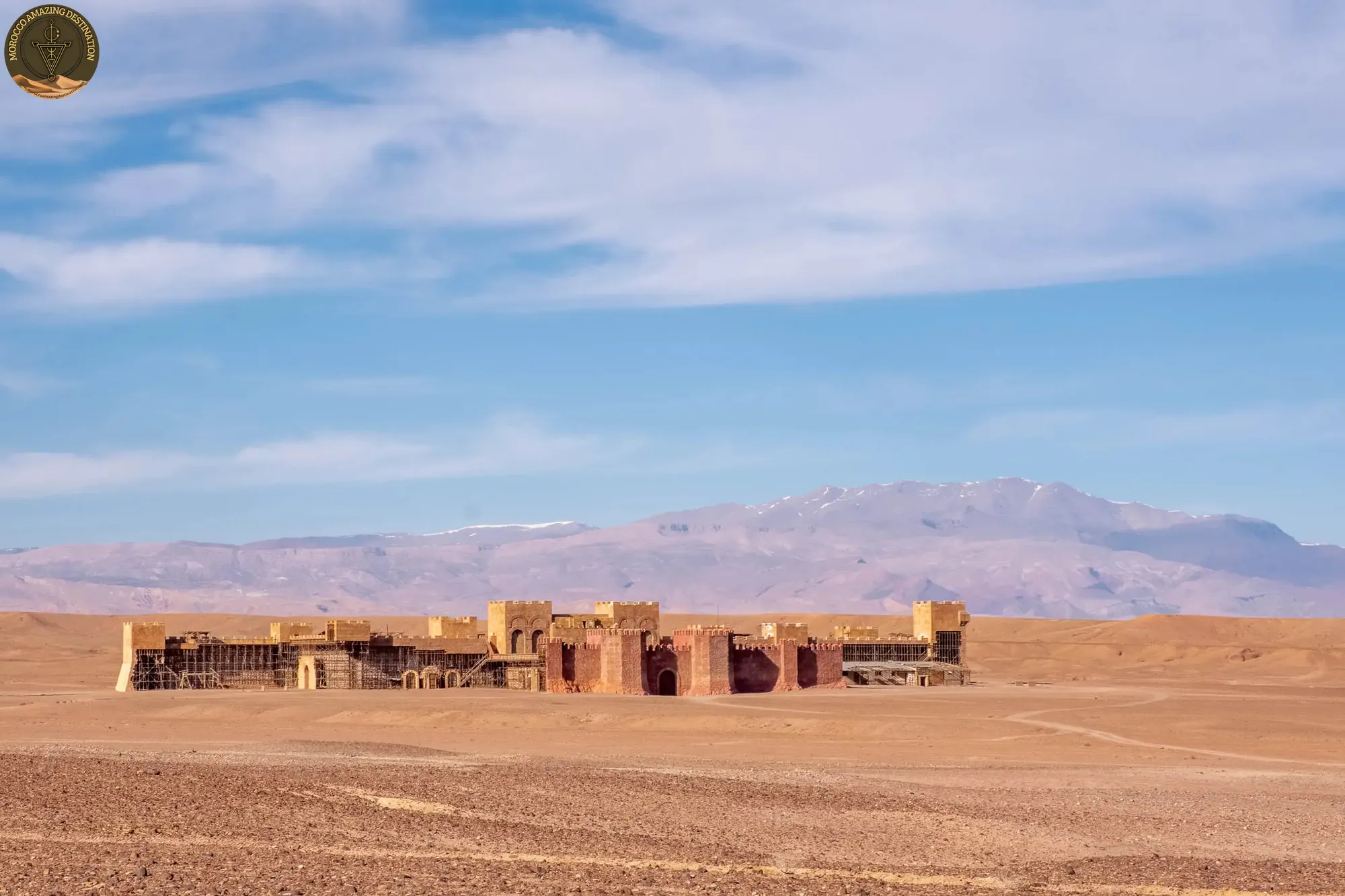
Atlas Studios Gladiator II work sits at Km 5 on the Route de Marrakech, on a desert backlot spanning more than twenty hectares. Here the production repurposed the large Jerusalem set built for Kingdom of Heaven just north of the main studio on the N9, redressing it as the coastal town invaded by Roman ships in the opening act. Hydraulic-mounted vessels and set dressing turned the backlot into a harbour under attack without ever leaving the desert.
On nearby dunes the crew constructed the arena where Macrinus first sees Lucius forced to fight. The structure was built for filming in the open desert light, with controlled fight choreography enhanced later with visual effects. An abandoned kasbah and digitally extended pyramids were also used for flashback textures tied to Lucius as a child. Whether every temporary structure remains standing varies by season and production cycle, so treat the studio tour as the best way to see what is accessible today.
A guided visit is included with your ticket and runs from morning until sunset. Expect sun, dust and wide horizons — wear sun protection, bring water and allow time for photos between sets.
Gladiator II Ouarzazate — Desert, Kasbahs and Valleys
Gladiator II Ouarzazate extends beyond the studio walls. The wider Gladiator II Morocco scenes open in a North African province imagined as Numidia, which the film evokes through classic Ouarzazate ingredients: hard desert light, palm oases along the Ounila Valley, rocky ridgelines backed by the High Atlas, and earth-built architecture.
You can trace that look without joining a shoot. From Ouarzazate, drives into the desert fringe, the Ounila Valley and palm corridors mirror the approach routes seen on screen. The city itself — often called the Hollywood of Africa and the Gateway to the Sahara — anchors your stay with Taourirt Kasbah, the Cinema Museum and straightforward logistics for film-location hopping in a private air-conditioned vehicle. A local guide helps you read pisé walls, fortified ksar forms and oasis patterns that let this landscape double so convincingly for antiquity.
Gladiator II Ait Benhaddou — The Ksar Corridor
Gladiator II Ait Benhaddou belongs to the same corridor, but with nuance. The UNESCO World Heritage site of Ait Benhaddou is a fortified ksar of earth and clay architecture set on a historic caravan route, about thirty minutes from Ouarzazate and reached from Marrakech via the Tizi n’Tichka Pass.
For the original Gladiator, specific market and slave-area streets inside the ksar were widely noted. For the sequel, verified detail is thinner, and sources describe the shoot more generally as the Ouarzazate–Ait Benhaddou region rather than naming individual alleys. That is why this guide treats the ksar as part of the regional canvas you can experience fully — cross the Ounila River, walk the lanes, climb to the agadir granary for the panorama, meet artisans, and feel the Berber and Amazigh heritage that gives the architecture its depth — without overclaiming a single doorway.
If you come at sunrise or sunset the light matches the film’s warm palette, and the spring and autumn seasons offer the most comfortable walking conditions.
Gladiator II Morocco Scenes Explained: What Was Shot Where
Gladiator II Morocco scenes cover the film’s Numidian opening: a coastal town invasion, the desert arena introduction for Lucius, and flashback textures of childhood. Morocco does not stand in for Rome in this title; the Colosseum and city interiors were built as a large replica elsewhere.
- Coastal town under Roman attack: The repurposed Jerusalem set north of Atlas Studios served as the seaside settlement where Roman ships arrive and combat erupts. The set’s streets and harbour edge were dressed to read as a Mediterranean port on the edge of the desert.
- Arena where Lucius fights: A purpose-built arena in the dunes near Ouarzazate is where Macrinus observes Lucius forced to face heightened threats, including digitally enhanced creatures. The location uses natural light and desert scale for impact.
- Childhood memory fragments: An abandoned kasbah near Ouarzazate, supplemented with digital pyramids, evokes Lucius as a child in hiding. The approach roads through oases and valleys sell the journey between these points.
Later in the story the action shifts to Rome — that material was filmed on a full-scale Colosseum replica and associated sets outside Morocco, which the next section clarifies so your expectations stay accurate.
Morocco vs Malta vs UK: Where Each Part Was Filmed
Viewers often ask whether the Colosseum was Morocco. It was not. The clearest way to plan is to compare all three hubs.
| Region | Role in Gladiator II | Real-World Place | Can You Visit Today | Access Notes |
|---|---|---|---|---|
| Morocco – Ouarzazate / Atlas Studios | Numidian opening, coastal town, desert arena, kasbah flashback textures | Atlas Studios backlot at Km 5 Route de Marrakech, dunes near Ouarzazate, Ounila Valley approaches | Yes | Daily guided studio tour included with ticket; combine with Ait Benhaddou and Taourirt in a private vehicle |
| Morocco – Ait Benhaddou corridor | Regional texture for Numidia, on-screen caravan world | UNESCO World Heritage site of Ait Benhaddou, pisé ksar and agadir | Yes | Walk the ksar, cross the Ounila, climb to the granary; treat as corridor rather than single alley claim |
| Malta – Fort Ricasoli & Film Studios | Rome and Colosseum exteriors, flooded arena sea-battle work, gladiator school | Fort Ricasoli in Kalkara, Malta Film Studios water tanks, Fort Manoel on Manoel Island | Partial | Forts are historic military sites with limited access; studio tanks are working facilities |
| UK – South Downs | Battle landscapes and plates beyond Rome | Devil’s Dyke and surrounds in the South Downs, Sussex | Yes | Open countryside; no sets remain, landscape only |
This table keeps your film-inspired itinerary honest: Morocco for desert and studio craft, Malta for Rome on a grand replica, the UK for open battle country.
Why Morocco Was Chosen for Gladiator II
Morocco was chosen for its reliable desert light, diverse topography and established studio infrastructure that lets a large production move fast without losing authenticity. More than three hundred days of sun, crisp air and the High Atlas as a natural backdrop give cinematographers the clarity they need, while dunes, kasbahs and oases sit within short drives of each other.
Atlas Studios provides the operational base: expansive backlots, workshops, skilled local crews, and the ability to leave and reuse large sets such as the Jerusalem town. Support from CLA Studios and a deep roster of craftspeople means construction, dressing and logistics are handled on the ground. Official incentive frameworks describe a cash rebate for qualifying foreign productions, subject to minimum spend and shoot-day thresholds and capped levels, which helps explain why large titles return. Viewer-facing sources also note the legacy of the original Gladiator, which spent weeks in the same corridor and left a practical memory that makes complex builds smoother the second time.
For travelers the benefit is tangible: when the film work wraps, the sets, desert roads and welcoming local hospitality remain, and you can move between them without wasted transit because your driver knows the gates, the light and the quiet times.
By the Numbers: The Production Landscape Behind the Locations
Understanding scale helps you choose where to spend time. The following sketch draws on production and tourism reporting cited by name only, with soft figures where sources vary.
- Foreign production investment in Morocco has been described as exceeding one hundred million in a recent year, reflecting the country’s sustained attraction for international shoots, according to Morocco World News and industry summaries.
- Atlas Studios is consistently described as covering more than twenty hectares, often noted as the largest studio by area, with room to expand temporary builds for each title, according to studio and travel reporting such as Time Travel Turtle and Morocco Travel Base.
- The UNESCO World Heritage site of Ait Benhaddou is presented as a caravan ksar whose current pisé ensembles reflect centuries of earthen building along historic trade routes, according to UNESCO listings and site interpretation.
- Incentive guides describe a Moroccan cash rebate at thirty percent for eligible spend, uncapped in headline terms and subject to minimums and ceilings, according to Celluloid Pact and Saturation reporting.
Ticket levels at Atlas Studios are typically described around eighty for the studio and around forty for the Kingdom set, with a combined option around one hundred ten, but prices shift, so check locally on the day. Flag uncertainty and confirm at the gate.
How to Visit Atlas Studios and Ait Benhaddou Without Hassle
You can visit both hubs in one smooth day from Ouarzazate, or as a scenic extension from Marrakech with a night in Ouarzazate to avoid rushing. A private tour removes friction, keeps timing flexible and lets you linger where the light is best.
Five simple steps
- Fly or drive to Ouarzazate: Fly via the main hub to Ouarzazate airport when available, or drive from Marrakech across the Tizi n’Tichka Pass. The mountain road is scenic and best enjoyed with a private driver who knows the viewpoints and the pace.
- Tour Atlas Studios first: Arrive for an early guided tour while temperatures are lower and sets are quieter. Walk the backlot, ask your guide which town facades were redressed for the opening, and photograph the desert horizon that sells Numidia without effects.
- Cross to Ait Benhaddou: Drive about thirty minutes to the ksar. Cross the Ounila, wander the alleys, climb to the agadir for the classic panorama, and pause for crafts dyed and woven in local workshops.
- Pause in Ouarzazate: Return for Taourirt Kasbah and the Cinema Museum if you want more context, or for a calm mint tea in a garden terrace between sets.
- Stay overnight nearby: A night in Ouarzazate lets you catch sunrise or sunset at the ksar and avoids a long return drive after a full day.
Getting between Marrakech and Ouarzazate
From Marrakech, plan around four hours via the Tizi n’Tichka Pass, with stops for photos and villages. With a private vehicle and driver you maximize sightseeing and skip parking and navigation stress; self-driving is possible but demands mountain focus and local road awareness. If you overnight in Ouarzazate you can split the film work across two gentle halves rather than one long push.
Practical Tips for a Smooth Film-Location Visit
- Go private and tailor-made: A private vehicle and driver plus a licensed local guide turn a scattered film map into a coherent story, with flexible timing and door-to-door ease that feels hassle-free.
- Time your light: Early morning and late afternoon give the warm, cinematic glow seen on screen and keep temperatures kinder for walking.
- Dress for desert and kasbah: Light layers, closed walking shoes, sun protection and a scarf for dust cover both studio sand and ksar lanes. Carry water.
- Treat the ksar as a living place: Ait Benhaddou is home and heritage as well as backdrop. Ask before photographing residents, walk softly, and support artisans directly.
- Check set access on arrival: Active productions can close parts of the backlot, which can be exciting if you catch live work. Confirm what is open at the gate.
- Combine film with culture: Add palm oases, gorge walks or a short tea in a Berber village between sets to feel the soul of Morocco that made the doubling so believable.
Walk the Film Desert With Private Morocco Tours
You do not need a crew badge to follow this story. A tailor-made route links the Gladiator II Morocco scenes to the landscapes that make them feel real, with authentic stays and local experts who feel like family.
The 4-Day Guided Morocco Tour: Ouarzazate to Marrakech Desert Adventure starts where the sequel started — in Ouarzazate with Taourirt Kasbah and Atlas Studios, including the sets linked to Gladiator — then weaves through Skoura, the Dades and Todra gorges and on toward the desert before crossing the High Atlas to Marrakech. With a private driver and hand-picked riads, you move between film sites and hidden gems without wasted time.
For a broader canvas that frames the corridor within a classic circuit, the 10-Day Morocco Tour from Marrakech crosses the High Atlas to the UNESCO World Heritage site of Ait Benhaddou, continues through Dades and the desert, loops via the Draa Valley and Ouarzazate studios, and returns to Marrakech. You get the film corridor plus dunes, valleys and medinas in one immersive arc.
We can customize a tour to match your needs — design your perfect itinerary
If you found this helpful, add us as your preferred source on Google.
Frequently Asked Questions
Where was Gladiator II filmed in Morocco?
Gladiator II filmed its Morocco sequences in the Ouarzazate area, centered on Atlas Studios and the surrounding desert, with the broader Ouarzazate–Ait Benhaddou corridor representing Numidia. The main Colosseum was a large replica in Malta, not Morocco.
Was Gladiator II filmed at Ait Benhaddou?
The production is documented for the Ouarzazate–Ait Benhaddou region, with Atlas Studios as the confirmed base and desert sets nearby. The exact streets of the ksar used for the sequel are less detailed than for the original Gladiator, so treat the ksar as part of the regional corridor you can visit.
Can you visit Atlas Studios where Gladiator II was filmed?
Yes. Atlas Studios near Ouarzazate is open daily with a guided tour included. You can walk sets linked to Gladiator II and many other titles, then continue to Ait Benhaddou, set about 30 minutes away via the Ounila Valley.
What is the difference between the Morocco and Malta filming locations?
Morocco provided the North African opening — desert, kasbahs and studio backlots standing in for Numidia — while Malta provided the Rome and Colosseum material, including the Fort Ricasoli replica and water-tank work for sea-battle scenes.
Ready for an Adventure?
Have questions? Feel free to contact us using the form below. We're here to help!