
· Travel · 5 min read
El Jadida Architecture Walk: Reading the Portuguese City
An El Jadida architecture walk in five stops: 90 minutes, free, from the land gate to the ramparts. What to read in the stone.
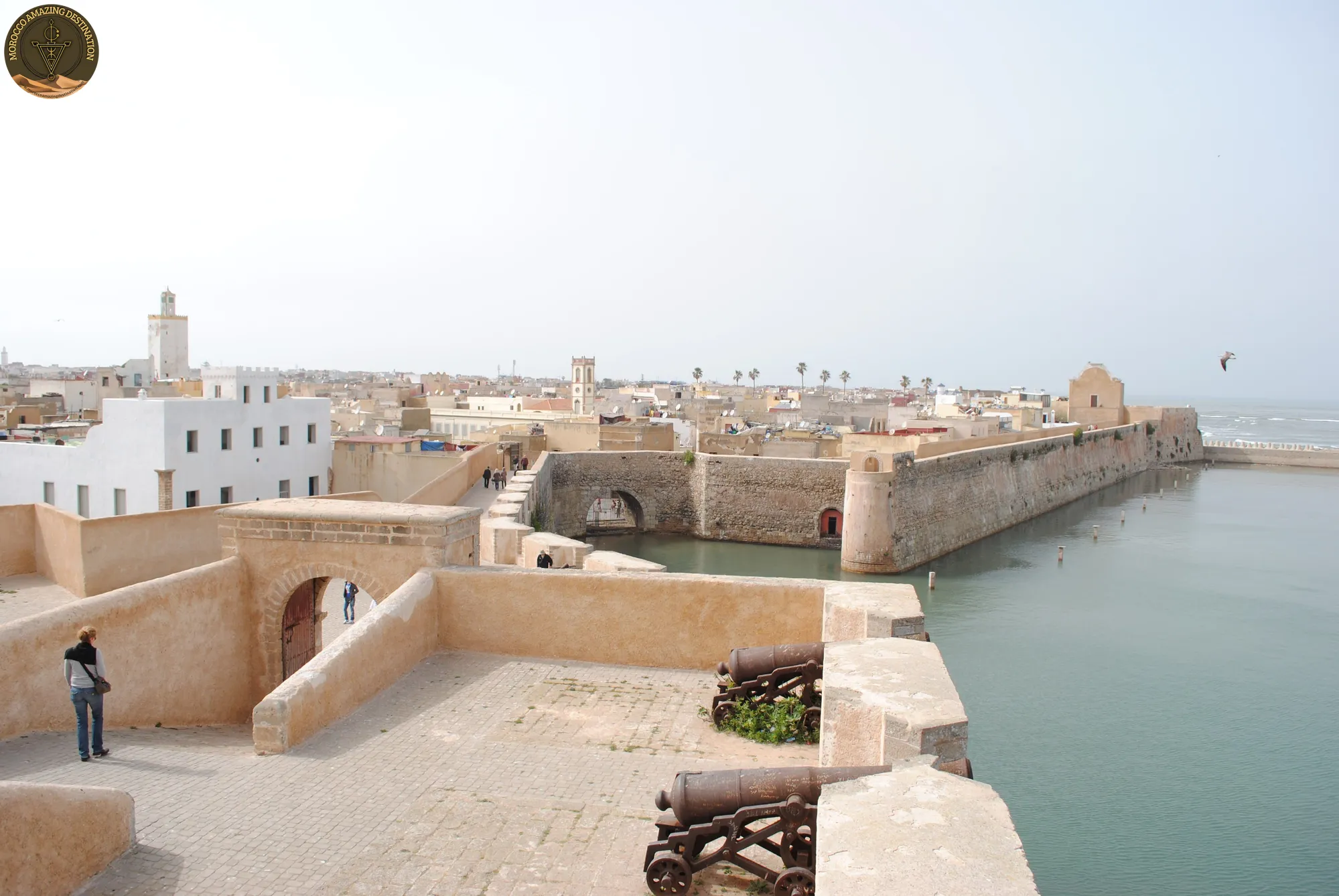
El Jadida’s Portuguese city covers 7.5 hectares, small enough to cross in five minutes and detailed enough to fill an afternoon. An El Jadida architecture walk is the way to read it: land gate first, then the old main street, the church door, the citadel, and the ramparts last. The loop takes about 90 minutes and costs nothing, because the streets and walls are public space.
In this guide, we will break down the five stops in order, the minutes between them, and what to look for in the stonework as you go.
El Jadida’s Walled City: Shape and Scale
The fort works as a machine for keeping ships out, and its numbers explain everything that follows. A first citadel went up in 1514 under Francisco and Diogo de Arruda. After Agadir fell in 1541, the Portuguese rebuilt the enclosure as a star between 1541 and 1548. The plans are credited to Benedetto da Ravenna, with João Ribeiro and Juan Castillo.
The finished shape measures roughly 250 by 300 metres. Walls average 8 metres high and 10 metres thick, with a 2-metre walkway along the top. UNESCO listed the Portuguese City of Mazagan in 2004 under criteria (ii) and (iv).
What to look for in the wall stonework:
- The batter: the sloping foot that takes cannon shot at an angle instead of square on.
- The coursing: stone size and joint lines shift between the 1514 work and the 1540s rebuild.
- The angles: each bastion is set to rake the ditch below its neighbour.
- The walkway: wide enough for gun crews to pass each other with a ramrod.
The Land Gate and the Rua da Carreira
You enter through the south rampart, at the main gate with its two arches set one behind the other. Until the Protectorate, the approach crossed a drawbridge over a ditch about 20 metres wide and 3 metres deep, filled by the sea. The ditch was later filled in, and a new gate was cut through the wall to open onto the Rua da Carreira.
That street runs to the sea gate and holds the best-preserved buildings in El Jadida. The Portuguese city of Mazagan grew along this spine, and the plots on either side keep their narrow Portuguese frontage.
Where to slow down:
- The gate passage: two arches in sequence, cool and dark, framing the street ahead.
- The upper facades: window surrounds and cornices survive better than the shopfronts below.
- The far end: the sea gate forms a small harbour with the north-east rampart.
Gate to gate is about 300 metres, five minutes at walking pace.
The Church of the Assumption and Its Manueline Door
The Church of the Assumption was begun in 1541 and stands south of the citadel, a short turn off the main street. The plan is plain: nave, choir, sacristy, and a square-shafted bell tower that still breaks the roofline above the lanes.
It is the only Portuguese church still standing in Morocco, and the door alone justifies the detour. Portuguese architecture in El Jadida shows itself here in Manueline carving, and visitor accounts describe twisted colonnettes, rope motifs and shields on the jambs. We have found no official confirmation for each of those details, so go and look, and trust your eyes over any list.
Access is the weak point. The tower cracked in the 2023 earthquake, and opening depends on the day and on who holds the key. Plan for the door, and ask in the medina before you count on the interior.
The Citadel, the Minaret and the Cistern Below
The citadel is the oldest piece of the ensemble, raised in 1514 and measuring about 47 by 56 metres. Three main rooms wrap a central space, with a tower at each corner. The southern one, El-Briya, predates the Portuguese. A northern tower became the base of a nineteenth-century minaret, which is why a Portuguese fort carries a Moroccan minaret at its centre.
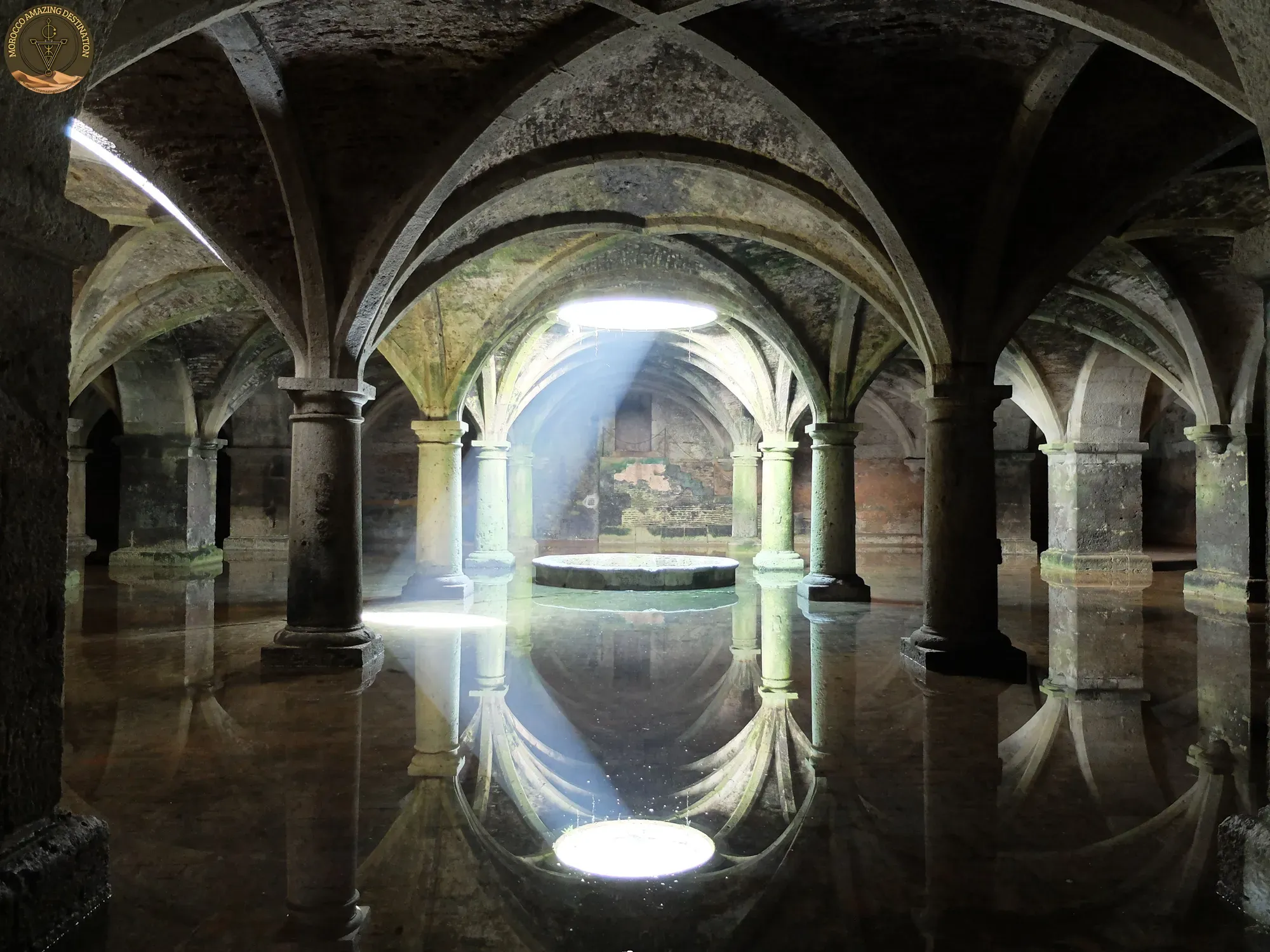
Below ground, the cistern was converted in 1541: 33 to 34 metres square, five rows of five pillars, brick vaults braced with stone ribs. The vault is the reason photographers come, and it is closed for restoration with no firm reopening date. Our guide to the museums of El Jadida follows that story in full.
The Ramparts, Four Bastions and the Sea Gate
Four bastions survive; a fifth was mined when the Moroccan army took the city in 1769. From the walkway you can see how they work together, each angle of fire covering the face of the next. At the north-east corner the sea gate closes the loop, where rampart meets harbour wall.
Getting up there is informal. Stone stairs rise at several points, the walkway is open in stretches rather than end to end, and no hours are published anywhere. Check at the gate when you arrive.
The five stops, with times from the land gate:
- Land gate: the start, 0 minutes.
- Rua da Carreira: 300 metres, 5 minutes.
- Church of the Assumption: 3 minutes off the street.
- Citadel: 4 minutes, in the middle of the enclosure.
- Ramparts to the sea gate: 1.1 to 1.3 kilometres, 25 to 30 minutes without stops.
For the port, the beaches and the oyster run south to Oualidia, our El Jadida guide picks up where the walls end. Nothing in the old city needs booking. A half day is enough to walk it twice, and the stone reads differently in the late light.
Our 15-Day Grand Cultural Tour to Explore Morocco from Tangier stops in El Jadida on the coastal leg between Safi and Casablanca. The 14-Day Morocco Tour from Casablanca begins about 90 minutes up the coast, which makes a walking morning easy to add. A private driver-guide can shift the timing so the ramparts come at the end of the day, and ask about the church key before you set out.
We can customize a tour to match your needs - design your perfect itinerary
If you found this helpful, add us as your preferred source on Google.
Frequently Asked Questions
How long does an El Jadida architecture walk take?
About 90 minutes at an easy pace, or closer to two hours if you add the lanes and a mint tea. The land gate to the sea gate is roughly 300 metres and five minutes, and the full rampart circuit runs 1.1 to 1.3 kilometres in 25 to 30 minutes without stops. Those times are estimates, since nobody publishes an official route here.
What can you actually visit on the walk?
The streets, gate passages and ramparts are public space, so the walk itself costs nothing and needs no ticket. The Portuguese cistern is closed for restoration with no firm reopening date. The Church of the Assumption is the other draw, but the tower cracked in the 2023 earthquake, so treat entry as a maybe and the carved door as the sure thing.
Where does the walk start?
Start at the main gate in the south rampart, the one with the double arch that leads onto the Rua da Carreira. That is where the old drawbridge and seawater ditch once stood. Arriving from the beach or the port, you reach it in about ten minutes on foot, and the whole enclosure is small enough that no leg of the loop takes more than five minutes.
What should I look for in the walls of the Portuguese city?
Four things. The sloping batter at the foot of the wall, which deflected cannon shot instead of absorbing it square on. The change in stone coursing between the 1514 citadel and the 1540s star-shaped rebuild. The angle of each bastion, set to rake the ditch beside it. And the two-metre walkway along the top, built wide enough for gun crews to pass.
Ready for an Adventure?
Have questions? Feel free to contact us using the form below. We're here to help!