
· Travel · 9 min read
Dar Skala Essaouira: A Complete Guide to Essaouira's Iconic Ramparts and Fortress
Discover Dar Skala Essaouira, the historic Atlantic ramparts and fortress that define Morocco's coastal gem. A complete guide to the Skala du Port, panoramic views, history, and insider tips.
What Is Dar Skala in Essaouira?
Perched on the edge of the Atlantic Ocean, where centuries-old stone walls meet endless blue horizons, lies one of Morocco’s most captivating landmarks. Dar Skala Essaouira — the houses and buildings nestled along the city’s famous ramparts — represents the very essence of this UNESCO-listed coastal gem.
The term combines “Dar” (house in Arabic) with “Skala” (bastion or rampart), describing the historic properties built into and alongside Essaouira’s fortress walls. These whitewashed structures with their distinctive blue shutters are not just architectural treasures; they are living pieces of Moroccan history that continue to shape the city’s character and charm.
Whether you are planning a visit, researching the city’s heritage, or looking for the perfect photo spot, this guide covers everything you need to know about Dar Skala Essaouira and the magnificent ramparts that define it.
The History of Dar Skala: Essaouira’s Fortified Heart
The Birth of a Fortified City
To understand Dar Skala, you must first understand Essaouira itself. In the mid-18th century, Sultan Mohammed ben Abdallah commissioned French military architect Théodore Cornut to design a fortified port city from scratch. What Cornut created was revolutionary — a city laid out on a rational European grid, wrapped in imposing stone ramparts, and built to withstand both Atlantic storms and naval attacks.
The Skala — derived from the Portuguese word “escala” meaning a landing place or port of call — became the city’s defining feature. Two main bastions were constructed: Skala du Port guarding the harbour to the south, and Skala de la Ville protecting the city’s northwestern flank. These fortified walls were not merely defensive; they were a statement of power, a symbol of the sultan’s ambition to turn Essaouira into Morocco’s principal trading gateway to the world.
The Dar: Houses of the Rampart
The concept of Dar Skala emerged naturally as the city grew. Wealthy merchants, consuls, and dignitaries built their residences along the ramparts, taking advantage of the elevated position, the cooling ocean breezes, and the prestige of living within the city’s most prominent architectural feature. These Dar Skala properties became some of Essaouira’s most desirable addresses — a status they retain to this day.
Many of these historic houses still stand, their thick stone walls, interior courtyards, and rooftop terraces bearing witness to centuries of Atlantic sunsets. Some have been lovingly restored as boutique riads and guesthouses, offering visitors the chance to sleep within the very walls that once protected the city from the sea.
Skala du Port: The Crown Jewel of Dar Skala Essaouira
The Iconic View
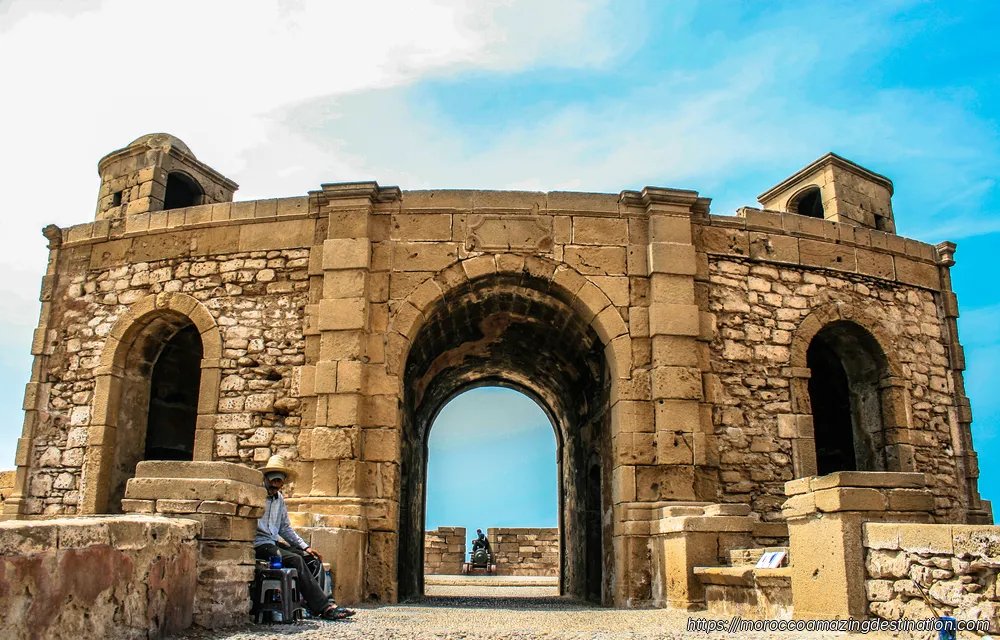
If there is one single image that captures the essence of Dar Skala Essaouira, it is the panorama from Skala du Port. Standing on this 18th-century sea bastion, you look out over a scene that has barely changed in two hundred years: bright blue fishing boats bobbing in the harbour, seagulls wheeling overhead, and the silhouette of Mogador Island on the horizon.
A row of brass cannons — imported from Spain in the 19th century — lines the rampart, their barrels still pointed toward the Atlantic as if awaiting an attack that never came. These cannons are among the most photographed objects in all of Morocco, and for good reason: they frame a view that is genuinely breathtaking.
What You Will Experience
- The entrance is a carved stone archway leading up a short flight of steps to the rampart level. The moment you emerge onto the platform, the Atlantic unfolds before you in all its vastness.
- The cannons stretch along the entire length of the bastion. Each one is slightly different — some bear Spanish inscriptions and royal crests, others have been weathered smooth by salt and wind.
- The fishing port below is a hive of activity. Watch fishermen unload their catch, repair their nets, and prepare their boats for the next voyage. The smell of salt, fish, and sea spray fills the air.
- Mogador Island sits offshore, a rocky sanctuary that once housed a prison and now serves as a wildlife reserve for Eleonora’s falcons.
Visit at sunset and you will understand why filmmakers, photographers, and travellers have been drawn here for generations. The golden light turns the whitewashed walls amber, the sea sparkles, and the cannons cast long shadows across the stone — it is nothing short of magical.
Skala de la Ville: The Quiet Corsair of the North
While Skala du Port draws the crowds, Skala de la Ville offers a quieter, more contemplative experience. This northwestern rampart stretches along the edge of the medina, its walkway wide enough for a leisurely stroll with the Atlantic crashing against the rocks below.
What Makes It Special
- Fewer visitors mean more space to soak in the atmosphere. You can often have entire sections of the wall to yourself, especially in the morning.
- The views are different — instead of the working port, you look out across open ocean, with the curve of Essaouira’s long sandy beach visible to the south.
- The cannons here are equally impressive, and their placement along the sea-facing wall creates dramatic silhouettes against the sky.
- Watch the waves slam against the base of the ramparts. On windy days, the spray can reach impressive heights, a reminder of why these walls were built so thick and so high.
Both bastions are accessible with a single combined ticket, and most visitors choose to experience both as part of a single exploration of Essaouira’s medina.
Staying at a Dar Skala: The Ultimate Essaouira Experience
One of the most unforgettable ways to experience Dar Skala Essaouira is to stay in one of the historic properties built into or alongside the ramparts. These converted riads and guesthouses offer something no modern hotel can replicate: the sensation of living within history.
What to Expect from a Dar Skala Stay
- Rooftop terraces with uninterrupted Atlantic views — perfect for breakfast as the sun rises over the ocean or a mint tea as it sets behind Mogador Island.
- Thick stone walls that keep rooms cool in summer and surprisingly warm on windy evenings, a testament to traditional Moroccan building techniques.
- Interior courtyards filled with the sound of fountains, the scent of jasmine, and the play of light through intricate wooden screens.
- Proximity to everything — the medina, the port, the souks, and the beach are all within a few minutes’ walk, yet the constant murmur of the sea creates a sense of peaceful seclusion.
- Authentic Moroccan hospitality — many Dar Skala properties are family-run, with owners who are passionate about sharing their city’s history and culture.
Even if you do not stay overnight, several Dar Skala establishments welcome daytime visitors for mint tea, light meals, or simply to admire the view from their terraces. Ask politely, and you may be invited to take a look.
Photography at Dar Skala Essaouira
The interplay of light, stone, sea, and sky makes Dar Skala Essaouira a photographer’s dream. Here is how to capture it at its best:
- Golden hour is your friend. The hour before sunset bathes the ramparts in warm, honey-coloured light. Position yourself at Skala du Port with the sun behind Mogador Island for the most dramatic shots.
- The blue boats in the harbour create a vivid contrast against the white medina walls and the grey stone ramparts. A polarising filter will help cut the glare off the water.
- Details matter. The weathered texture of the cannons, the carved stonework of the battlement, the patterns of shadows cast by the crenellations — these small elements tell the story of the place.
- Early morning offers soft light, empty ramparts, and the chance to photograph fishermen preparing their boats without the crowds.
- Stormy weather might not seem ideal, but dramatic clouds and churning seas can produce some of the most powerful images of the ramparts in action.
Practical Information for Visiting Dar Skala
Opening Hours and Tickets
Both Skala du Port and Skala de la Ville are open daily from approximately 9:00 until sunset. A combined ticket costs around 70 MAD per adult, with children under 12 entering free. A small additional fee (around 25 MAD) applies if you wish to use a professional camera or tripod.
Best Time to Visit
- Morning (9:00-11:00): Quietest time, soft light, cooler temperatures. Ideal for photography and peaceful exploration.
- Late afternoon (16:00-sunset): The golden light transforms the ramparts. This is when the site is at its most magical and also its busiest.
- Avoid midday in summer — the stone absorbs heat and there is little shade on the ramparts.
- Spring and autumn offer the most comfortable weather. Winter can be windy but the light is often spectacular. Summer brings reliable sunshine but stronger winds.
Getting There
Skala du Port is located at the southern end of the medina, a short walk from Moulay Hassan Square and the fishing port. Skala de la Ville runs along the northwestern edge of the old city. Both are well-signposted and impossible to miss once you are inside the medina walls.
What to Bring
- A windbreaker or light jacket — Essaouira’s famous winds are strongest on the ramparts. Even on a warm day, the breeze can be surprisingly cool.
- Sunscreen and sunglasses — there is little shade and the Atlantic sun reflecting off white walls can be intense.
- Comfortable walking shoes — the stone surface is uneven in places.
- Your camera — this is one of the most photogenic spots in Morocco. You will want to capture it.
Why Dar Skala Matters
Dar Skala Essaouira is more than a tourist attraction. It is a testament to the vision of an 18th-century sultan, the skill of a French architect, and the resilience of a city that has weathered centuries of Atlantic storms, economic shifts, and the passage of empires. The ramparts continue to define Essaouira’s skyline and its identity, anchoring the city to its past while framing its present.
Walking the ramparts, you follow in the footsteps of sailors, merchants, soldiers, and dreamers who have gazed out at the same horizon for nearly three hundred years. That continuity — the sense of standing in a place where history feels alive — is what makes Dar Skala Essaouira an essential stop on any Moroccan journey.
Explore Dar Skala and Beyond with a Guided Tour
The ramparts are even more rewarding when experienced as part of a broader journey through Morocco. Our 8-Day Morocco Tour: Marrakech, Sahara Desert and Essaouira Adventure combines the magic of the Sahara with two nights in Essaouira, giving you ample time to explore the Skala, wander the medina, and soak in the city’s coastal charm at your own pace.
If you prefer a deeper exploration of the coast alongside the desert, our 9-Day Morocco Tour from Marrakesh: Sahara Desert, Essaouira and Cultural Highlights dedicates extra time to Essaouira’s cultural treasures, from the ramparts and the port to the argan cooperatives and artisan workshops of the surrounding countryside.
Every tour is fully customisable to match your interests and travel style. Prefer more time on the coast? Want to combine the Skala with the imperial cities? We will craft the perfect itinerary for you. Get in touch to design your tailor-made Morocco tour and let us bring your dream journey to life.
If you found this helpful, add us as your preferred source on Google.
Frequently Asked Questions
What is Dar Skala in Essaouira?
Dar Skala in Essaouira refers to the historic houses and buildings situated along the Skala — the fortified ramparts built in the 18th century that overlook the Atlantic Ocean. The term combines the Arabic word "Dar" (house) with "Skala" (bastion/rampart), describing properties built into or adjacent to Essaouira's iconic sea walls, many of which have been converted into riads, cafes, and guesthouses offering spectacular ocean views.
Is Skala du Port worth visiting?
Absolutely. Skala du Port is one of Essaouira's most unmissable attractions. Its bronze cannons, panoramic views of the fishing port and Mogador Island, and the dramatic sunset views make it a highlight of any visit to the city. The entrance fee is minimal and the experience — especially at golden hour — is unforgettable.
What is the difference between Skala du Port and Skala de la Ville?
Skala du Port is the southern bastion overlooking the fishing harbour and Mogador Island, famous for its row of bronze cannons and the iconic view used in films and series. Skala de la Ville is the northwestern rampart running along the oceanfront, offering a quieter, more expansive walk along the city walls with equally stunning Atlantic views and historic cannons.
How much does it cost to visit the Skala ramparts in Essaouira?
Entry to Skala du Port and Skala de la Ville costs around 70 MAD (approximately 7 EUR or 7 USD) for a combined ticket, with a small additional fee if you wish to take photographs with a professional camera. Children under 12 typically enter for free. Tickets can be purchased at the entrance to either bastion.
Ready for an Adventure?
Have questions? Feel free to contact us using the form below. We're here to help!