A tetouan day trip from chefchaouen is the easiest cultural contrast in the Rif - you leave the Blue City after breakfast and, in just over an hour, you are wandering the white terraces of the white dove tetouan. If you’ve seen our overview of 7 trips from Chefchaouen, this guide zooms in on Tetouan with everything you need for a full, walkable day in its UNESCO medina and Spanish-era new town.
This chefchaouen to tetouan day trip is short, affordable and packed with architecture, crafts and food - no long drive, no complicated logistics, just a dense historic centre you can explore entirely on foot with a guide.
Why Tetouan Makes the Perfect Day Trip from Chefchaouen
Chefchaouen and Tetouan sit in the same Rif landscape, but they feel strikingly different:
- Close and easy: About 65 km north of Chefchaouen - about 60–70 km depending on the route - in the Martil valley at the foot of Jebel Dersa. Roughly 1–1.5 hours by grand taxi or private driver, around 2 hours by CTM bus.
- The White Dove: Locals call Tetouan Al Hamama Al Baidaa, the White Dove, for the way its low, whitewashed houses cascade down the hillside when seen from the mountain - a bright, airy counterpart to Chefchaouen’s blue.
- Living heritage, not a museum: The tetouan medina is UNESCO World Heritage-listed for its intact Hispano-Moorish town planning - the smallest but most complete medina in Morocco, still lived-in and worked-in.
- Two cities in one: An Andalusian old town plus the wide, Art Deco boulevards of the Ensanche Española from the former Spanish protectorate capital era.
If you love architecture, artisan quarters and walkable cities, Tetouan rewards a full day without feeling rushed.
The Story Behind the White Dove: Tetouan Andalusian Heritage
Understanding the tetouan andalusian heritage makes everything you see inside the walls click into place.
The present tetouan medina was rebuilt by Andalusian families - Muslims and Sephardic Jewish communities - who arrived after the fall of Granada at the end of the Reconquest. They brought with them patio houses with carved wood and zellige, wrought-iron balconies, intricate plasterwork, gold-thread embroidery, leather and metal guilds, and the classical Andalusian music known as Al-Ala.
That influx shaped a fortified Mediterranean town unlike any other in Morocco: low, white façades with green shutters, a hierarchy of wide commercial arteries and quiet residential lanes, and a dense network of fountains, communal ovens, hammams, fondouks and small mosques and zawyas. Enclosed by about 5 km of walls pierced by seven historic gates - including Bab El Okla, Bab Mqabare, Bab Nouader and Bab Tout - the medina has remained largely untouched by later outside influences, which is why its Andalusian character still feels so pure.
You see that heritage alive today at Dar Sanaa, the historic School of Arts and Crafts, and at the National Institute of Fine Arts nearby - living schools where artisans still learn zellige mosaic, plaster carving, inlaid wood, filigree and the famed Tetouani embroidery known as tarz Tetouani.
What to See on a Tetouan Medina Walking Loop
The old city is entirely pedestrian - no cars inside the walls - so the best way to explore is a relaxed loop of about 2–3 hours with a licensed guide. Start from the seam between old and new town and work inward.
1. Place Hassan II - the Feddan
Begin on Place Hassan II, known locally as El Feddan or El Mechouar - the ceremonial square that links the medina to the Ensanche. The ornate gates and white façade of the Royal Palace line one side. The palace interior is not open to visitors, but the exterior is a favourite photo stop, flanked by formal gardens, modernist lamps and terrace cafés perfect for mint tea with a view.
2. Bab El Okla and the Two Museums
Step through Bab El Okla, one of the medina’s most imposing gates, and you are right beside the two small museums that together explain Tetouan’s deep past:
- Ethnographic Museum (Museum of Moroccan Art) on the Skala: Housed in a former military bastion on the ramparts, with Rif costumes, jewellery, wedding palanquins, weapons, musical instruments and sweeping views along the walls.
- Archaeological Museum: A compact Andalusian garden and three rooms of Phoenician and Roman finds from nearby Lixus and Tamuda - mosaics, pottery, amphorae, coins and steles - plus prehistory displays.
Both charge a small fee and opening hours can vary, so check locally on the day.
3. The Mellah and the Souks
From the museums, slip into the mellah, the former Jewish quarter, where the Bengualid Synagogue recalls a Sephardic presence that arrived with the Andalusian exodus. Nearby, the historic cemetery lies just outside the walls.
Then lose yourself - in a good way - in the specialty souks that still work by guild:
- Leather tannery near Bab Mqabare - smaller and less pungent than Fes, but very photogenic
- Metal and copper lane, wood inlay, pottery and textiles, including fine fouta hats and kaftans
- Spice, olive and fish souks around El Hout, where daily life is loudest in the morning
This is the best place in the Rif to buy zellige, embroidery, brocade and leather at lower prices than the more touristy cities - take your time and ask your guide about fixed-price shops versus bargaining.
4. The Ensanche Española - Spanish-Era Boulevards
Exit the medina on the opposite side and the atmosphere changes instantly. The Ensanche Española, the extension built when Tetouan served as capital during the former Spanish protectorate capital era, offers wide avenues, arcades and balconies in neoclassical and Art Deco style.
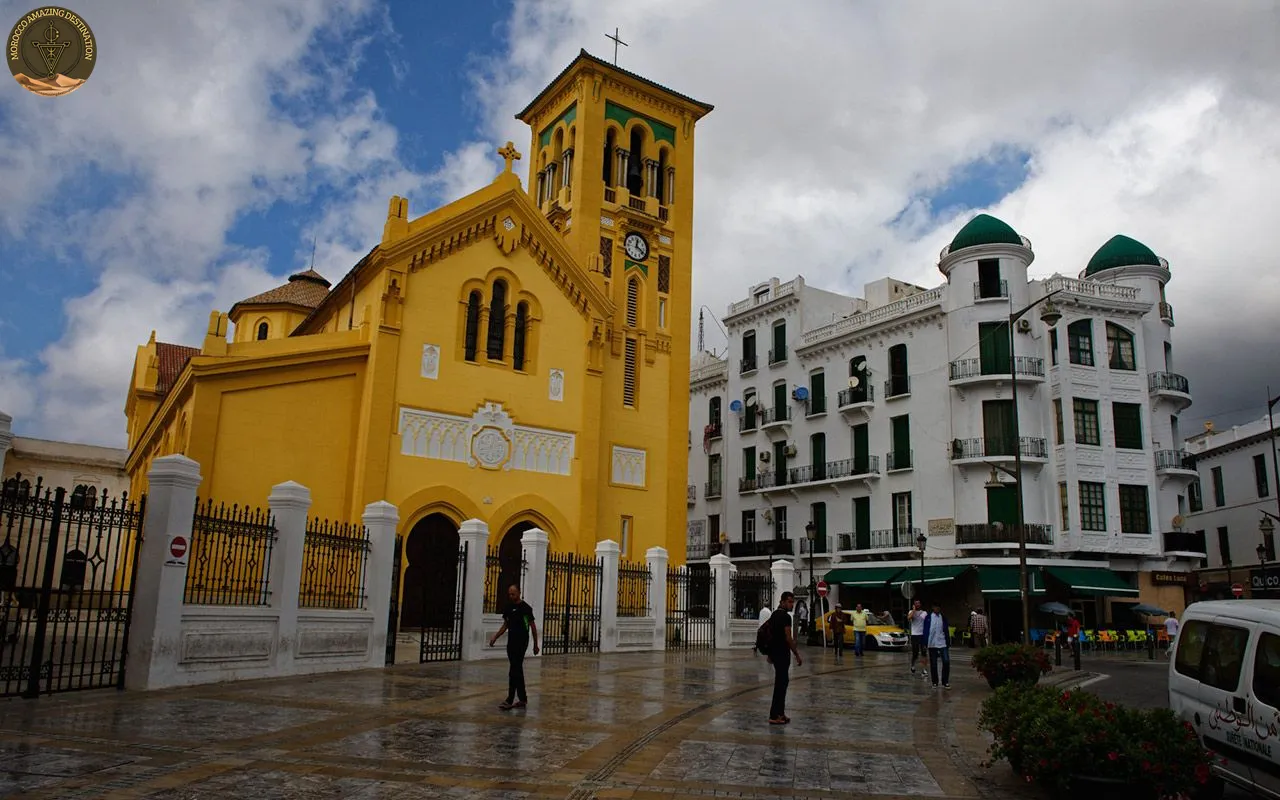
Stroll Boulevard Mohammed V and Avenue Moulay El Mehdi toward Plaza Primo - now Place Moulay El Mehdi - with its palm-lined centre, then pass the Church of Our Lady of Victory and the restored Teatro Español (Spanish Theatre). Government buildings, cafés and bookshops with bilingual Arabic-Spanish signage give this neighbourhood a distinctly Mediterranean, almost Andalusian-Spanish feel that perfectly complements the medina.
Pause on the Feddan again before you leave - the light on the white walls is most beautiful in early morning and late afternoon.
Food, Crafts and Shopping Between Sights
Tetouan’s craft and food culture is tightly tied to its Andalusian roots:
- Crafts to look for: Zellige tile panels, carved plaster, inlaid wood, filigree jewellery, brocade, gold-thread embroidery and vegetable-tanned leather bags and slippers.
- Tastes to try: Bocadillos and croquettes reflecting Spanish influence, fresh fish tagines from nearby Martil, honey pastries, and mint tea on a Feddan terrace.
- How to buy well: If you want a major piece - a zellige table or embroidered kaftan - a guide can take you to workshop-shops where you see the making and can compare quality without pressure. For smaller souvenirs, the fixed-price craft complex near Dar Sanaa is a good benchmark.
Getting There & Practical Tips
How to Get from Chefchaouen to Tetouan
- Shared grand taxi: The most common option. Classic Mercedes sedans wait near the Chefchaouen taxi ranks and leave when full with six passengers. The ride is about 1 hour to 1.5 hours; expect roughly 30–40 MAD per seat one-way for a shared place, or about 300–420 MAD if you take the whole car private. No timetable - mornings fill fastest. Negotiate the return waiting time before you leave if you want the same driver to wait.
- CTM bus: Modern air-conditioned coaches run several times daily between Chefchaouen bus station and Tetouan. The fastest runs are close to an hour and a quarter, but with stops allow around 2 hours. Tickets are typically in the range of about 35–55 MAD - confirm at the station as prices shift slightly by season.
- Private driver: The most comfortable for a day trip - door-to-door, flexible stops for pine-forest viewpoints on the Rif road, and the driver waits while you walk the medina. Best value if you travel as a pair or group.
- No train: There is no railway station in Tetouan; road is the only option from Chefchaouen.
On the Ground - Make Your Day Easy
- Start early: Leave Chefchaouen mid-morning at the latest - or right after breakfast if you want both museums and unhurried souk time. You need about 5–6 hours on the ground plus 2–3 hours of driving for a full day; a half-day focused on the medina alone is also possible.
- Wear the right shoes: The medina is entirely walking-only - cobbles, slopes and uneven steps. Comfortable closed shoes are essential.
- Take a licensed guide: The medina has seven gates and a labyrinth of lanes organised by guild; a local guide for 2–3 hours unlocks the story behind each quarter and helps you navigate efficiently. Your riad or driver can arrange one.
- Cash and dress: Bring dirhams in small notes - cards are rarely accepted inside the medina. Dress modestly for mosques and local neighbourhoods; Spanish is widely understood alongside Arabic, and many signs are bilingual.
- Palace and museum notes: The Royal Palace is exterior only - not open inside. Museum hours and fees vary and can be affected by holidays, so check locally rather than relying on posted times.
- Safe and welcoming: Tetouan is relaxed and family-friendly, less touristy than Chefchaouen or Fes - interactions tend to feel authentic, and prices for crafts and cafés are often lower.
Is a Tetouan Day Trip from Chefchaouen Worth It?
If the blue medina of Chefchaouen is about colour and mountain calm, Tetouan is about layers - Andalusian courtyards, whitewashed harmony, Spanish boulevards and living artisan schools, all packed into a walkable historic core. For culture and architecture lovers, it is the most rewarding easy day trip you can do from a Chefchaouen base.
If this deep dive has you wanting more of the north, consider stretching your stay beyond a single chefchaouen to tetouan day trip. The 5-Day Tour to Chefchaouen & Imperial Cities from Tangier is the closest fit - it pairs Chefchaouen’s blue streets with Tetouan’s region, the Roman site of Volubilis and the imperial cities of Meknes, Fes and Rabat in a compact northern circuit. For a broader loop that adds the Sahara, the 8-Day Northern Tour: Imperial Cities & Desert from Tangier runs from Chefchaouen through Fes to the dunes of Merzouga and on to Marrakech, combining Rif medinas, desert camping and High Atlas gorges in one journey.
We can customize a tour to match your needs - design your perfect itinerary