· Travel · 11 min read
Top 3 Cities to Visit in Morocco: Marrakech, Fes & Chefchaouen — Highlights, Food & How to Combine Them
Discover the top 3 cities to visit in Morocco — Marrakech, Fes & Chefchaouen — with highlights, food, transport and how to combine them.
Top 3 Cities to Visit in Morocco: Marrakech, Fes & Chefchaouen — Highlights, Food & How to Combine Them
Planning your first Morocco trip and struggling to narrow the map? The top 3 cities to visit in morocco for most travellers are Marrakech, Fes and Chefchaouen — a trio that delivers nonstop contrast without constant packing and unpacking.
This shortlist works because each city feels like a different country. Marrakech is loud, theatrical and sun-washed. Fes is dense, spiritual and medieval. Chefchaouen is powder-blue, mountain-cool and slow. Together they give you palaces and souks, the world’s great medina labyrinth, and a photogenic mountain town — all linked by straightforward transport.
If you are weighing the best cities to visit in morocco for a first visit, this guide lays them out head to head. We cover what to see, where to eat, where to stay and exactly how to stitch the three into one smooth loop — with alternatives if you arrive via Tangier or Casablanca.
You will see why these three stand out among all cities to visit in morocco, how many nights to allow in each, and what to expect from the journeys in between. We also link to wider comparisons for when you want to swap in a coastal or capital stop.
Why a 3-City Shortlist Works
Morocco is bigger and more varied than it looks on a map. Trying to see six cities in a week means you spend more time in transit than in medinas.
A three-city core keeps travel days short and experience days long:
- Coverage without rush — Red City energy, medieval craft heritage and mountain calm in one trip.
- Easy logistics — Marrakech and Fes are connected by frequent trains; Fes and Chefchaouen by bus or private car.
- Flexible extensions — Add a Sahara night between Marrakech and Fes, or a beach pause in Essaouira at the end, without rewriting the trip.
For many visitors, this is the sweet spot between depth and variety — enough contrast to feel you have seen Morocco, enough time in each place to get lost, eat well and return to the same riad at night.
1. Marrakech — The Red City (Plan 3–4 Nights)
Marrakech is the country’s showpiece and its busiest gateway. The ochre walls, palm groves and snow-dusted Atlas backdrop set the stage; the medina provides the drama.
What not to miss
- Jemaa el-Fnaa — the vast square that shifts from juice stalls and henna artists by day to storytellers, drummers and open-air grills at night. It is listed by UNESCO as intangible heritage.
- Koutoubia Mosque minaret — the landmark that orients the entire old city (exterior view for non-Muslim visitors).
- Bahia Palace — a sprawling late-era palace of painted cedar ceilings, zellige tilework and stained glass built for a grand vizier. Rooms, courtyards and gardens cover several hectares near Jemaa el-Fnaa.
- Saadian Tombs and El Badi Palace — quiet, patterned tombs versus atmospheric palace ruins, both walkable from the Bahia cluster.
- Ben Youssef Madrasa — a restored Koranic school of carved cedar, stucco and marble, among the finest Islamic architecture in the country.
- Majorelle Garden & Menara Gardens — cobalt-blue villa and cactus gardens versus olive groves with Atlas views.
- The souks — lanes specialised by craft: lanterns, leather, spices, textiles. Go early, bring small notes, and expect to haggle.
Food and atmosphere
Tagine slow-cooked over charcoal, chicken pastilla dusted with sugar and cinnamon, harira soup, méchoui lamb and fresh orange juice at the square. Rooftop dinners at sunset, when the call to prayer rolls across the medina, are a Marrakech ritual.
Book a hammam, take a half-day cooking class, and leave an afternoon free for people-watching from a café terrace. Mornings are best for palaces before crowds build.
Where to stay
Stay inside the medina at least one night — a riad around a tiled courtyard is the classic experience. For longer stays, many travellers split between a medina riad and a quieter palmeraie or Ville Nouvelle hotel with a pool.
Marrakech also anchors the imperial cities morocco circuit — it was capital under the Almoravid and Almohad dynasties and the city that gave the country its name. That imperial past still echoes in its gates, walls and palaces.
If you want a deeper city-by-city comparison before deciding, see our guide to Marrakech, Fez, Chefchaouen, Rabat, Casablanca or Essaouira: which to visit.
2. Fes — The Medieval Labyrinth (Plan 2–3 Nights)
If Marrakech is spectacle, Fes is immersion. Fes el-Bali is often described as the largest car-free urban area in the world, a tangle of thousands of alleys within fortified walls. The medina is UNESCO World Heritage-listed and still lived in, workshop by workshop.
Enter through the tiled Bab Boujloud (the Blue Gate), the city’s most photographed threshold, and the centuries fold in around you.
Highlights
- Chouara Tannery — the largest of the city’s three tanneries, where hides are dyed in stone vats with natural pigments. View from the leather-shop terraces above; shop staff offer mint to soften the smell — a ritual in itself.
- Bou Inania and Al-Attarine Madrasas — exquisite Marinid schools of wood, stucco and tile. Bou Inania is one of the few religious buildings open to non-Muslim visitors.
- Al Quaraouiyine — the mosque-university founded by Fatima al-Fihri, regarded as the oldest continuously operating university in the world. Non-Muslims cannot enter, but you can glimpse the courtyard from the doorway.
- Seffarine Square and Nejjarine — coppersmiths hammering trays, woodworkers and the ornate Nejjarine Fountain and fondouk (former caravanserai).
- Mellah, Royal Palace gates and Jnan Sbil Garden — the historic Jewish quarter anchored by the Ibn Danan Synagogue, gilded palace doors ideal for photos, and an airy garden for a tea break.
- Crafts — leather, ceramics from the Ain Nokbi quarter, zellige and brass. A licensed guide helps you navigate and bargain fairly.
Tone and practicalities
Fes feels more conservative and quieter than Marrakech, especially at prayer times. Getting lost is part of the charm — that is why many visitors hire a licensed medina guide for a half-day. Expect to pay for a badge-carrying guide on an hourly or half-day basis; your riad can recommend someone reputable.
Try tagine, rfissa and harira in small, family-run restaurants, and pause for mint tea looking over the tanneries. Evenings are for slow wandering between madrasa doorways and bread ovens.
Plan at least two nights; three lets you add the Roman ruins of Volubilis and Meknes on a day trip without rushing Fes itself.
3. Chefchaouen — The Blue Pearl in the Rif Mountains (Plan 1–2 Nights)
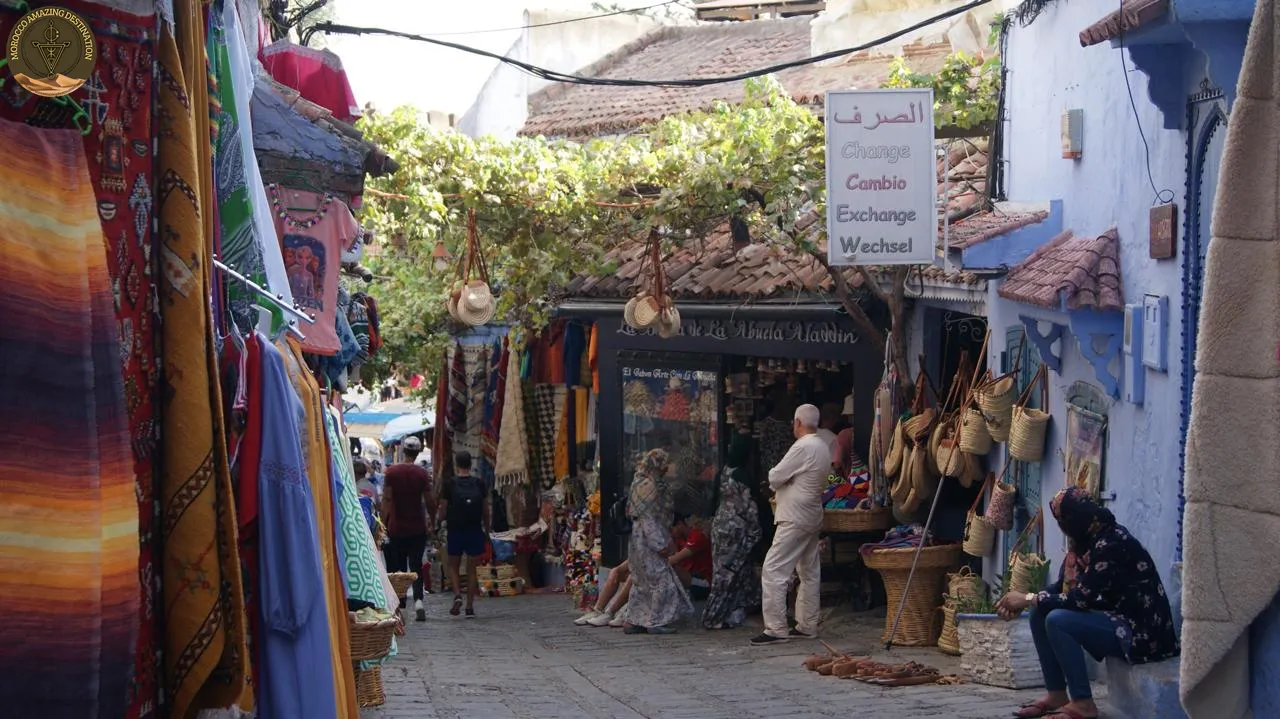
High in the Rif, Chefchaouen trades noise for colour and altitude. The medina’s walls, stairs and doors are washed in layers from powder blue to indigo — a tradition local theories link to Andalusian and Jewish families who settled here, kept alive as habit and identity. Among the most beautiful cities in morocco, this is the most photogenic by far.
What to do
- Wander the blue medina — every lane is a photo. Uta el-Hammam square, the kasbah museum and its garden, and the market stalls of woven blankets and wool djellabas set the pace.
- Spanish Mosque hike — a 45–60 minute uphill walk rewards you with the classic panorama: the blue cascade tumbling down the hillside. Time it for the half hour before sunset when the town glows.
- Ras el Maa — the spring just beyond the eastern gate where locals wash textiles and fill bottles, a short stroll from the medina.
- Beyond town — Akchour waterfalls and the Rif’s limestone gorges are within a short drive for hiking and swimming.
Pace and stay
The core sights take half a day; one night lets you see sunset and sunrise without crowds, while two nights suits photographers and hikers. Shopping is relaxed, bargaining gentler than in the big cities — look for handwoven throws and local goat cheese.
Stay in a small medina guesthouse for atmosphere; parking is limited inside the walls, so drivers typically drop you at a gate. Pack a light layer — mountain evenings can be cool even when Marrakech is warm.
How to Combine the Three Cities: Order, Transport and Nights
For a first trip, the smoothest loop links north and centre then saves the buzz for last. Two logical orders work well depending on where you land:
- Tangier or Casablanca arrival → Chefchaouen → Fes → Marrakech (depart from Marrakech) — ideal if you ferry from Spain or fly into the north.
- Marrakech arrival → Fes → Chefchaouen → Tangier/Casablanca departure — the reverse, handy for Sahara extensions that start in the south.
A comfortable baseline is:
- Chefchaouen 1–2 nights
- Fes 2–3 nights
- Marrakech 3–4 nights
That totals 6–9 nights before flights and any desert detour.
Getting around
Marrakech ↔ Fes: The easiest public option is the ONCF Al Atlas train via Casablanca. Journey time is about 6.5–7 hours; distance is roughly in the 400-km range and services run many times daily. Fares typically land around 230–460 MAD depending on class and demand, with first class offering reserved seats and second class often unreserved — ranges are safest to quote as prices shift with demand. Book a couple of weeks ahead when you can and arrive well before departure. A private car takes longer on the road — around 8–9 hours — but frames the High Atlas crossing. Buses (CTM/Supratours) are an alternative but less comfortable for this length.
The memorable alternative turns the transfer into a highlight: a two- or three-day overland route over the Tizi n’Tichka pass, with stops at Aït Benhaddou (UNESCO ksar), the Dades and Todra gorges, and an overnight among dunes near Merzouga before rejoining Fes or Marrakech.
Fes ↔ Chefchaouen: No train line serves Chefchaouen. Expect a CTM or Supratours coach of about 4 hours, or a similar drive by private car — roughly 3.5–4 hours depending on traffic and stops.
Chefchaouen ↔ Marrakech: No direct train; you would route via Fes (bus plus train) or arrange a private transfer. If time is tight, flying open-jaw (into one city, out of another) saves backtracking.
For all you need on trains, buses, private drivers and self-drive, our practical guide to how to get between cities in Morocco breaks down pros, cons and booking tips. For a concise list of all morocco cities to visit beyond this trio, keep it linked to this loop and add days rather than swapping cities in and out.
Practical Tips for a Smooth 3-City Trip
Where to stay
- Choose a riad inside the medina in Fes and Marrakech for at least one night each — the courtyard, breakfast and roof terrace are part of the experience.
- In Chefchaouen, smaller medina guesthouses feel intimate; confirm luggage help and nearest vehicle access.
- Mid-range riads commonly fall in a broad band from a few hundred to a little over a thousand dirhams per night, rising with season and location — book ahead for terraces with views.
What to eat
- Marrakech: tagine, pastilla, kefta, harira, fresh orange juice.
- Fes: rfissa, grilled meats, harira, elaborate pastries and palace-style tagines.
- Chefchaouen: goat cheese, honey, tagines and woven-bread stalls near Uta el-Hammam.
- Rooftop dinners paired with mint tea are a thread that links all three — order tagine to share and linger.
Shopping smart
Leather in Fes, ceramics and brass across Fes and Marrakech, woven blankets in Chefchaouen. Fix a walk-away price in mind, keep the tone friendly, and do not feel obliged to buy after a tannery viewpoint or shop demonstration.
Etiquette
Dress modestly, especially around mosques and inside the medinas; use the right hand for eating and greeting; ask before photographing people up close. A few words of Arabic or French go a long way, and a small tip for helpful shop terraces, guides and drivers is customary.
When to refine the list
If you have only a long weekend, prioritise Marrakech plus one of the other two. If beaches call, swap Chefchaouen for Essaouira. For a fuller imperial sweep, slot in Meknes or Rabat — but keep the heart of the trip on the three that deliver the widest contrast.
Make the Loop Effortless with a Private Tour
Seeing Marrakech, Fes and Chefchaouen privately keeps logistics simple and time where it matters — inside medinas, at viewpoints and around tables rather than in ticket queues.
Two hand-picked options match this exact trio:
- Stitch the north, centre and south into one seamless journey on the 12-Day Morocco Grand Tour, which covers Marrakech, Fes and Chefchaouen among other highlights.
- If you are landing in the north, the 5-Day Tour Chefchaouen & Imperial Cities from Tangier focuses tightly on Chefchaouen and the imperial cities including Fes — easy to extend toward Marrakech.
Prefer a tailor-made pace? We can customize a tour to match your needs — design your perfect itinerary
If you found this helpful, add us as your preferred source on Google.
Frequently Asked Questions
What are the top 3 cities to visit in Morocco for first-timers?
Marrakech, Fes and Chefchaouen. They cover the vibrant south, the medieval centre and the calm blue north with maximum contrast, and they combine easily by train and bus or private driver.
How many days do I need for Marrakech, Fes and Chefchaouen?
Plan around 1–2 nights in Chefchaouen, 2–3 nights in Fes and 3–4 nights in Marrakech. A 7–9 day loop stitches the three together comfortably, with extra days if you add the Sahara.
How do I travel between Marrakech, Fes and Chefchaouen?
Take the ONCF train between Marrakech and Fes (about 6.5–7 hours via Casablanca, frequent departures) and the CTM or Supratours bus between Fes and Chefchaouen (about 4 hours). A private driver offers door-to-door ease, and a desert route via Aït Benhaddou turns the transfer into a highlight.
Is Casablanca or Tangier a better alternative to Chefchaouen?
Casablanca suits a short stop for the Hassan II Mosque, while Tangier is ideal if you arrive by ferry from Spain. For photography, calm and mountain scenery, Chefchaouen makes the more distinctive third city.
Ready for an Adventure?
Have questions? Feel free to contact us using the form below. We're here to help!