· Travel · 13 min read
Night in the Sahara Desert Morocco: Camp, Music & Stars Guide
Discover a night in the Sahara Desert Morocco — from drum circles to Milky Way stars and luxury camp comfort under dark skies.
A night in the sahara desert morocco is a quiet ritual more than a hotel stay. You arrive by camel or 4x4 in late afternoon, sip mint tea, watch the sun sink behind golden dunes, share a tagine dinner, gather for drums around a fire, and sleep in a tented camp under an exceptionally dark sky. You wake before dawn for sunrise and return to the edge of the dunes for breakfast.
This guide explains exactly how that ritual unfolds, what changes between camp levels, how the music and stargazing work, and what to pack so you feel comfortable. It focuses only on a Sahara desert camp at night, not on the stony Agafay plateau or on evenings in the city.
What a Night in a Sahara Camp Is Really Like — Hour by Hour
A Sahara desert camp at night follows a predictable flow, which makes it reassuring even for first-time visitors. Timings shift with sunset, but the sequence is steady and your driver and camp team manage every step.
The short answer: You arrive in late afternoon, get tea and your tent, climb a dune for sunset, return for dinner, enjoy drums by the fire, stargaze in silence, sleep, then rise for sunrise. The whole evening is guided and unhurried.
-
Late afternoon — Arrival and tea. You reach the edge of the dunes near Merzouga, leave your main luggage with your driver, and continue by camel or 4x4 to camp. Staff greet you with sweet mint tea and show you to your tent so you can store a small overnight bag.
-
Golden hour — Sunset dune walk. With light turning soft, you walk or ride to a high crest. The sand shifts from gold to rose to deep amber. Guides know which dune gives the best view without a long climb. Bring a scarf for wind and a light jacket as the air cools fast.
-
Early evening — Dinner under canvas. Back in camp, dinner is served in a communal dining tent or outdoors if the night is mild. Expect harira soup or salads, chicken or vegetable tagine, couscous, bread baked in the sand, and fruit, with mint tea. Vegetarian options are common if requested in advance.
-
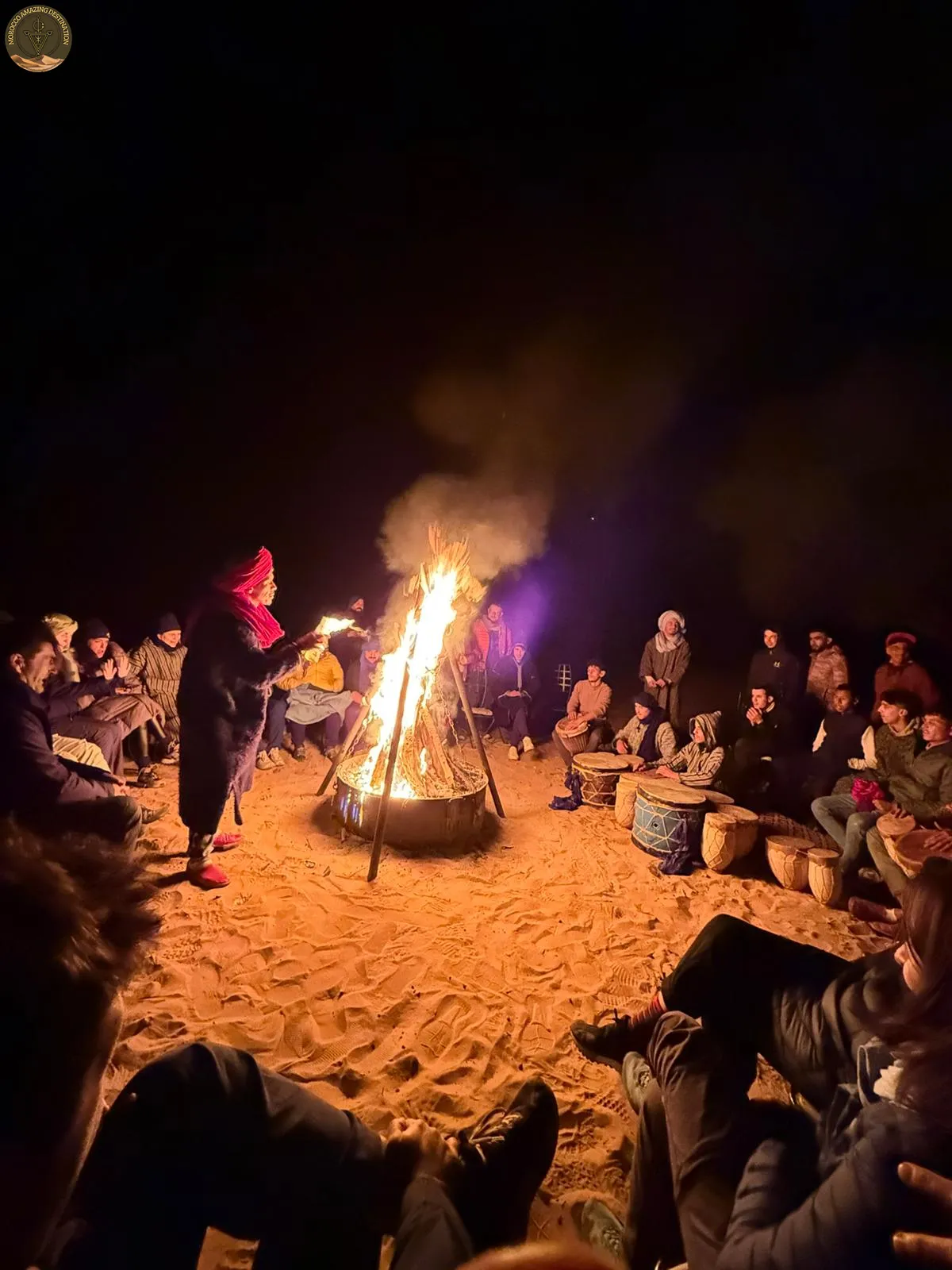
After dinner — Berber music around the fire. This is the heart of the night. Local musicians gather around a central fire for drums, clapping and call-and-response songs. Guests often form a circle, and you are invited to try a drum.
-
Late evening — Silence and stargazing. When the drums fade, the desert falls silent. Without artificial light, the sky opens. Many camps provide mats or low chairs outside the dining area. Lie back, let your eyes adjust for ten minutes, and watch satellites track slowly overhead.
-
Pre-dawn — Sunrise wake-up. Staff give a gentle wake-up call while it is still dark. You climb a nearby dune as the horizon lightens. The sunrise is quick and quiet, with long shadows stretching across the ripples.
-
Morning — Return for breakfast. You ride back to Merzouga as the sun rises higher. Breakfast is simple and filling, usually bread, eggs, jam, cheese and coffee or tea, before you rejoin your vehicle for the next stage of your tour.
If you choose a 4x4 instead of camels, the flow stays the same, only the transfer is faster. Families with small children often prefer the vehicle for comfort and for easier access to bathrooms on arrival.
Sahara Desert Camp at Night — Standard vs Luxury
Understanding what to expect night in Sahara camp starts with the tent tier. Camps at Erg Chebbi range from basic bivouacs to boutique lodges in the sand. The night program is similar everywhere, but comfort, privacy and heating differ.
The short answer: All tiers include dinner, breakfast, music and stargazing, but bathrooms, beds, heating and electricity improve markedly from basic to luxury. Choose based on how much privacy and warmth matter to you at night.
| Feature | Basic / Nomad Bivouac | Standard Camp | Sahara desert luxury camp night |
|---|---|---|---|
| Tents | Low canvas tents, mattresses on floor, shared blankets | Private canvas tents with proper beds, linens and rugs | Large en-suite tents with real beds, thick duvets, rugs, nightstands and decor |
| Bathroom | Shared basic wash block, sometimes pit-style | Private or semi-private with flush toilet, often shared shower | Private en-suite with hot shower and toilet inside your tent |
| Electricity | Minimal, often none — bring a power bank | Solar power, lights in tent, shared charging point | Solar power, lighting, sockets in tent for phones and cameras |
| Heating | Blankets only | Heavy blankets, sometimes portable heater on request | Heating, extra blankets and insulated tents for winter nights |
| Meals | Simple tagine and bread, communal | Tagine, salads, fruit, tea — waiter service | Restaurant-level presentation, varied menus, vegetarian options |
| Best For | Budget travellers and adventurers seeking simplicity | Couples and families wanting comfort without excess | First-timers, families, and anyone sensitive to cold who wants hotel-like comfort in the dunes |
According to sources such as Morocco Desert Heritage and Desert Luxury Camp guides, the difference is most noticeable at night. In winter, when tent walls cool quickly, a luxury tent with a heater and a private hot shower changes how well you sleep. In warmer months, even a standard tent feels comfortable with blankets pulled back.
Your choice also affects location inside the dune field. Luxury camps often sit slightly deeper among the dunes, which means a longer sunset walk but darker skies for stargazing Sahara desert Morocco later.
Berber Music at Night — Drums Around the Fire
Berber music Sahara night is not a staged show. It is a participatory gathering that carries the oral memory of the Sahara. Around the fire, musicians keep a steady pulse and invite you in.
The short answer: After dinner, local Amazigh musicians play bendir frame drums and qraqeb metal castanets, singing in Tamazight and layering rhythms that you can clap or drum along to. The session links to Gnawa heritage heard in nearby Khamlia village.
Instruments are simple and powerful. The bendir is a large frame drum with a warm bass, played by hand. The qraqeb are iron castanets that cut through the night air with a bright clack. Some groups add a ribab, a one-stringed bowed instrument, and handclaps that lock the rhythm. Songs alternate between leader and chorus, often with short, repeated phrases that are easy to follow even if you do not know Tamazight. Themes speak of travel, water, hospitality and the desert itself.
Near Merzouga, many musicians trace family links to Khamlia, a village south of the dunes. According to guides cited by Sahara Discovery and Sun Trails, Khamlia was settled by descendants of Sub-Saharan communities, and its Gnawa heritage shaped the drum vocabulary you hear at night. Some tours include a daytime stop there, so the evening fire feels connected to a living tradition rather than an isolated performance.
What feels authentic is the invitation. Players pass a spare bendir around the circle. You do not need skill, only a steady hand. Children are welcomed to tap along, and the circle often ends with soft singing as guests drift toward their tents. The volume never overwhelms the quiet that follows.
For the best experience, sit close to the drums rather than at the back. The low frequencies travel through the sand. If you wish to record, ask first and keep lights low so you do not disturb stargazing for others.
Stargazing in the Sahara — Why the Night Sky Is Unforgettable
If the drums are the sound of the night, stargazing Sahara desert Morocco is its vision. The Sahara is one of the darkest accessible places for travellers without mountaineering, with minimal haze and very low humidity.
The short answer: Around Erg Chebbi the sky rates around Bortle Class 1–2, with more than 300 clear nights per year. You can see around 4,500 stars with the naked eye versus 200–300 in a city, and the Milky Way is visible as a bright band, especially around new moon.
The numbers help you plan. Sources including Moroccan Journeys climate tables and Along Dusty Roads night-sky notes describe the following pattern:
- Darkness: Bortle Class 1–2 near the dunes, compared with Class 4–5 in European towns. You notice it when you can read the ground by starlight alone.
- Clear nights: More than 300 per year, with the steadiest conditions in spring and autumn.
- Star count: Around 4,500 stars visible to the unaided eye under ideal conditions, versus a few hundred in light-polluted cities.
- Milky Way: The bright core is most prominent from April to early October, arching overhead near midnight in summer. In winter you still see dense star fields, even if the core sits lower.
- Moon: A new-moon window gives the darkest sky. Even a thin crescent adds soft light on the dunes, which many photographers love. Full moon washes out faint stars.
- Meteors: The Perseids in mid-August and the Geminids in December are particularly vivid here when skies are clear, according to Check In Away and Eternal Arrival trip notes.
You need no telescope. Let your eyes adapt for at least ten minutes, keep phone screens covered, and look away from the camp lights. Some luxury camps set out a small telescope on request, but the naked-eye view already feels three-dimensional. The silence amplifies the scale. Satellites move steadily overhead, and the dunes form a soft black horizon that frames the sky.
In cooler months, combine stargazing with warmth. Wear a down layer, bring a beanie, and ask for an extra blanket to wrap around you on the mat outside your tent. A headlamp with a red mode preserves night vision while you walk back.
What to Expect — Warmth, Bathrooms, Electricity and Practical Tips
Knowing what to expect night in Sahara camp in practical terms removes anxiety and lets you enjoy the evening. The desert is comfortable when you pack for the swing between day and night.
The short answer: Expect a temperature swing of 20–30°C between afternoon and pre-dawn, private or shared bathrooms depending on tier, solar electricity for light charging, and limited signal. Pack layers, a power bank and a scarf.
-
Temperature swing: Day to night can shift 20–30°C. Summer days feel very hot while nights sit around 20–28°C. In winter, days are mild but nights can drop to around 0–8°C. Camps provide heavy blankets, yet your own thermal base layer and warm socks make sleep easier.
-
Warmth in tent: Luxury tents often include heating or extra blankets. In standard tents, ask for an additional blanket at check-in if you feel the cold. Keep the tent zipped to hold heat and keep sand out.
-
Bathrooms and showers: Basic camps have shared facilities, while standard and luxury camps offer private en-suite bathrooms and hot showers. Water is solar-heated, so an evening shower is usually warmer than a very early morning one.
-
Electricity: Most camps run on solar with low-voltage lighting and a shared charging point. Some luxury tents have sockets inside. Bring a power bank for phones and cameras. A headlamp helps for tent and dune walks.
-
Signal and internet: Mobile signal fades among the dunes and Wi-Fi is rare. Treat the night as offline. Tell family in advance and download maps before you leave Merzouga.
-
Food and water: Dinner and breakfast are included on all reputable tours. Vegetarian meals are straightforward if you advise your driver ahead of time. Carry a reusable bottle; water is available at camp but not always cold.
-
Family and comfort: Camps are family-friendly. Children enjoy sandboarding, which many camps include in late afternoon. If you or a child is uneasy on a camel, request a 4x4 transfer. It is smooth, faster, and avoids the sway that some travellers dislike.
-
Safety and guidance: Staff stay awake through the night, the camp perimeter is clear, and paths to dunes are marked. Walk with a light at night and follow your guide’s advice on which crests are safe after dark. The silence can feel deep, but you are never far from help.
-
Packing checklist: Thermal top and bottom, warm jacket, beanie, scarf or buff, sunglasses, sunscreen, lip balm, slip-on shoes for dunes, closed shoes for transit, power bank, camera or phone, and a small overnight bag. Leave large luggage in the vehicle.
According to Serenity Morocco Tours packing guides and Morocco Escape desert notes, the travellers who enjoy the night most are those who layer rather than pack one heavy coat. You can add or peel as the air shifts.
Erg Chebbi vs Erg Chigaga — Where to Spend the Night
Both dune seas deliver a true Sahara night, but they attract different travellers. Choosing between them depends on time, access and how much solitude you want.
The short answer: Erg Chebbi near Merzouga is accessible by paved road, with dunes up to around 150 metres and the widest choice of camps. Erg Chigaga near Mhamid is wilder, with dunes up to around 300 metres, reachable only by 4x4 and fewer visitors.
-
Erg Chebbi (Merzouga): About 560 kilometres from Marrakech via the Tizi n’Tichka pass, Ait Benhaddou and the Dades and Todra gorges. The approach is paved to the edge of the dunes, so a standard vehicle plus a short camel or 4x4 transfer reaches camp. Dunes rise up to around 150 metres, forming tight, photogenic ridges ideal for sunset and sunrise walks. Camp choice is broad, from basic to boutique luxury, which makes it easy to match budget and comfort.
-
Erg Chigaga (Mhamid): Morocco’s largest dune field, set beyond the end of the paved road. You need a 4x4 for the final stretch across desert tracks, and the journey from Marrakech is longer. Dunes reach up to around 300 metres, with longer, more isolated crests. Camps are fewer, often solar-powered and more spaced apart. Nights feel even quieter, with fewer lights on the horizon.
If you have one night and want the classic postcard dunes plus reliable comfort, choose Erg Chebbi. If you have two or more nights, enjoy driving, and want a deeper sense of remoteness, Erg Chigaga rewards the extra travel. Some travellers combine both regions across a longer itinerary, spending the first night near Chebbi for ease and a later night in the deeper south for solitude.
Either way, you get the same core ritual: tea, sunset, tagine, drums and stars. The difference is scale and quiet. Erg Chigaga offers more of both, while Erg Chebbi offers easier logistics and more tier options for a Sahara desert luxury camp night.
Plan Your Night in the Sahara
A night in the sahara desert morocco stays with you because it is simple, human and vast at once. The practical details become easy when a local team handles the road, the transfer into the dunes, and the camp choice that matches your comfort level.
To keep the magic without the logistics, consider a private route that builds the night into a flowing itinerary. The 3-Day Trip from Marrakech to Merzouga puts the classic Erg Chebbi night at the centre, with a sunset camel trek, dinner and drums in a Berber camp and sunrise over the dunes. If you prefer a slower pace with time for Khamlia music, nomad visits and a riad night to recover, the 4-Day Morocco Desert Tour from Marrakech adds a full exploration day around Merzouga and keeps the same private vehicle, driver and hand-picked stays.
We can customize a tour to match your needs — design your perfect itinerary
If you found this helpful, add us as your preferred source on Google.
Frequently Asked Questions
Is it cold at night in the Sahara Desert in Morocco?
Yes, nights can feel very cold, especially in winter when temperatures at Erg Chebbi drop to around 0–8°C, while summer nights stay mild at about 20–28°C. The swing from afternoon heat to early morning cold can exceed 20°C, so warm layers, a jacket and a hat are essential even if the day feels hot.
Are there bathrooms and showers in Sahara desert camps?
It depends on the camp tier. Basic camps offer shared facilities with simple wash areas, while standard and luxury camps provide private tents with en-suite bathrooms and hot showers. Luxury camps add proper beds, heating and solar electricity, so you can choose comfort without losing the desert atmosphere.
Can you see the Milky Way and stars clearly in the Sahara?
Yes. The Sahara around Merzouga is rated around Bortle Class 1–2, among the darkest skies available. On clear, moonless nights you can see thousands of stars and the Milky Way arching overhead. For the brightest core, travel around new moon and between late spring and early autumn, with over 300 clear nights per year.
What is the difference between a standard and a luxury Sahara desert camp?
Standard camps offer comfortable private tents with shared or private bathrooms and solar power, while luxury camps add en-suite hot showers, real beds with thick blankets, heating for winter, finer meals and more space. Both include dinner, breakfast and live music, but luxury prioritizes privacy, warmth and hotel-level detail in the dunes.
Ready for an Adventure?
Have questions? Feel free to contact us using the form below. We're here to help!