
· Travel · 5 min read
When Is the Next Solar Eclipse in Morocco? Dates & Places
When is the next solar eclipse in Morocco? A partial on 6 Feb 2027, then totality on 2 Aug 2027 — plus local times, best towns and how to plan.
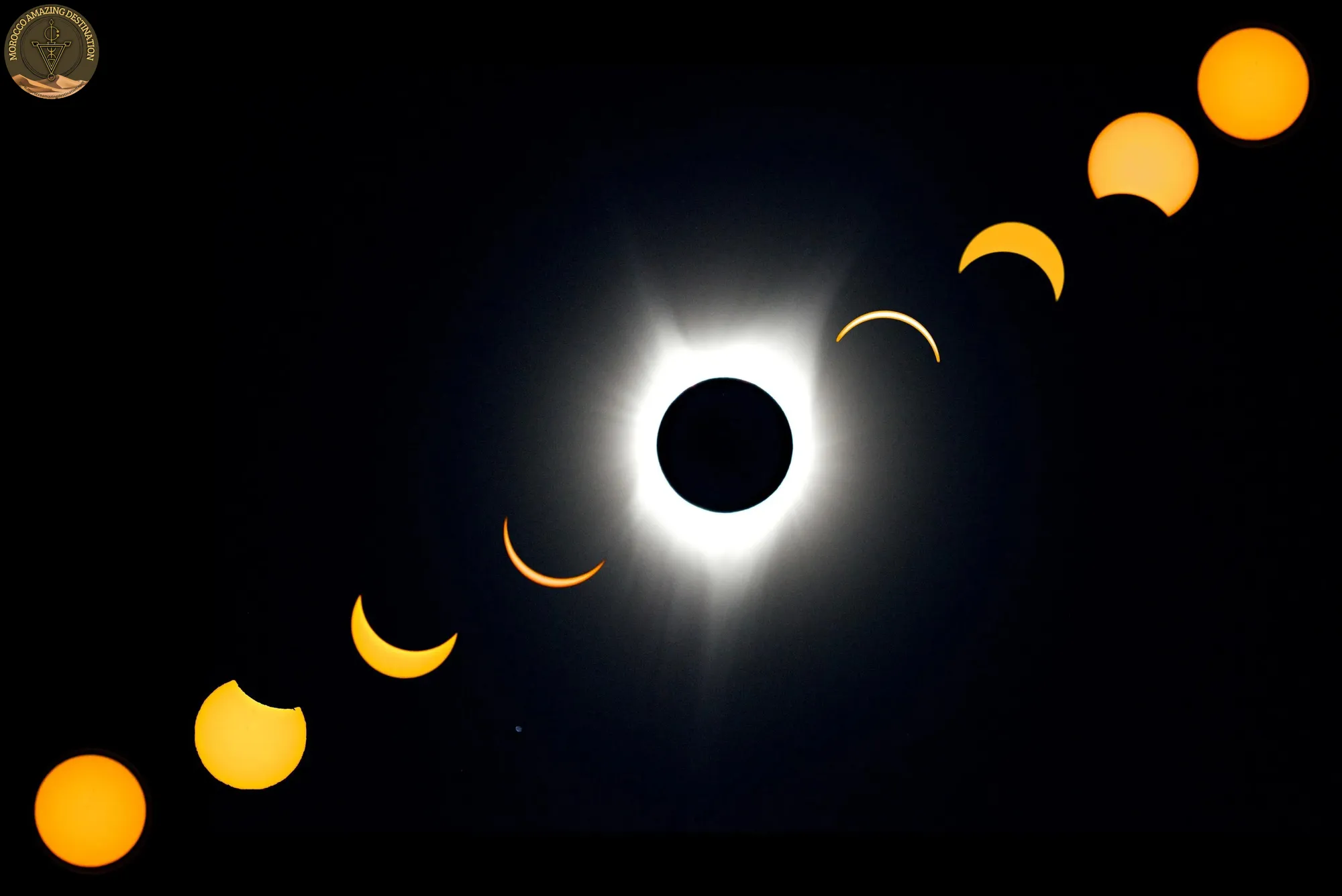
When is the next solar eclipse in Morocco? The next eclipse you can watch from Moroccan soil is a partial solar eclipse on Saturday 6 February 2027, low in the late-afternoon sky. The event most travellers are planning around, though, is the total solar eclipse of Monday 2 August 2027, when the Moon’s shadow crosses northern Morocco and turns mid-morning into near-night for almost five minutes — a rare sight that draws sky-watchers from around the world.
In this guide, we will answer the timing question directly, explain which regions fall inside the path of totality, and show how to plan a total solar eclipse Morocco trip with confidence. The two dates offer very different experiences, from a quiet partial show to a full black-Sun totality.
When Is the Next Solar Eclipse in Morocco?
Planning for a solar eclipse Morocco visitors dream about comes down to two dates. The first is a partial eclipse on 6 February 2027, when the Moon takes a bite out of the low, late-afternoon Sun nationwide. It is subtle, and easy to miss without a clear western horizon.
The second date is the headline act. On 2 August 2027, the Moon’s shadow sweeps off the Atlantic, over southern Spain and Gibraltar, and straight through northern Morocco. Only the north falls inside the path of totality; the rest of the country sees a deep partial eclipse. Between the two, the August event is far more impressive.
Two dates to remember:
- 6 February 2027: partial eclipse, low in the late-afternoon sky, visible nationwide.
- 2 August 2027: total solar eclipse across northern Morocco, mid-morning.
Plan around the local clock, not the UTC figures you may find elsewhere — if a source quotes UTC, add one hour.
Totality in Northern Morocco: Tangier, Tetouan & Chefchaouen
Morocco eclipse 2027 is a morning event, and the north is where the darkness lands. The partial phase begins around 08:40, totality runs roughly 09:45–09:50, maximum touches about 09:47 in Tangier, and the whole spectacle wraps up near 11:00 local time.
The Moon gives several northern towns nearly five minutes of daytime darkness. The Sun sits only 38–43° high, so no mountain summit is needed — just open sky to the east and overhead. Edge-of-path towns are risky, because small location errors cost you minutes of totality.
Where totality lasts longest:
- Tangier: roughly 4m51s of totality.
- Martil and Tetouan: about 4m54s and 4m53s.
- Chefchaouen: about 4m14s.
- Al Hoceima and Nador: about 4m28s and 4m16s.
Oujda sits on the southern edge of the band with about a minute — a poor choice. The previous total solar eclipse visible from Morocco crossed the far south on 2 October 1959, so this one is genuinely rare.
A Deep Partial Eclipse for Fes, Marrakech & the South
South of the totality band, Morocco still gets a dramatic show — just never a total one. Coverage stays under 100%, and that final fraction changes everything.
Deep partial coverage by city:
- Rabat: about 98.1%.
- Fes: about 97.9%.
- Casablanca: about 96.8%.
- Marrakech: about 90.2%.
At 98%, the sky still looks like a bright, hazy afternoon. The corona — the Sun’s glowing outer atmosphere — never appears, because 99% is not 100%. Many first-time watchers find this surprising. A filtered telescope will show craters and the Moon’s dark silhouette crossing the Sun, but never the corona.
If the black Sun and the corona are what you came for, you must be in the north. Otherwise, Fes, Rabat, Casablanca and Marrakech remain wonderful, comfortable places to watch a deep partial eclipse.
Eclipse Safety: Watching Without Risk
An eclipse is only enjoyable when your eyes stay safe. Certified ISO 12312-2 eclipse glasses are essential for every partial phase — before and after totality in the north, and for the entire event in the south.
Safety essentials:
- Wear certified ISO 12312-2 glasses for all partial phases.
- Use your naked eyes only during the minutes of totality in the north.
- Fit solar filters over the front lens of cameras, phones, binoculars and telescopes.
- Without glasses, use pinhole projection to view the Sun indirectly.
Never look through an unfiltered lens, a phone camera or ordinary sunglasses. Buy certified glasses weeks ahead, because supplies tighten as the date approaches. If you wear prescription glasses, place the eclipse glasses over them, not underneath.
Turn the Eclipse Into a Tangier & Chefchaouen Trip
The smartest way to see totality is to fold it into a longer northern journey. Tangier sits inside the path, and it makes a superb first stop — sea-facing, walkable and full of real Morocco character.
From Tangier you can reach Chefchaouen, the blue city in the Rif, and the imperial cities beyond. Base in the north the night before, book early for peak August season, and keep a private driver who can reposition at dawn. Early August is also the hottest week in the south, so the cooler north is the more comfortable base.
Weather is the wildcard: the Tangier–Asilah coast can sit under marine cloud, while inland Chefchaouen often stays clearer. Sleep in the band, stay mobile, and check a live forecast on the morning. Booking two nights in the region means a cloudy dawn never ruins the whole trip.
Our 5-Day Tour to Chefchaouen & Imperial Cities from Tangier and 8-Day Northern Tour to Imperial Cities and Desert from Tangier both begin inside the band. For exact durations and astronomy detail, read our complete guide to the total solar eclipse in Morocco on 2 August 2027, or explore our dedicated Morocco Eclipse 2027 tours and travel guide.
We can customize a tour to match your needs — design your perfect itinerary
If you found this helpful, add us as your preferred source on Google.
Frequently Asked Questions
When is the next solar eclipse in Morocco?
The next eclipse visible from Morocco is a partial solar eclipse on 6 February 2027, low in the late-afternoon sky. The next total solar eclipse crosses northern Morocco on 2 August 2027, around 09:45–09:50 local time.
Is Marrakech in the path of the 2027 total solar eclipse?
No. Marrakech lies south of the path of totality and sees only a deep partial eclipse of about 90.2%. The corona never appears there. To see totality you must be in northern Morocco, in the Tangier–Tetouan–Chefchaouen–Nador band.
How long does totality last in Tangier?
Totality lasts about 4 minutes 51 seconds in Tangier, and slightly longer at Martil, around 4 minutes 54 seconds. Chefchaouen gets about 4 minutes 14 seconds, with the Sun roughly 38–43° high.
Is it safe to watch the eclipse in Morocco?
Yes, if you follow the rules. Use certified ISO 12312-2 eclipse glasses for every partial phase, and remove them only during the minutes of totality. Fit solar filters to cameras, phones and binoculars, or use pinhole projection.
Ready for an Adventure?
Have questions? Feel free to contact us using the form below. We're here to help!