· Travel · 12 min read
Mhamid Desert Tour: Complete Guide to Morocco's Last Oasis & Erg Chigaga
Discover Mhamid desert tours: last oasis gateway, Erg Chigaga dunes, Berber culture and Draa Valley routes from Ouarzazate.
Mhamid Desert Tour: Complete Guide to Morocco’s Last Oasis & Erg Chigaga
Where the paved road ends and the dunes begin, a mhamid desert tour takes you deeper into the Sahara than almost any other route in Morocco. Past palm oases, ancient ksour and the long green ribbon of the Draa Valley, the small town of Mhamid El Ghizlane waits as the country’s last oasis before open desert — the true gateway to the great sand seas.
If you crave wild dunes without the crowds of Merzouga, authentic Berber encounters, and the thrill of crossing a dry lake bed on an old rally piste, the mhamid sahara is where the adventure starts. This guide covers everything you need to plan a mhamid desert experience: from mhamid dunes at Erg Lihoudi and Erg Chigaga, to mhamid excursion berber culture, the legendary mhamid foum zguid piste across Lake Iriqui, and the logistics of getting ouarzazate to mhamid through the Draa Valley.
Why Mhamid El Ghizlane Is Morocco’s Last Oasis
Mhamid El Ghizlane — often just called Mhamid — sits where the Draa River finally disappears into the sand. For centuries it was the last place where caravans could fill water skins, trade dates and prepare for the crossing to Timbuktu. Today the paved N9 national road ends here, and beyond lies only hamada, dry riverbeds and dunes.
What makes this mhamid desert gateway so special is its position:
- The last palms: A seven-kilometre oasis of date palms and tamarisks fed by underground aquifers, surrounded by pisé villages and ksour that glow rose-gold at sunset
- The last souk: The Monday weekly souk draws Sahrawi nomads, Draa farmers and traders from deep in the desert — one of the most authentic markets in the south
- The last fuel and supplies: After Zagora, Mhamid is the final place to buy fuel, water and cash before heading off-road
- The first dunes: From the edge of town you can already see the first ripples of sand that build into Erg Lihoudi and, further out, Erg Chigaga
Unlike busier desert hubs, Mhamid remains quiet and traditional. The Taragalte Festival held nearby celebrates Saharan music and nomad culture, while the old ksar, Tamegroute pottery village and the Zaouia library en route speak to centuries of trans-Saharan learning and craft.
Mhamid Dunes: Erg Lihoudi vs Erg Chigaga
Choosing your dunes defines your mhamid desert tour. The two great ergs accessible from Mhamid offer very different experiences, and many travellers experience both.
Erg Lihoudi — The Introductory Dunes
Just 7 to 8 kilometres from Mhamid, Erg Lihoudi is the smaller, closer dune field. Often called the “Dunes of the Jews” after a historic settlement, it features compact, golden dunes rising to about 100 metres.
- Access: About a one-hour camel trek or 30 minutes by 4x4 from Mhamid
- Atmosphere: Intimate and accessible — perfect for a first night, families, or travellers short on time
- Landscape: Rolling dunes mixed with tamarisk and flat hamada, with views back toward the oasis
- Camps: Standard and comfort camps, good for sunset and sunrise without a long transfer
Erg Lihoudi works beautifully as night one: you ride out in late afternoon, watch the sun sink behind the palms, and sleep to drumbeats under a dense sky.
Erg Chigaga — The Great Wild Sea
About 50 to 60 kilometres beyond Mhamid lies Erg Chigaga, Morocco’s largest and wildest dune field. Stretching roughly 40 kilometres long and 15 kilometres wide, its dunes reach around 60 to 80 metres high — lower than marketing claims of 300 metres suggest, but far more extensive and isolated than Erg Chebbi at Merzouga.
Mhamid dunes at Chigaga feel truly Saharan:
- Scale: A vast ocean of sand with almost no other tracks or camps in sight
- Access: Only by 4x4, about 2 to 2.5 hours driving from Mhamid across rocky piste and sand corridors
- Solitude: A fraction of the visitors of Merzouga. You often have whole dune corridors to yourself
- Camps: Luxury and wilderness camps with proper beds, en-suite bathrooms at the higher end, and campfires, tagines and stargazing at every level
If Erg Lihoudi is the warm-up, Erg Chigaga is the immersion. Most two-night mhamid dunes itineraries spend night one at Lihoudi and night two at Chigaga for the contrast.
Tip: If you only have one night, choose Chigaga if you want true wilderness and do not mind the longer drive, or Lihoudi if you prefer minimal transfer time and a softer introduction.
Berber Culture: What a Mhamid Excursion Berber Really Means
A mhamid excursion berber is less about sightseeing and more about hospitality. Mhamid sits at the meeting point of Amazigh (Berber), Arab and Sahrawi cultures, and the desert lifestyle here remains close to its nomadic roots.
Here is what a culturally rich Berber excursion typically includes:
- Mint tea ceremony: The famous three glasses — “bitter as life, sweet as love, gentle as death” — served in a tent or guest kasbah
- Bread in the sand: Medfouna or sand-baked bread prepared under hot ashes, shared with olive oil and honey
- Music around the fire: Gnawa rhythms from Khamlia traditions, desert blues, hand drums and call-and-response songs that continue under the stars
- Nomad family visit: Learn traditional weaving with palm fibre and wool, see how bread ovens and tents are built, and hear stories of seasonal migration with goat herds
- Oasis walks: Guided strolls through the palm grove to understand the khettara irrigation channels and date palm cultivation
- Tamegroute along the way: Many ouarzazate to mhamid routes stop at the Tamegroute pottery workshops, where green-glazed ceramics are fired in earth kilns, and at the historic Quranic library
Ethical operators share revenue with local families and camps, hire Sahrawi guides from the Mhamid community itself, and keep groups small. The experience feels personal because it is — you are a guest, not a spectator.
The Mhamid Foum Zguid Piste via Lake Iriqui
For travellers who want to cross the Sahara rather than just sleep in it, the mhamid foum zguid piste is legendary. This 90 to 100 kilometre off-road track connects Mhamid to Foum Zguid via the great dry bed of Lake Iriqi, inside the Parc National d’Iriqui.
Key facts about the piste:
- Distance and time: About 90 to 100 kilometres, 5 to 6 hours by 4x4 with a driver-guide. No paved road, no fuel stops, no phone signal for long stretches
- Terrain: Fossil-strewn hamada, black volcanic Jebel Bani ridges, soft sand corridors, and the vast white pan of Lake Iriqui itself
- Lake Iriqui: A seasonal salt lake, dry most of the year and blindingly white under the sun. After rare heavy rains it fills shallowly, attracting flamingos and waders, but then the clay pan becomes a mud trap — the piste can be impassable for days. Always check with local guides after rain
- History: Part of the old Paris-Dakar rally route. You still see faint tyre tracks cutting dead straight across the lake bed
- Requirements: High-clearance 4x4, experienced driver-guide, extra fuel and water, and preferably travelling in convoy. Not suitable for rental cars or self-driving without desert experience
This track is why many travellers choose Mhamid over Merzouga: it lets you link the Draa Valley to the Anti-Atlas and Souss region without backtracking to Ouarzazate, entering the desert at Mhamid and exiting near Foum Zguid toward Tata or Taliouine.
Getting There: Ouarzazate to Mhamid Through the Draa Valley
The classic approach for a mhamid desert tour is ouarzazate to mhamid along the N9, following the Draa River south — one of Morocco’s most beautiful road trips.
The Route in Stages
The total distance is about 259 to 260 kilometres, typically 5 to 6 hours of driving plus stops:
- Ouarzazate to Agdz (about 70 km): Cross the Anti-Atlas via the Tizi n’Tinififft pass, then descend into the upper Draa with its first palm corridors and the Tamnougalt Kasbah near Agdz
- Agdz to Zagora (about 95 km): The heart of the Draa — a near-continuous oasis of more than a million palms, fortified ksour, and the landmark Tinfou dunes just before Zagora. Zagora is the last larger town for fuel, banks and pharmacies
- Zagora to Tagounite to Mhamid (about 90 to 100 km): The palms thin, the hamada opens, and the road narrows to Mhamid El Ghizlane. Scenic stops include Tamegroute with its pottery and library, and desert viewpoints where the sand finally takes over
The N9 is fully paved to Mhamid and suitable for standard cars, minibuses and private transfers. Beyond Mhamid, only pistes continue — that is where 4x4 takes over.
Transport Options
- Private car with driver-guide: The most comfortable option. You can stop for Tamegroute, Tinfou dunes and ksar visits, and your driver continues into the dunes by 4x4
- Shared transfer to Zagora then local driver: Budget travellers can take a bus or shared taxi to Zagora, then arrange a local 4x4 and camp from Mhamid
- Self-drive rental: Possible to Mhamid on the paved road, but not into Erg Chigaga or across the Foum Zguid piste without a guide and proper vehicle
- From Marrakech: Most travellers combine ouarzazate to mhamid with a Marrakech to Ouarzazate crossing over the High Atlas via Ait Ben Haddou, making the Draa journey part of a longer southern itinerary
Practical note: Fill fuel and withdraw cash in Ouarzazate or Zagora. Carry water, sunscreen, a scarf for wind and sand, layers for cold nights, and a power bank — camps have limited electricity.
What You Actually Do on a Mhamid Desert Tour
A well-planned mhamid desert tour balances soft adventure with downtime. Here is what days in the mhamid sahara typically include:
Camel Trek at Sunset and Sunrise
The classic ritual. Late afternoon you leave Mhamid or your camp by dromedary — often about 45 to 60 minutes at a gentle pace — to reach a high dune crest for sunset. Dawn the next day offers the reverse, with light spilling across the sand from pink to gold.
4x4 Safari Across Hamada and Dunes
To reach Erg Chigaga and the Lake Iriqui piste you need a 4x4. Drivers navigate by landmarks and GPS, climbing dune corridors, crossing the lake bed and stopping for fossils, desert roses and panoramic viewpoints.
Desert Camps — From Standard to Luxury
Nights are spent in tented camps:
- Standard camps: Comfortable beds with blankets, shared or private bathrooms, communal dining tent, tagine dinner and breakfast
- Luxury camps: En-suite bathrooms with showers, proper beds, rugs and lighting, chef-prepared meals, and sometimes heated tents for cold nights
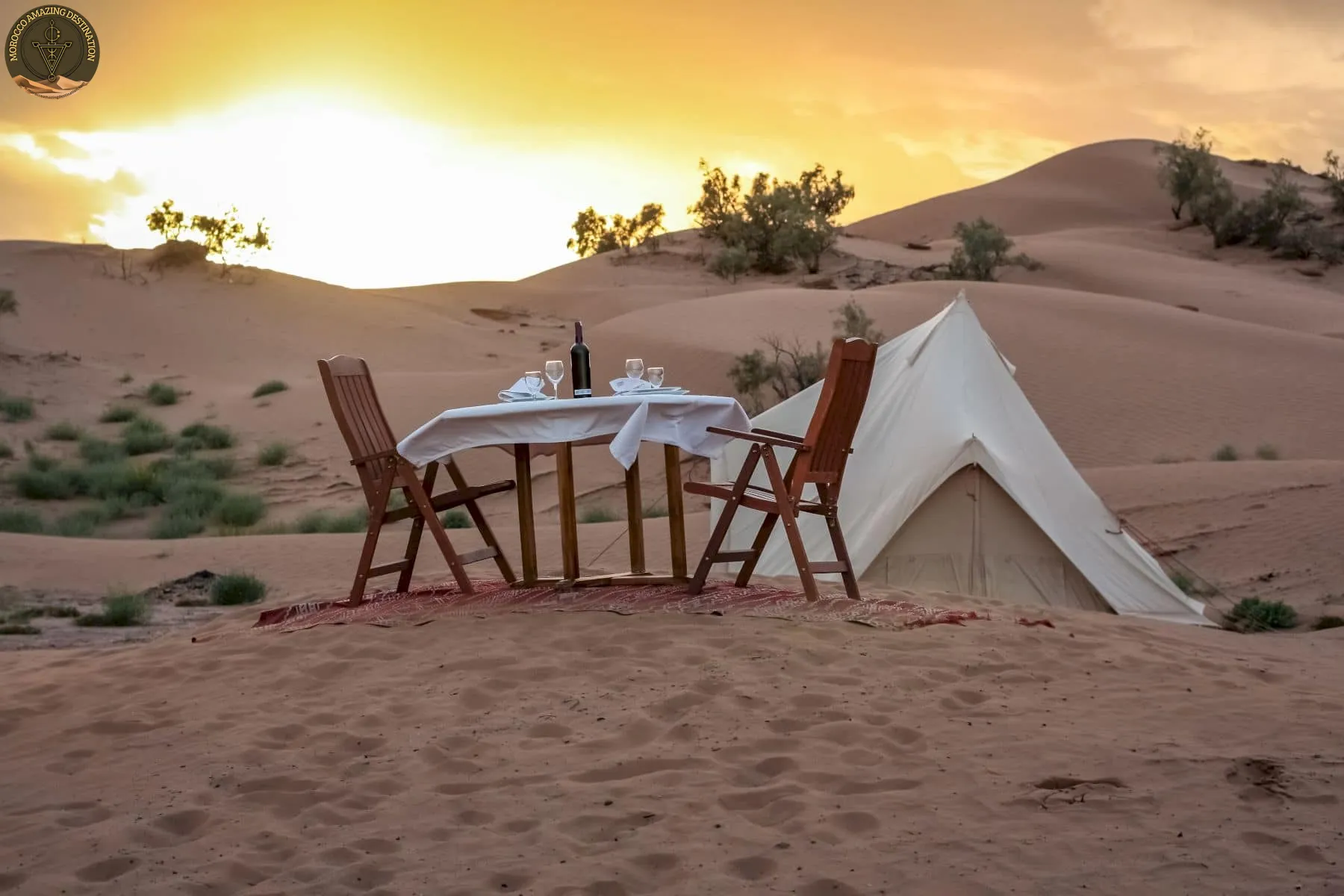
- Shared experience: At every level you get mint tea on arrival, dinner around the fire, drumming and storytelling
Sandboarding, Walks and Stargazing
- Sandboarding: Glide down dune faces on boards — easy, fun, and best in late afternoon when the sand is cooler
- Oasis and hamada walks: Guided walks through the Mhamid palm grove or across fossil beds to stretch legs between drives
- Stargazing: With almost no light pollution, the mhamid sahara offers exceptional dark skies. The Milky Way is visible to the naked eye, and constellations feel close enough to touch
When to Go and How to Prepare
The desert climate shapes your experience:
- Mild seasons: The most pleasant conditions for both days and nights tend to fall when days are warm and nights cool but not freezing. Mountain passes and desert pistes are generally most comfortable outside peak heat and cold
- Summer heat: Daytime temperatures can exceed 45°C, while winter nights can drop near freezing around 0°C. Pack layers whatever the season, as the swing from afternoon to early morning can exceed 20°C
- Wind and sand: Wind is more common in certain seasons and can reduce visibility. A scarf or shemagh helps
- After rain: The Lake Iriqui pan and some pistes can become impassable. Local guides will advise
Pack light layers for the day, a warm jacket for evenings, closed shoes for camel treks, sunscreen and sunglasses, a headlamp for camp, and cash in dirhams for lunches and handicrafts.
FAQ
What is the difference between Erg Lihoudi and Erg Chigaga near Mhamid?
Erg Lihoudi is a small dune field about 7 to 8 kilometres from Mhamid, with dunes around 100 metres high and reachable by camel in about one hour — ideal for a first night. Erg Chigaga is a vast dune sea about 50 to 60 kilometres out, stretching roughly 40 by 15 kilometres with dunes around 60 to 80 metres high. It is remote, wild and requires a 4x4, offering far more solitude than Merzouga.
How do you get from Ouarzazate to Mhamid?
The route from Ouarzazate to Mhamid follows the N9 for about 260 kilometres through the Draa Valley via Agdz, Zagora and Tagounite. The drive takes around 5 to 6 hours with stops, split into Ouarzazate to Zagora (about 165 kilometres, 2.5 to 3 hours) and Zagora to Mhamid (about 90 to 100 kilometres, 1.5 to 2 hours). The road is paved to Mhamid; beyond that only piste tracks continue.
Can you travel the Mhamid Foum Zguid piste via Lake Iriqui?
Yes, the piste connecting Mhamid and Foum Zguid crosses the dry bed of Lake Iriqui inside the Iriqui National Park. It is about 90 to 100 kilometres of off-road track, taking 5 to 6 hours by 4x4 with a guide. You cross fossil beds, the Jebel Bani range and old Paris-Dakar tracks. The lake is dry most of the year but can flood after rain, when the piste becomes impassable mud.
What should I expect from a Berber excursion in the Mhamid desert?
A Berber excursion centres on Amazigh and Sahrawi hospitality — mint tea, bread baked in the sand, Gnawa music, drumming around the fire, and visits to nomad families who share weaving, cooking and desert skills. You travel by camel or 4x4, sleep in standard or luxury desert camps, and enjoy sandboarding, oasis walks and exceptional stargazing under dark Sahara skies.
Related Tours
To experience Mhamid as part of a longer journey, the 4-Day Morocco Desert Tour from Ouarzazate follows the Draa Valley from Ouarzazate to the dunes with cultural highlights including Todra Gorges, Tamegroute and a night in a desert camp — the ideal base to adapt toward Mhamid and Erg Chigaga with a local driver.
For a broader country itinerary that links the Draa Valley to the High Atlas and imperial cities, the 10-Day Morocco Tour from Marrakech crosses the Draa Valley, explores the Sahara dunes over several nights, and continues to Ouarzazate, Ouzoud and Marrakech — easily tailored to include a Mhamid extension via the Lake Iriqui piste.
We can customize a tour to match your needs — design your perfect itinerary
If you found this helpful, add us as your preferred source on Google.
Frequently Asked Questions
What is the difference between Erg Lihoudi and Erg Chigaga near Mhamid?
Erg Lihoudi is a small dune field about 7 to 8 kilometres from Mhamid, with dunes around 100 metres high and reachable by camel in about one hour — ideal for a first night. Erg Chigaga is a vast dune sea about 50 to 60 kilometres out, stretching roughly 40 by 15 kilometres with dunes around 60 to 80 metres high. It is remote, wild and requires a 4x4, offering far more solitude than Merzouga.
How do you get from Ouarzazate to Mhamid?
The route from Ouarzazate to Mhamid follows the N9 for about 260 kilometres through the Draa Valley via Agdz, Zagora and Tagounite. The drive takes around 5 to 6 hours with stops, split into Ouarzazate to Zagora (about 165 kilometres, 2.5 to 3 hours) and Zagora to Mhamid (about 90 to 100 kilometres, 1.5 to 2 hours). The road is paved to Mhamid; beyond that only piste tracks continue.
Can you travel the Mhamid Foum Zguid piste via Lake Iriqui?
Yes, the piste connecting Mhamid and Foum Zguid crosses the dry bed of Lake Iriqui inside the Iriqui National Park. It is about 90 to 100 kilometres of off-road track, taking 5 to 6 hours by 4x4 with a guide. You cross fossil beds, the Jebel Bani range and old Paris-Dakar tracks. The lake is dry most of the year but can flood after rain, when the piste becomes impassable mud.
What should I expect from a Berber excursion in the Mhamid desert?
A Berber excursion centres on Amazigh and Sahrawi hospitality — mint tea, bread baked in the sand, Gnawa music, drumming around the fire, and visits to nomad families who share weaving, cooking and desert skills. You travel by camel or 4x4, sleep in standard or luxury desert camps, and enjoy sandboarding, oasis walks and exceptional stargazing under dark Sahara skies.
Ready for an Adventure?
Have questions? Feel free to contact us using the form below. We're here to help!