
· Travel · 7 min read
Waterfall Marrakech: The Complete Guide to Waterfalls Near Marrakech & the Atlas Mountains
Waterfall Marrakech guide: the best waterfalls near Marrakech — Setti Fatma, Imlil and Ouzoud — how to visit, when to go and costs.
Waterfall Marrakech: The Complete Guide to Waterfalls Near Marrakech & the Atlas Mountains
Marrakech dazzles with souks, palaces and rooftop views, but some of its most unforgettable scenery lies beyond the city walls — where rivers tumble off the High Atlas in ribbons of white water. A waterfall marrakech day trip is the classic escape from the heat: cool mountain air, Berber villages and cascades you hear long before you see them.
The best part? The mountains start barely an hour from the medina. This guide covers the best waterfalls near marrakech — which to choose, how to get there, what it costs, and when to go — so you can plan a waterfall outing with total confidence.
The Best Waterfalls Near Marrakech: How to Choose
The Atlas Mountains south of the city hold three headline cascades, each with a different personality. Comparing atlas mountains waterfalls marrakech options comes down to three questions: how long you have, how far you want to walk, and how busy you can handle.
- Setti Fatma (Ourika Valley) — closest and most popular; seven cascades above a lively village; 60–65 km, 1–1.5 h drive.
- Cascades d’Imlil — the hiker’s choice; a 30–45 minute walk from the Toubkal gateway village; 65 km, 1.5–2 h via Asni.
- Ouzoud — the showstopper; North Africa’s tallest falls at about 110 m; 150 km, 2.5–3 h, best as a full day.
For most first-timers, the classic waterfall trip marrakech experience is Setti Fatma — close, easy and packed with local colour. Hikers should head for Imlil, and anyone chasing pure spectacle should make time for Ouzoud.
Setti Fatma and the Seven Waterfalls of the Ourika Valley
Setti Fatma is the last village at the head of the Ourika Valley, about 60–65 km southeast of Marrakech — a drive of one to one and a half hours through orchards and terraced fields. Wikivoyage describes it as the most popular day-trip destination in the High Atlas, and for many travellers this is the waterfall marrakech morocco outing they remember longest.
Above the village, a chain of seven cascades climbs the valley:
- The first fall — an easy 20–45 minute walk from the village along the river, lined with cafés. Perfect for families.
- The upper falls — steeper, with some scrambling; a 2–3 hour round trip that rewards you with quieter pools and bigger drops.
Local guides charge roughly 100–200 MAD to walk you to the upper falls — worth it for safety and route-finding. The falls themselves are free; parking costs about 10–20 MAD. Add a riverside tagine, a Monday visit to the Tnine de l’Ourika souk, or a stop at an argan-oil cooperative and you have a full day out. Anima Garden, a sculpture garden near the valley entrance, makes a popular add-on.
Imlil Waterfalls: Cascades d’Imlil and the Toubkal Trailhead
Imlil sits at about 1,740 m at the end of the tarmac road, the famous gateway village for Mount Toubkal. Above it, the imlil waterfall known as Cascades d’Imlil drops roughly 30 m into the Mizane valley — a 30–45 minute walk through walnut groves, orchards and the hamlet of Achayne. AllTrails rates the short out-and-back route as moderate, so sturdy shoes are a must.
Hikers who linger find more imlil waterfalls scattered through the upper valleys: the shrine of Sidi Chamharouch (2,310 m) has its own cascade on the Toubkal route, and the Cascades d’Irhoulidene — over 20 m, described by Lonely Planet as one of the region’s finest walks — make a full-day hike from Imlil. Aroumd village and the celebrated Kasbah du Toubkal lie just below, ideal for a post-walk mint tea.
For the atlas mountains marrakech waterfall experience that combines walking with mountain culture, Imlil is hard to beat. Note that a licensed guide is effectively mandatory inside the Toubkal massif, at roughly 400–700 MAD per day.
Ouzoud: The Tallest Waterfalls in North Africa
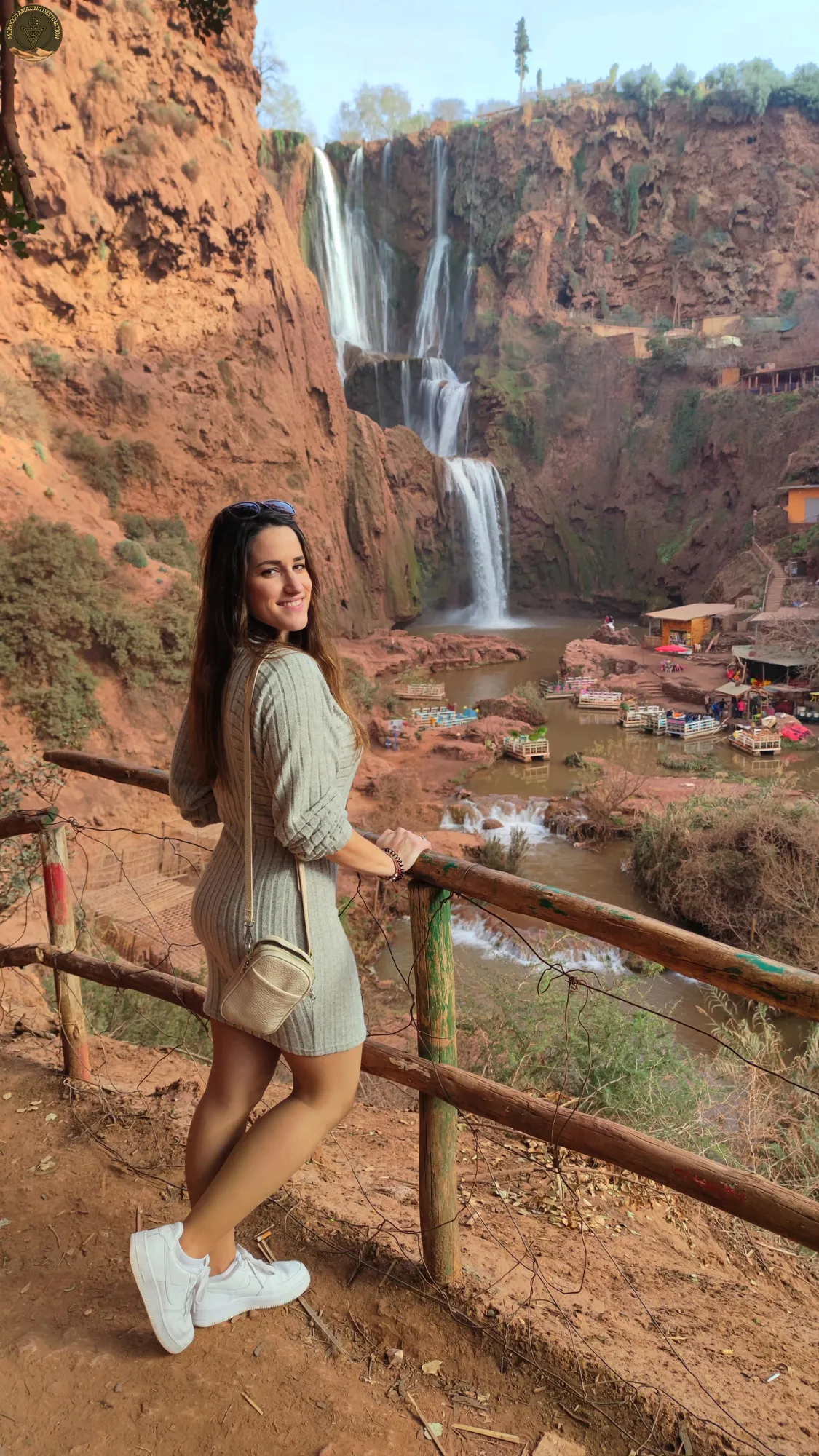
About 150 km northeast of Marrakech, the atlas mountains morocco waterfalls reach their grand finale. Ouzoud plunges about 110 m in three tiers into the gorge of the El-Abid River — by most accounts the tallest waterfall in North Africa, per Wikipedia. Barbary macaques patrol the cliffs, boatmen ferry visitors into the spray, and rainbows form in the afternoon sun.
It’s a longer day — 2.5 to 3 hours each way — but the falls alone are worth it. Our dedicated Ouzoud Waterfalls day trip guide covers the practical details.
Other Waterfalls Worth Knowing
- Cascades d’Irhoulidene — a 20 m-plus cascade reached on a full-day hike from Imlil; one of Lonely Planet’s favourite Atlas walks.
- Sidi Chamharouch — a small waterfall and pilgrimage shrine at 2,310 m on the Toubkal route.
- Akchour — stunning falls in the Rif Mountains near Chefchaouen, but too far for a Marrakech day trip; save them for a northern itinerary.
How to Get to the Waterfalls from Marrakech
- Organized tour — the easiest option. A marrakech waterfall tour bundles hotel pickup, private transport, a licensed guide and lunch. Shared tours run about 250–500 MAD; private tours about 600–1,200 MAD.
- Grand taxi — shared taxis to Setti Fatma cost about 25–50 MAD per person; return rides get scarce after about 4 pm, so leave early or arrange a driver.
- Private driver — roughly 400–600 MAD for the day; the flexibility of a tour without the fixed itinerary.
- Self-drive — fine for Ourika and Imlil; expect winding mountain roads and limited parking at busy times.
When to Visit the Waterfalls
- Spring (March–May) — the classic season: snowmelt swells every cascade and the valley sides turn green.
- Summer — hot in Marrakech but the valleys run 10–15 °C cooler; busy on weekends.
- Autumn — warm, quieter and still good flow.
- Winter — snow dusts the peaks above about 1,500 m and falls stay active; roads can be icy.
Safety and Packing Essentials
- Flash floods are real — the Ourika Valley has seen deadly floods, and warning sirens now sound before water surges down the wadi. If you hear them, move to high ground immediately and never cross a swollen river.
- Footwear — sturdy shoes or trail runners for the easy falls; proper boots for the upper cascades and Imlil.
- Water and sun protection — at least 1.5 litres per person, a hat and sunscreen.
- Cash — take dirhams; there are no ATMs at the falls.
- Dress modestly in villages, and use only official licensed guides.
Waterfall Adventures in a Longer Morocco Trip
If one day of waterfalls isn’t enough, both of our signature private tours build them into a bigger journey. Our 10 Days in Morocco: The Ultimate Private Tour from Marrakech to the Sahara spends a night beside the Ouzoud falls before crossing the High Atlas to the desert, while the 3-Day Trip from Marrakech to Merzouga climbs over the Tizi n’Tichka pass — the same range that feeds the cascades — en route to the dunes.
For day-trip depth, our dedicated guides cover the details: the Ourika Valley & Setti Fatma day tour from Marrakech, the Ouzoud Waterfalls day trip, and the Atlas Mountains day trip from Marrakech.
Frequently Asked Questions
How far are the waterfalls from Marrakech? The closest waterfalls — Setti Fatma in the Ourika Valley — sit about 60–65 km southeast of Marrakech, roughly one to one and a half hours by road. The Cascades d’Imlil are a similar distance (about 65 km, 1.5–2 hours via Asni), while Ouzoud is further at about 150 km and 2.5–3 hours.
Which waterfall near Marrakech is best for families? Setti Fatma is the family favourite: the first of its seven cascades is an easy 20–45 minute walk from the village, with cafés and riverside restaurants along the way. The upper falls are steeper and need scrambling, so keep small children to the lower sections.
Do I need a guide to visit the waterfalls near Marrakech? For the easy lower falls at Setti Fatma a guide is optional, though local guides (about 100–200 MAD) know the best pools and safe routes. In the Toubkal massif around Imlil, a licensed guide is effectively mandatory — expect roughly 400–700 MAD per day.
When do the waterfalls run at their most powerful? Spring (March–May) is the peak season: melting snow swells every cascade in the High Atlas, and the valley sides turn green. Autumn is also good; summer is cooler in the valleys than in Marrakech but busy at weekends; and winter brings snow above about 1,500 m.
We can customize a tour to match your needs — design your perfect itinerary
If you found this helpful, add us as your preferred source on Google.
Frequently Asked Questions
How far are the waterfalls from Marrakech?
The closest waterfalls — Setti Fatma in the Ourika Valley — sit about 60–65 km southeast of Marrakech, roughly one to one and a half hours by road. The Cascades d'Imlil are a similar distance (about 65 km, 1.5–2 hours via Asni), while Ouzoud is further at about 150 km and 2.5–3 hours.
Which waterfall near Marrakech is best for families?
Setti Fatma is the family favourite: the first of its seven cascades is an easy 20–45 minute walk from the village, with cafés and riverside restaurants along the way. The upper falls are steeper and need scrambling, so keep small children to the lower sections.
Do I need a guide to visit the waterfalls near Marrakech?
For the easy lower falls at Setti Fatma a guide is optional, though local guides (about 100–200 MAD) know the best pools and safe routes. In the Toubkal massif around Imlil, a licensed guide is effectively mandatory — expect roughly 400–700 MAD per day.
When do the waterfalls run at their most powerful?
Spring (March–May) is the peak season: melting snow swells every cascade in the High Atlas, and the valley sides turn green. Autumn is also good; summer is cooler in the valleys than in Marrakech but busy at weekends; and winter brings snow above about 1,500 m.
Ready for an Adventure?
Have questions? Feel free to contact us using the form below. We're here to help!