· Travel · 8 min read
Is Morocco an Arab or Amazigh Country? Unpacking Morocco's Ethnic Identity
Is Morocco Arab or Amazigh? Uncover Morocco's fascinating dual ethnic identity, from its indigenous Amazigh roots to centuries of Arab influence. A complete guide.
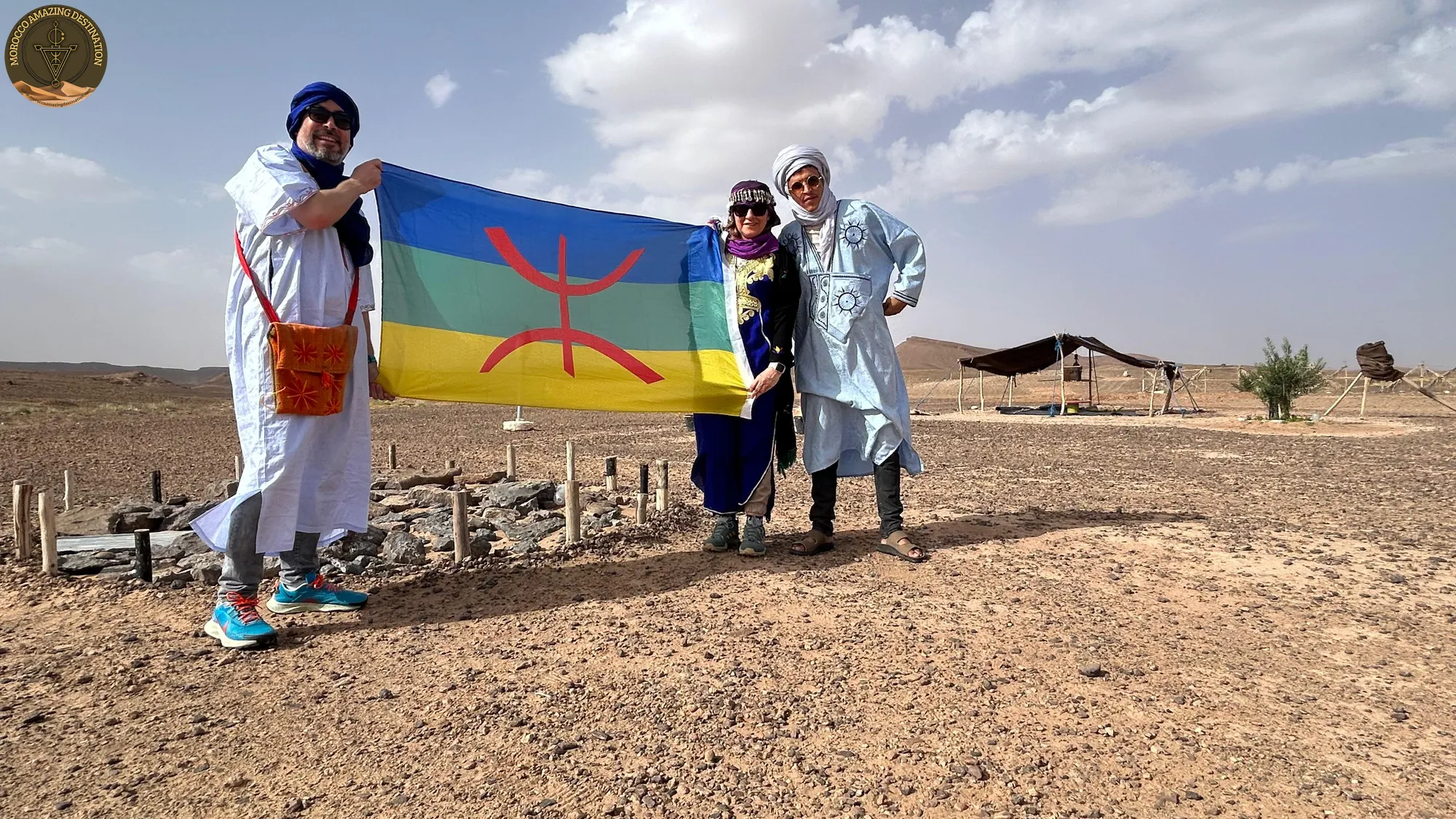
If you have ever traveled through Morocco, you have probably noticed something intriguing. In the bustling souks of Marrakech, you hear the cadence of Darija, the local Arabic dialect. But venture into the High Atlas Mountains, and the language shifts — you will hear Tamazight, the voice of the Amazigh people. This duality raises a question many travelers ask: is Morocco an Arab or Amazigh country?
The answer is neither simple nor singular. Morocco is both Arab and Amazigh, and understanding how these two identities intertwine is key to truly grasping Moroccan culture. In this guide, we unpack Morocco’s ethnic identity, tracing its indigenous Amazigh roots, the centuries of Arab influence, and what this means for your travels.
Who Are the Amazigh? Morocco’s Indigenous People
Long before Arab armies reached North Africa in the 7th century, the Amazigh — often called Berbers — inhabited the region. Their presence stretches back more than 4,000 years, making them the indigenous people of Morocco and one of the oldest continuous cultures in North Africa.
The Amazigh are not a single monolithic group. They comprise several distinct communities, each with its own dialect:
- Tachelhit (Shilha): Spoken in the High Atlas, Anti-Atlas, and Souss regions
- Tamazight (Central Atlas): Spoken in the Middle Atlas
- Tarifit (Riffian): Spoken in the Rif Mountains of northern Morocco
Their ancient writing system, Tifinagh, predates the Arabic script in Morocco by millennia. Today you can see Tifinagh characters carved into desert rocks, woven into carpets, and increasingly displayed on official road signs and government buildings — a powerful symbol of a cultural revival underway.
Estimates vary, but most scholars agree that between 40 and 60 percent of Moroccans have identifiable Amazigh ancestry. Countless more carry mixed Arab-Amazigh heritage, which blurs the lines between these two identities.
The Arab Influence: Islam, Language, and Empire
When Arab armies brought Islam to Morocco in the late 7th century, they set in motion a transformation that would reshape the region permanently. The Arabic language spread through religion, trade, and governance, becoming the lingua franca of administration and scholarship.
Several key developments cemented the Arab cultural footprint:
- The Idrisid dynasty (789–974) founded the city of Fes and established Morocco’s first Islamic state
- Arabic became the language of the Quran, education, and legal affairs — giving it immense prestige
- Amazigh dynasties like the Almoravids and Almohads, while ethnically Amazigh at their core, adopted Arabic as the language of their courts and built an Islamic empire that stretched from Senegal to Spain
- Arab tribes such as the Banu Hilal and Banu Maqil migrated to Morocco in the 11th and 12th centuries, further Arabizing the plains and urban centers
Urban life, formal education, and religious scholarship became increasingly associated with the Arabic language. Amazigh-speaking communities progressively retreated to the mountains, the desert fringe, and the most remote rural areas — where their language and traditions survived intact.
Yet the Arab influence never fully displaced the Amazigh presence. The two cultures intertwined deeply. Moroccan Arabic (Darija) is peppered with Amazigh vocabulary. Moroccan cuisine blends culinary traditions from both worlds. The country’s most celebrated music incorporates rhythms and instruments from Amazigh, Arab, and sub-Saharan African sources.
Amazigh vs Arab: A False Dichotomy
Framing Morocco as either Arab or Amazigh misses the point entirely. The reality is that most Moroccans see themselves as both — or, more precisely, see the question as irrelevant. A person might speak Darija at the market, Tamazight at home, and French at work — code-switching between identities as fluidly as they switch between languages.
This dual identity manifests visibly across daily life:
- Architecture: The medinas of Fes and Marrakech blend Amazigh geometric patterns with Arabesque flourishes and Andalusian influences from Muslim Spain
- Clothing: The djellaba, worn by men and women nationwide, has Amazigh origins but is considered a universal Moroccan garment today
- Cuisine: The iconic tagine and couscous trace back to Amazigh cooking traditions, while the use of spices like saffron, cinnamon, and dried fruits reflects Arab and Andalusian layers
- Music: Ahidous and Ahwash are traditional Amazigh circle dances performed at weddings and harvests, while Gnawa music blends sub-Saharan rhythms with Arab spiritual chants
- The mint tea ceremony: Often portrayed as an emblem of Arab hospitality, its deepest roots are Amazigh — a perfect metaphor for a culture where tracing origins becomes almost impossible
The question is not whether Morocco is Arab or Amazigh. It is how these two identities have shaped and enriched each other across 14 centuries of coexistence.
What the Constitution Says: Legal Recognition
For much of the 20th century, Morocco’s official identity was framed primarily around Islam and Arabism. The Amazigh language and culture were marginalized in education, media, and public life — treated more as folklore than as a living national heritage.
This changed dramatically in 2011, when Morocco adopted a new constitution that recognized Tamazight as an official language alongside Arabic. The preamble also acknowledged the Amazigh dimension as a fundamental pillar of Moroccan national identity — a historic milestone for indigenous recognition in North Africa.
Since then, the Moroccan government has:
- Integrated Tamazight into the national school curriculum
- Launched Tamazight TV, a public television channel broadcasting entirely in Amazigh dialects
- Made Yennayer, the Amazigh New Year celebrated around January 13, an official public holiday in 2023
- Required government buildings and road signs to display Tifinagh script alongside Arabic and French
This constitutional recognition does not diminish Morocco’s Arab identity. Rather, it acknowledges what Moroccans have always known: their country is a tapestry woven from multiple threads, each indispensable to the whole.
Everyday Morocco: Where the Two Identities Meet
Travelers who pay attention will notice the interplay of Amazigh and Arab culture everywhere they go.
In the cities Cities like Marrakech, Fes, and Rabat — the imperial capitals founded by Arab-led dynasties — showcase grand Islamic architecture. Minarets pierce the sky, Quranic verses adorn fountains, and the call to prayer provides a daily rhythm. Yet even here, the Amazigh presence endures unmistakably. The intricate zellige tilework that decorates mosques and riads follows geometric principles rooted in Amazigh craftsmanship. Inside the medinas, artisans practice trades whose lineages stretch back to pre-Islamic times.
In the mountains and desert The High Atlas, Anti-Atlas, and Rif Mountains — along with the Sahara’s edge — remain strongholds of Amazigh culture. Here, village life follows ancient seasonal rhythms, and Tamazight is the language of the street and the home. A warm “azul” (hello) or “tanmirt” (thank you) will earn you genuine smiles and perhaps an invitation for mint tea. In these regions, the Amazigh identity is not a historical footnote — it is daily reality.
The mint tea connection Speaking of tea: the elaborate Moroccan mint tea ceremony, with its theatrical high pour and the three glasses tradition demands, is often presented to visitors as a quintessentially Arab ritual. In truth, its origins lie in Amazigh hospitality customs, later elevated by Arab tea traders who introduced gunpowder green tea from China. It is a perfect symbol of Morocco itself — a beautiful blend where claiming singular ownership misses the magic entirely.
What This Means for Travelers
Understanding that Morocco is not simply Arab nor solely Amazigh transforms a trip from sightseeing into genuine connection.
- Learn a few words in Tamazight. A simple azul (hello) will surprise and delight people in mountain and desert regions. It signals that you see beyond the surface narrative.
- Visit Amazigh villages. Many families in the Atlas Mountains welcome visitors for meals and cultural exchange. It is one of the most authentic experiences you can have in Morocco — sitting on handmade rugs, breaking bread, and hearing stories that have been told for millennia.
- Buy crafts directly from cooperatives. Women’s argan oil cooperatives near Essaouira and Agadir, weaving workshops in the Middle Atlas, and silver jewelry artisans in the Souss Valley all keep Amazigh traditions alive while supporting local economies.
- Attend a local festival. If your travel dates align with the Imilchil Marriage Festival (usually in September) or Yennayer (Amazigh New Year in mid-January), you will witness living Amazigh culture at its most vibrant and unscripted.
- Ask your guide about their heritage. Most Moroccan guides are deeply proud of their background. Ask whether they identify as Amazigh, Arab, or both — the answer often opens a door to a conversation far richer than any guidebook.
Morocco’s ethnic identity is not a puzzle to be solved but a story to be heard. The more layers you peel back, the richer your experience becomes.
Conclusion: A Country of Layers
So, is Morocco an Arab or Amazigh country? The answer is both — and neither, in the sense that the question itself imposes a Western-style binary onto a culture that has never operated in those terms.
Morocco is a country where indigenous Amazigh traditions have absorbed Arab, African, Andalusian, and European influences over millennia without losing their essential character. It is a place where the call to prayer echoes through Amazigh mountain villages, where Berber carpets bear Tifinagh symbols alongside Quranic motifs, and where a single conversation can flow seamlessly between Darija, Tamazight, and French.
The beauty of Morocco lies precisely in this layered complexity. By understanding it, you do not just visit Morocco — you begin to feel it.
Explore Morocco’s Dual Identity With Our Cultural Tours
The most meaningful way to understand Morocco’s blend of Amazigh and Arab heritage is to experience it firsthand — walking through imperial medinas, sharing tea in mountain villages, and watching the sun set over dunes that have witnessed millennia of human history.
Discover our 15-Day Grand Cultural Tour from Tangier, a comprehensive journey through Morocco’s Amazigh heartlands, all four imperial cities, and the vast Sahara Desert. For a shorter yet equally immersive experience, our 7-Day Imperial Cities and Desert Tour takes you through the cultural crossroads where Arab and Amazigh identities meet — from Casablanca through Fes, the Atlas Mountains, and the desert.
If you found this helpful, add us as your preferred source on Google.
Frequently Asked Questions
Is Morocco an Arab or Amazigh country?
Morocco is both. The country has indigenous Amazigh roots stretching back over 4,000 years, deeply influenced by Arab-Islamic civilization since the 7th century. Most Moroccans have mixed Arab and Amazigh heritage, and the 2011 constitution recognizes both Arabic and Tamazight as official languages — affirming Morocco's dual identity.
What percentage of Morocco is Amazigh?
Estimates range from 40 to 60 percent of the population identifying as Amazigh, though precise figures are debated. Many more Moroccans have partial Amazigh ancestry through centuries of intermarriage between Arab and Amazigh communities. The highest concentrations are in the Rif Mountains, Middle Atlas, High Atlas, and Souss Valley.
Is Tamazight an official language in Morocco?
Yes. Since the 2011 constitutional reform, Tamazight (the Amazigh language) has been recognized as an official language of Morocco alongside Arabic. It has since been integrated into the national school curriculum, public television, and official government signage — a historic step for Morocco's indigenous heritage.
What is the difference between Amazigh and Berber?
They refer to the same indigenous people of North Africa. The term 'Berber' comes from the Latin 'barbarus' (foreigner), an outsider label applied by the Romans. 'Amazigh' — meaning 'free people' or 'noble people' in the Tamazight language — is the name the community uses for itself and is increasingly preferred both inside and outside Morocco.
- amazigh-culture
- berber-culture
- morocco-culture
- morocco-history
- morocco-identity
- arab-identity
- morocco-traditions
Ready for an Adventure?
Have questions? Feel free to contact us using the form below. We're here to help!