· Travel · 9 min read
How Many Mosques Are There in Morocco? A Complete Guide
Discover how many mosques are in Morocco, from the record-breaking Hassan II Mosque to the ancient Al-Qarawiyyin. A complete guide to Moroccan mosques and Islamic architecture.
Morocco is a country where the call to prayer echoes from every neighbourhood, and the silhouette of a minaret is never far from sight. Whenever you travel through Morocco, you will notice how many mosques in Morocco punctuate the landscape — from humble local prayer rooms to towering architectural masterpieces. But just how many mosques are there in Morocco, and what makes them so central to Moroccan life? In this guide, we answer that question and take you on a journey through the country’s most remarkable mosques, their history, architecture, and the role they play in daily Moroccan culture.
How Many Mosques Are There in Morocco?
According to the Ministry of Habous and Islamic Affairs, Morocco is home to approximately 41,755 mosques. Of these, around 16,489 are Friday mosques — known in Arabic as jamaa (جامع) — which hold the weekly congregational prayer and sermon. The remaining roughly 25,000 are neighbourhood masjids (مسجد) used for the five daily prayers.
To put this into perspective, with a population of around 37 million, Morocco has roughly one mosque for every 900 inhabitants. This is one of the highest densities of mosques anywhere in the world and reflects the deep integration of Islam into Moroccan daily life.
Masjid vs. Jamaa: What Is the Difference?
- Masjid: A neighbourhood mosque used for the five daily prayers. Smaller in scale, it serves the local community and may not have a permanent imam.
- Jamaa: A Friday or congregational mosque. Larger in size, it features a minbar (pulpit) from which the imam delivers the Friday khutbah (sermon). These mosques are often architectural landmarks and serve as anchors for the surrounding district.
Why Are There So Many Mosques in Morocco?
Several factors explain the abundance of mosques across the country:
- Islam is the state religion: More than 99% of Moroccans are Muslim, predominantly following the Maliki school of Sunni Islam. The King of Morocco holds the title Amir al-Mu’minin (Commander of the Faithful), underscoring the monarchy’s religious role.
- The Ministry of Habous and Islamic Affairs oversees the construction, maintenance, and administration of all mosques. The ministry trains imams, manages religious endowments (habous or waqf), and ensures that every community has access to a place of worship.
- Historical continuity: Mosques have been built continuously since Islam arrived in Morocco in 681 CE, through the Idrisid, Almoravid, Almohad, Marinid, Saadian, and Alawi dynasties. Each dynasty left its architectural mark.
- Urban and rural distribution: Even the smallest village often has a neighbourhood mosque, while cities like Fez, Marrakech, and Casablanca feature hundreds. In some historic medinas, mosques are spaced just a few minutes’ walk apart.
The Most Famous Mosques in Morocco
While every Moroccan mosque holds significance for its community, several stand out for their architectural splendour, historical importance, or sheer scale.
Hassan II Mosque — Casablanca
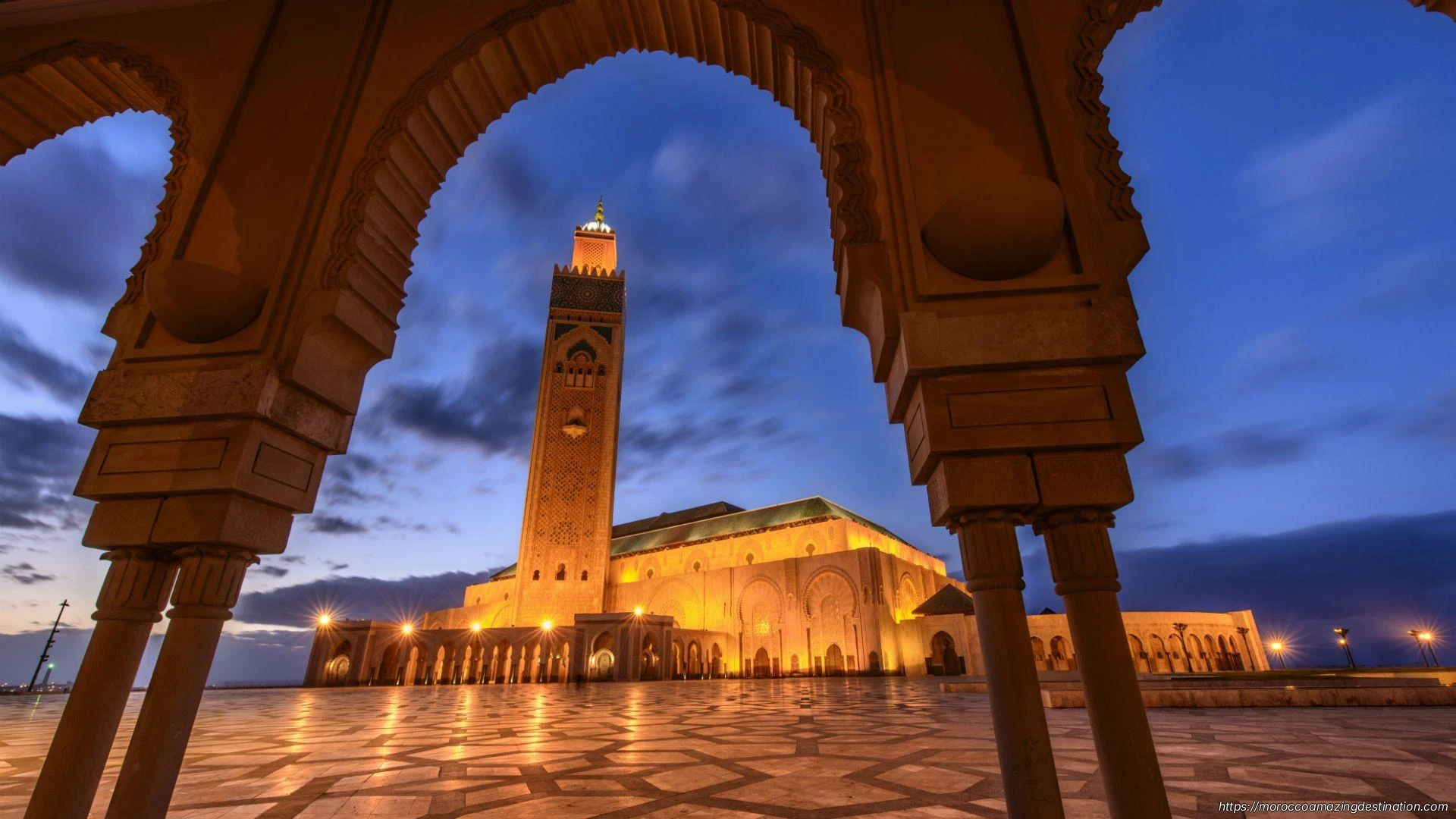
Perched dramatically on a promontory over the Atlantic Ocean, the Hassan II Mosque is not only the largest mosque in Morocco but also one of the most extraordinary religious buildings in the world.
- Completed in 1993 after seven years of construction
- Capacity: 105,000 worshippers (25,000 inside, 80,000 on the esplanade)
- Minaret: 210 metres tall — the tallest minaret in the world at the time of completion
- Unique features: A retractable roof weighing 1,100 tons that opens in five minutes, a glass floor section revealing the ocean below, and a laser beam at the top of the minaret pointing toward Mecca, visible from 30 kilometres away
- Materials: Almost entirely Moroccan — cedar from the Middle Atlas, marble from Agadir, granite from Tafraoute — with Italian white granite columns and 56 Murano glass chandeliers from Venice
- Artisans: 6,000 master craftsmen worked for five years on the zellij tilework, carved stucco, painted wood, and intricate plasterwork
Visitor information: The Hassan II Mosque is the only active mosque in Morocco open to non-Muslim visitors. Guided tours run several times daily (Saturday to Thursday at 9am, 10am, 11am, and 2pm). Tickets cost approximately 100 MAD for adults and 50 MAD for students. English-language tours are available.
Koutoubia Mosque — Marrakech
The Koutoubia Mosque is the iconic symbol of Marrakech. Its 77-metre minaret — visible from almost everywhere in the city — has served as the prototype for some of the most famous minarets in the Islamic world, including the Giralda of Seville and the Hassan Tower of Rabat.
- Built: Founded in 1147 by the Almohad Caliph Abd al-Mu’min, rebuilt around 1158
- Name meaning: “Booksellers’ Mosque” — named after the book trade that once flourished in the surrounding souk, with up to 100 book vendors at the base of the mosque
- Architecture: The minaret features the distinctive Almohad design with varying geometric arch motifs, sebka panels, and a finial topped with four copper spheres
Note: The Koutoubia is not open to non-Muslim visitors. However, the surrounding gardens offer excellent views, and the mosque is particularly beautiful at sunset when the minaret glows in golden light.
Al-Qarawiyyin Mosque and University — Fez
Founded in 857-859 CE by Fatima al-Fihri, Al-Qarawiyyin is recognized by UNESCO and Guinness World Records as the oldest existing, continually operating higher educational institution in the world. It remains both an active mosque and a centre of Islamic scholarship.
- Location: In the heart of Fes el-Bali, the oldest walled medina in the world
- Notable scholars: Ibn Khaldun, Ibn al-Arabi, Leo Africanus, and Muhammad al-Idrisi studied or taught here
- Library: Founded in 1349, the library holds priceless manuscripts including a 9th-century Quran on gazelle parchment and the original copy of Ibn Khaldun’s Muqaddimah, gifted by the author in 1396
- Architecture: The complex reflects centuries of expansion with a magnificent courtyard, a vast hypostyle prayer hall, Marinid-era fountains, and the oldest surviving minaret in Morocco (10th century)
The mosque is not open to non-Muslims, but you can admire its exterior and ornate entrance gates from the surrounding alleys of the Fez medina.
Hassan Tower — Rabat
Standing on a hill overlooking the Bou Regreg River, the Hassan Tower is the unfinished minaret of what was intended to be the largest mosque in the western Islamic world.
- Commissioned by: Almohad Caliph Yaqub al-Mansur in 1191
- What remains: The minaret stands 44 metres tall (intended to reach at least 64 metres) and 348 columns still rise from the esplanade
- UNESCO status: Part of a World Heritage site since 2012
- Accessibility: The entire complex is open to visitors, who can walk among the columns and admire the tower. The adjacent Mausoleum of Mohammed V is also open to non-Muslims and is a masterpiece of modern Moroccan craftsmanship
Tinmal Mosque — High Atlas
Nestled in the High Atlas Mountains on the Tizi-n-Test pass, the Tinmal Mosque was built in 1148 as the spiritual centre of the Almohad movement. It shares architectural similarities with the Koutoubia but on a more intimate scale.
- Status: No longer an active place of worship, preserved as a historic site
- Accessibility: One of the few mosque buildings in Morocco open to non-Muslim visitors
- Note: The mosque sustained severe damage in the 2023 earthquake; restoration work is ongoing
Can Non-Muslims Visit Mosques in Morocco?
This is one of the most frequently asked questions by travellers. The short answer is: most mosques in Morocco do not permit entry to non-Muslims. This policy dates to the French Protectorate period when Resident-General Lyautey established the rule as a gesture of respect for Moroccan religious sovereignty, and it has been largely maintained since independence.
Mosques you can visit as a non-Muslim:
- Hassan II Mosque — The only actively functioning mosque open to tourists, with guided tours
- Hassan Tower (Rabat) — An open historic ruin where prayers no longer take place
- Tinmal Mosque (High Atlas) — An inactive historic site (being restored after earthquake damage)
Mosques closed to non-Muslims:
- Koutoubia Mosque
- Al-Qarawiyyin Mosque
- All neighbourhood mosques and the vast majority of Friday mosques
Dress respectfully when visiting any mosque site. For the Hassan II Mosque tour, women are not required to cover their hair, but both men and women should cover shoulders and knees.
Moroccan Mosque Architecture Through the Dynasties
Moroccan mosque architecture is among the richest and most distinctive in the Islamic world. Each historical dynasty left its fingerprint:
| Dynasty | Period | Architectural Features |
|---|---|---|
| Idrisid | 8th-10th c. | Early hypostyle mosques; oldest surviving minarets; horseshoe arches |
| Almoravid | 11th-12th c. | Complex interlacing arches; introduction of muqarnas; early zellij and stucco |
| Almohad | 12th-13th c. | Monumental square minarets (Koutoubia, Hassan Tower); T-plan layout; sebka decoration |
| Marinid | 13th-15th c. | Exuberant zellij tilework, carved wood, and stucco; construction of madrasas |
| Saadian | 16th-17th c. | Multi-purpose charitable complexes around mosques |
| Alawi | 17th c.-present | Green-tiled roofs; modern innovations culminating in the Hassan II Mosque |
The square minaret is a hallmark of Moroccan Islamic architecture, distinguishing it from the cylindrical Ottoman minarets found elsewhere in the Muslim world. The distinctive finial — typically three or four decreasing golden copper spheres — is another uniquely Moroccan feature.
The Role of Mosques in Moroccan Daily Life
In Morocco, mosques are far more than places of worship. They are:
- Community hubs: The main souk is traditionally built around the grand mosque, and the entire medina layout radiates outward from it
- Centres of education: Historically, mosques like Al-Qarawiyyin were the primary institutions of learning, offering instruction in religious and secular sciences
- Architectural anchors: The minaret serves as a visual landmark for navigation within the medina
- Markers of time: The call to prayer (adhan) structures the daily rhythm, broadcast five times a day from every minaret
- Spaces of charity and gathering: During Ramadan, mosques host free communal iftar meals for those in need
The phrase you will hear most often — the melodic Allahu Akbar ringing out in overlapping waves across a city — is perhaps the most authentic soundtrack of Morocco.
Whether you visit Casablanca to marvel at the towering minaret of the Hassan II Mosque, explore the ancient streets of Fes where the world’s oldest university still stands, or simply listen to the sunset call to prayer echoing over the Atlas Mountains, Morocco’s mosques offer a profound window into the country’s soul.
If you are planning a trip that includes the country’s most iconic religious and cultural landmarks, our 8-Day Imperial Cities and Sahara Desert Tour from Casablanca takes you through Casablanca, Rabat, Meknes, Fes, and Marrakech — covering four imperial cities and the architectural wonders of each, from the Hassan II Mosque to the ancient medinas of Fes.
For a more in-depth journey, our 10-Day Tour from Casablanca to the Sahara Desert via Fes starts in Casablanca with visits to mosques and historic sites, continues through Rabat and Fes, and culminates with a camel trek and night under the stars in the Merzouga desert.
If you found this helpful, add us as your preferred source on Google.
Frequently Asked Questions
How many mosques are there in Morocco?
Morocco is home to approximately 41,755 mosques, of which about 16,489 are Friday (congregational) mosques known as jamaa. This means there is roughly one mosque for every 900 inhabitants, making it one of the highest densities of mosques in the world.
Can non-Muslims visit mosques in Morocco?
The vast majority of mosques in Morocco are closed to non-Muslim visitors. However, the Hassan II Mosque in Casablanca offers guided tours several times daily, the Hassan Tower in Rabat is an open historic site, and the Tinmal Mosque in the High Atlas is accessible as an inactive historic monument.
What is the largest mosque in Morocco?
The Hassan II Mosque in Casablanca is the largest mosque in Morocco and one of the largest in the world. It can accommodate 105,000 worshippers (25,000 inside the prayer hall and 80,000 on the outside plaza), and its minaret stands 210 meters tall.
What is the oldest mosque in Morocco?
The Al-Qarawiyyin Mosque in Fez, founded in 857-859 CE by Fatima al-Fihri, is considered the oldest university in the world by UNESCO and Guinness World Records. It remains an active mosque and an important centre of Islamic learning today.
- how-many-mosques-in-morocco
- mosques-in-morocco
- islamic-architecture
- religious-tourism-morocco
- morocco-culture
Ready for an Adventure?
Have questions? Feel free to contact us using the form below. We're here to help!