· Travel · 9 min read
How Many Churches Are There in Morocco? A Complete Guide to Christian Places of Worship
Discover how many churches are in Morocco, from Catholic cathedrals to Orthodox and Protestant places of worship. A complete guide to Christian heritage in the Kingdom.
How Many Churches Are There in Morocco?
When most people think of Morocco, they picture minarets, medinas, and mosques. The country is 99% Muslim, and Islam is the official state religion. So you might be surprised to learn that Morocco is home to a fascinating network of Christian places of worship — from grand cathedrals dating back to the colonial era to small, discreet house churches used by Moroccan converts.
So how many churches are there in Morocco?
The short answer: there are approximately 80 church buildings across the country. Of these, around 44 are currently active Catholic parishes, served by 57 priests and clergy from 15 different nationalities. In addition, there are 3 Eastern Orthodox churches, several Protestant and Anglican congregations, and an unknown number of house churches where Moroccan-born Christians worship privately.
Far from being a monolithic religious landscape, Morocco’s Christian heritage tells a story that spans nearly two millennia — one of Roman legions, medieval martyrs, colonial architects, and modern interfaith dialogue.
A Brief History of Christianity in Morocco
Christianity in Morocco is not a recent import. It dates back to the Roman Empire and the late 2nd century AD, when the province of Mauretania Tingitana — roughly modern-day northern Morocco — had thriving Christian communities. Tertullian of Carthage, writing around 200 AD, explicitly mentioned Christian believers among the Berbers of the region.
Several bishoprics existed in cities such as Tangier (Tingis), Asilah (Zilis), Larache (Lixus), Tetouan, and Salé. St. Marcellus of Tangier, a Roman centurion, was martyred in 298 AD for refusing to renounce his faith — one of the earliest recorded Christian martyrs in North Africa.
The arrival of Islam in the 7th century gradually diminished the Christian presence, and by the 12th century most indigenous Christian communities had disappeared under Almohad rule. However, Christianity never completely vanished from the region.
In 1219, during the lifetime of St. Francis of Assisi, the first Franciscan missionaries arrived in Morocco. Just one year later, in 1220, five Franciscan friars were martyred in Marrakech — an event that profoundly moved St. Francis and inspired the Franciscan order’s missionary spirit. The Catholic Church has maintained a continuous presence in Morocco ever since.
The colonial era — the French and Spanish protectorates from 1912 to 1956 — brought a dramatic expansion of Christianity. At its peak, there were over 200 Catholic churches and chapels serving nearly 500,000 European settlers. Sunday Mass was broadcast on national radio and television until 1961.
After Moroccan independence in 1956, more than 75% of the European Catholic population left the country. Many churches were deconsecrated, converted into mosques or cultural centers, or simply abandoned. Yet a dedicated network of clergy, religious orders, and congregations remained — shifting their focus from serving settlers to engaging in interfaith dialogue, education, and social service. Pope John Paul II visited in 1985, and Pope Francis made a historic apostolic visit in 2019, celebrating the deep bonds between the Church and Moroccan society.
How Many Active Churches Are There Today?
As of recent estimates, the current Christian places of worship in Morocco break down as follows:
Catholic Churches (~44 Parishes)
The Catholic Church operates two archdioceses:
- Archdiocese of Rabat — covering central and southern Morocco, including Casablanca, Marrakech, Fes, Meknes, Agadir, and Essaouira.
- Archdiocese of Tangier — covering northern Morocco, including the Mediterranean and Atlantic coastal towns.
At one point during the protectorate era, there were more than 200 Catholic churches. Today, about 44 remain active. Many former churches were repurposed — the most famous example being the Sacré-Cœur Cathedral in Casablanca, a striking Art Deco building deconsecrated in 1956 that now hosts art exhibitions and cultural events.
Orthodox Churches (3)
Three Eastern Orthodox churches operate in Morocco:
- Greek Orthodox Church of the Annunciation in Casablanca
- Russian Orthodox Church of the Resurrection in Rabat — one of the oldest Russian Orthodox churches in Africa, dating back to 1932
- Russian Orthodox Church in Casablanca
These serve a combined community of approximately 3,000 Orthodox faithful, mostly diplomats, expatriates, and their families.
Protestant and Anglican Churches
The Protestant presence in Morocco dates back to the 19th century. The first Protestant church was established in Essaouira in 1874. Today, several congregations are active:
- St. Andrew’s Anglican Church in Tangier — built in 1894 on land donated by Sultan Hassan I, famous for its blend of Moorish and Anglican architecture
- St. John’s Anglican Church in Casablanca — established in 1906, with a well-established congregation holding two Sunday services
- Evangelical Church of Morocco (Église Évangélique au Maroc) — the largest Protestant denomination in the country
- Various international Protestant churches serving expatriate communities in Casablanca, Rabat, and Marrakech
House Churches
A growing phenomenon is the presence of house churches — small, discreet gatherings of Moroccan-born Christians who have converted from Islam. Estimates of their numbers vary widely, ranging from 8,000 to 50,000 individuals. Because proselytism is illegal and apostasy from Islam carries severe social stigma, these Christians worship in private homes rather than public church buildings.
Notable Churches Worth Visiting
If you are interested in exploring Christian places of worship in Morocco, here are some of the most significant churches that welcome visitors:
Cathedral of St. Peter — Rabat
The Cathédrale Saint-Pierre is the seat of the Archdiocese of Rabat. Built in the early 20th century in Art Deco style, it serves as the spiritual heart of the Catholic Church in Morocco. Its striking white façade and twin towers make it a recognizable landmark in the capital. Mass is celebrated in multiple languages, reflecting the diversity of the local congregation.
Notre-Dame de Lourdes — Casablanca
This modernist Catholic church, completed in 1956, is famous for its breathtaking stained-glass windows created by French artist Gabriel Loire. The windows cover an entire wall and depict the Virgin Mary surrounded by biblical scenes in vivid blues and reds. It is widely considered one of the most beautiful churches in North Africa and remains an active place of worship.
Sacré-Cœur Cathedral — Casablanca
Although no longer a consecrated church, the former Cathedral of the Sacred Heart is an architectural masterpiece. Built in 1930 in a neo-Gothic style with Moroccan influences, it now serves as a cultural venue. Its soaring white towers are a distinctive feature of Casablanca’s skyline and it is open to the public for exhibitions and events.
Church of the Holy Martyrs — Marrakech
Located in the Gueliz district, the Église des Saints Martyrs serves the Catholic community of the Red City. Built in 1929, it remains an active parish holding Mass in French, English, and Spanish for the city’s diverse expatriate population. Its simple but elegant architecture provides a peaceful retreat from the bustling streets of Marrakech.
St. Andrew’s Church — Tangier
This Anglican church is a unique fusion of Moorish and Christian architecture. Its bell tower resembles a minaret, and the interior features Arabic calligraphy alongside Christian iconography. The churchyard contains the tomb of British explorer and journalist Walter Harris. Built in 1894 on land granted by Sultan Hassan I, it stands as a powerful symbol of interfaith respect.
Cathedral of Our Lady of the Assumption — Tangier
The Spanish-built Catholic cathedral, also known as the Catedral de Nuestra Señora de la Asunción, serves as the seat of the Archdiocese of Tangier. Its whitewashed exterior and central bell tower reflect Spanish colonial architectural style. The cathedral remains an active center of worship for Tangier’s diverse Christian community.
Church of Our Lady of Victory — Tetouan
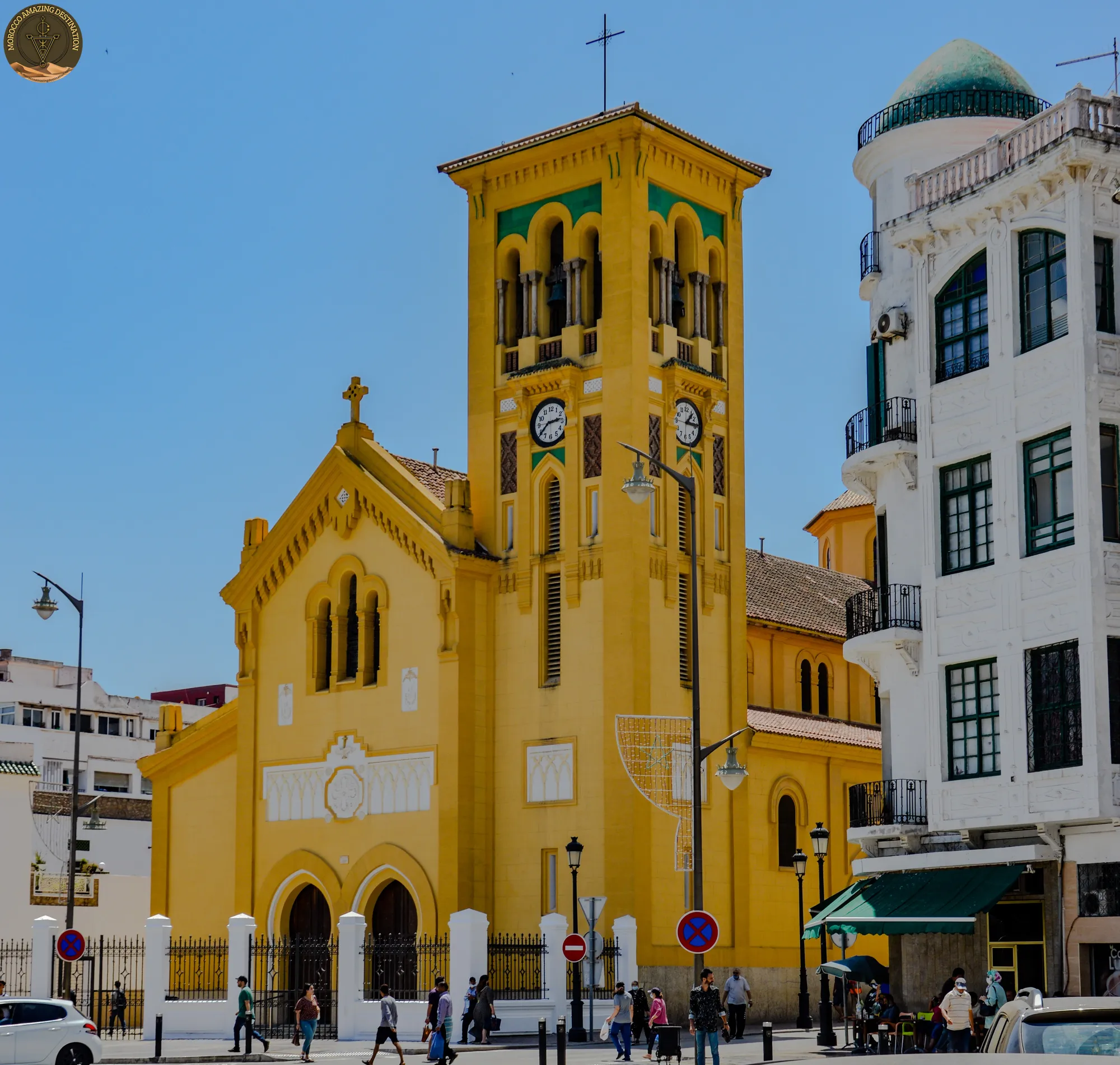
Built during the Spanish protectorate, the Iglesia de Nuestra Señora de la Victoria in Tetouan is a fine example of Spanish colonial ecclesiastical architecture. It sits in the heart of Tetouan, a city known for its rich Andalusian heritage, and continues to serve the local Catholic community. Its understated elegance and historical significance make it a worthwhile stop for visitors exploring northern Morocco.
The Christian Community in Morocco Today
The Christian population of Morocco numbers between 25,000 and 40,000 people, representing less than 1% of the country’s 38 million inhabitants. This community is remarkably diverse:
- European expatriates — French, Spanish, Italian, and other European nationals working in Morocco
- Sub-Saharan African migrants and students — the fastest-growing segment, bringing youth and energy to congregations
- Diplomats and international organization staff
- Moroccan-born converts — a small but growing number, estimated between 8,000 and 50,000
The average age of churchgoers in Morocco has dropped significantly in recent years, thanks largely to the influx of young African Catholics. As Cardinal Cristóbal López Romero, Archbishop of Rabat, has observed: “In our churches there are more young people than old, more men than women, and more Black people than white.”
The Catholic Church in Morocco operates not only as a place of worship but also as a social service provider — running schools, libraries, dispensaries, and Caritas programs that serve migrants and vulnerable Moroccans regardless of their religion. The Church, as Archbishop López Romero puts it, strives to be “a sign and an instrument of the Kingdom of God” — not by seeking converts, but by serving the common good alongside its Muslim neighbors.
Religious Freedom and Coexistence
Morocco’s Constitution declares Islam the state religion and the King as “Commander of the Faithful,” but it also guarantees freedom of worship for all. Foreign Christians are free to attend church services, and the government protects churches and their congregations.
However, the legal framework imposes important limits: proselytism — attempting to convert Muslims — is strictly prohibited and punishable by law. Moroccan converts to Christianity face legal and social difficulties, including restrictions on marriage, inheritance, and child custody. As a result, many practice their faith in private settings.
Despite these constraints, relations between Christians and Muslims in Morocco are generally peaceful and respectful. The Church’s role today is increasingly focused on interreligious dialogue, education, and humanitarian work — embodying a vision of peaceful coexistence that the Kingdom has cultivated for centuries.
Discover Morocco Beyond the Mosques
Exploring the churches of Morocco offers a unique perspective on the country — one that reveals layers of Roman, Christian, and colonial history often overlooked by traditional guidebooks. Whether you are a person of faith seeking a place to worship, a history enthusiast intrigued by the Christian heritage of North Africa, or simply a curious traveler, Morocco’s churches tell a story worth discovering.
Recommended Tours
If you want to explore the cities where Morocco’s most significant churches are located, our multi-day tours offer the perfect opportunity to combine cultural discovery with an unforgettable journey through the country.
8-Day Imperial Cities and Sahara Desert Tour from Casablanca — This comprehensive itinerary takes you through Casablanca (home to the stunning Notre-Dame de Lourdes), Rabat (with its St. Peter’s Cathedral), Fes, and Marrakech (where you can visit the Church of the Holy Martyrs), before heading into the Sahara Desert. View the tour
8 Days Northern Tour To Imperial Cities And Desert From Tangier — Starting from Tangier, where you can explore St. Andrew’s Anglican Church and the Spanish Cathedral, this tour covers Chefchaouen, Fes, the Merzouga desert dunes, and more — blending Morocco’s religious heritage with its breathtaking landscapes. View the tour
If you found this helpful, add us as your preferred source on Google.
Frequently Asked Questions
How many churches are there in Morocco?
Approximately 80 church buildings exist across the country, with around 44 currently functioning as active Catholic places of worship served by 57 clergy from 15 different nationalities. There are also 3 Eastern Orthodox churches, several Protestant and Anglican congregations, and an unknown number of house churches where Moroccan converts worship privately.
Can tourists visit churches in Morocco?
Yes, most active churches are open to visitors, though access is generally limited to service hours. They are not promoted as tourist attractions, so it is advisable to contact the parish in advance for visiting times. Some former churches, such as the Sacré-Cœur Cathedral in Casablanca, have been deconsecrated and now function as cultural spaces open to the public.
Where are the main churches located in Morocco?
The majority of Christian churches are concentrated in major cities with significant expatriate communities: Rabat (the political capital), Casablanca (the economic hub), Tangier, and Marrakech. Cities like Fes, Agadir, Essaouira, Meknes, and El Jadida also have at least one active Catholic church each.
Are Moroccans allowed to attend church?
Moroccan law guarantees freedom of worship for non-Muslims, and foreign Christians may attend church freely. However, Moroccan citizens who have converted from Islam to Christianity face significant legal and social challenges — proselytism is illegal, and converts often practice their faith in private house churches rather than public places of worship.
Ready for an Adventure?
Have questions? Feel free to contact us using the form below. We're here to help!