· Travel · 12 min read
Best City in Morocco to Visit: Top Picks by Traveller Type & How to Choose
Discover the best city in Morocco to visit for your style — Marrakech, Fes, Chefchaouen, Essaouira and more compared.
Choosing the best city in morocco to visit feels tricky because Morocco is not a one-city country — imperial medinas, blue mountain towns and Atlantic ports each promise something different. The good news: there is no wrong answer, only a better fit for your travel style, pace and interests.
This guide compares the leading contenders head to head so you can pick with confidence, whether you want vibrant markets, deep cultural immersion, photogenic streets, sea air or a seamless first trip. You will find a quick answer by traveller type, detailed city profiles, how to combine destinations and practical tips for getting between them without backtracking.
What Is the Best City in Morocco to Visit?
There is no single winner that suits every traveller, which is why most experienced guides frame the choice by purpose rather than ranking alone. As highlighted by destination overviews such as Visit Morocco and editorial roundups from travel publications including QZ and Lonely Planet, Morocco rewards different tastes in different places, and the best strategy is often to pair two or three cities.
Think of the decision this way:
- Want maximum sights, food and atmosphere in one base? Choose Marrakech.
- Want the deepest cultural walk, with living crafts and scholarly heritage? Choose Fes.
- Want a small, photogenic mountain escape? Choose Chefchaouen.
- Want ocean light, ramparts and a slower family-friendly pace? Choose Essaouira.
Rather than searching for a universal crown, match the city to your priorities and season, then build connections around it.
Short Answer: Best Cities in Morocco by Traveller Type
If you prefer a snapshot, the best cities in morocco break down cleanly by what you value most. Use this quick table to narrow your shortlist, then read the detailed profiles below for nuance.
| Traveller Type | Best Fit | Why It Wins |
|---|---|---|
| First-time visitors | Marrakech | Most sights, gardens, souks and day trips in one hub with frequent flights |
| Culture & history lovers | Fes | Medieval UNESCO medina, madrasas and tanneries in a largely car-free historic core |
| Photographers & couples | Chefchaouen | Blue-washed lanes, mountain light and compact, walkable charm |
| Families & relaxed pace | Essaouira | Atlantic medina, beaches, wind sports and easy walks |
| Coastal & modern contrast | Casablanca | Hassan II Mosque and contemporary city life |
| Europe gateway & art scene | Tangier | Strait views, ferries from Spain and layered international heritage |
| Capital calm & walkability | Rabat | Hassan Tower, Mausoleum and seaside Kasbah of the Udayas |
Keep in mind that several cities share strengths. Marrakech and Fes together cover most imperial heritage; Chefchaouen pairs naturally with Tangier or Fes; Essaouira is an easy add-on from Marrakech.
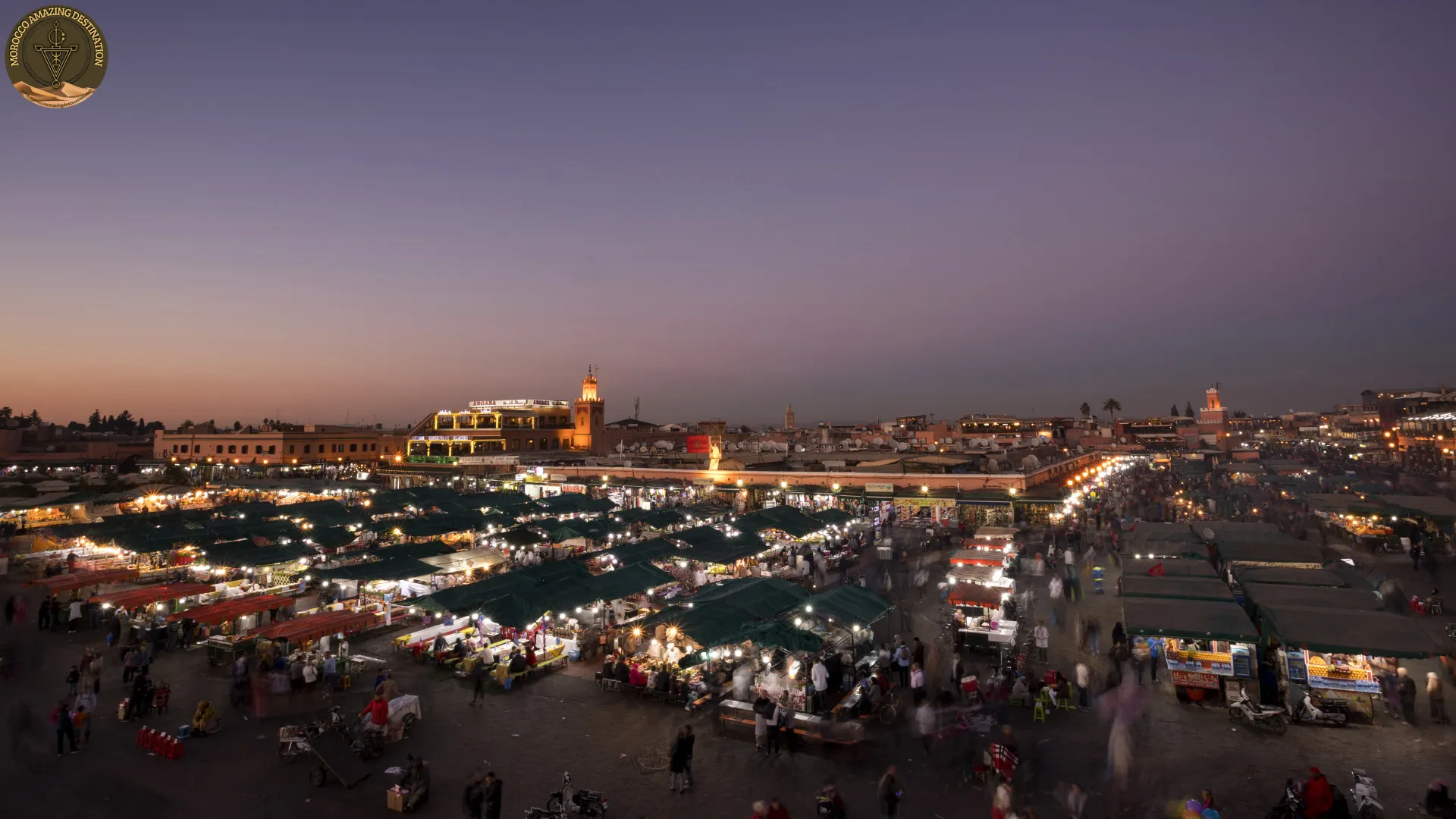
Marrakech — The Best City to Visit in Morocco for First Timers
If this is your first Morocco trip, Marrakech is the best city to visit in morocco for first timers for practical and cultural reasons. It concentrates more must-see sights within walking distance than any other city, offers the broadest choice of riads and restaurants, and serves as a gateway to the Atlas Mountains, Agafay Desert and Essaouira.
Founded in the 11th century by the Almoravids, the Red City centres on its UNESCO-listed medina and the famous Jemaa el-Fnaa square, recognised by UNESCO as Intangible Cultural Heritage for its storytelling, music and food stalls that animate each evening. Landmarks include:
- Koutoubia Mosque minaret, a 12th-century Almohad landmark rising about 77 m, visible across the medina
- Bahia Palace with its courtyards and zellige tilework, and the nearby Saadian Tombs
- Ben Youssef Madrasa, a 16th-century Koranic school renowned for carved cedar and stucco
- Jardin Majorelle and the Yves Saint Laurent Museum, a calm contrast to the souks
Who it suits best: First-time visitors, food lovers, photographers and anyone who wants markets, palaces and lively squares without long transfers.
How long to stay: Three to five nights lets you cover the medina, souks and one day trip without rushing.
Pros: Densest concentration of sights, most flight options via Marrakech Menara Airport, widest range of accommodation, easy private-driver connections south.
Cons: Busiest medina, more persistent selling in souks and strong summer heat inland.
Tip: Stay inside or near the medina for atmosphere, but schedule a garden or rooftop pause when the souks feel intense. Early morning at Jemaa el-Fnaa is calmer and better for photos.
Fes — The Cultural and Spiritual Capital
Fes offers the deepest cultural immersion of any Moroccan city. Founded in the late 8th century, it is considered the spiritual heart of the country and retains a medieval urban fabric that feels remarkably intact.
The historic core, Fes el-Bali, is listed by UNESCO and often described as one of the largest car-free urban areas in the world, with thousands of alleys over roughly 250 hectares. Highlights include:
- University of Al-Qarawiyyin, founded by Fatima al-Fihri, widely cited as the oldest continuously operating higher-education institution
- Bou Inania and Al-Attarine Madrasas, masterpieces of Marinid architecture
- Chouara Tanneries, operating since around the 11th century, best viewed from the surrounding terraces
- Lively souks specialising in leather, textiles, ceramics and the refined Fassi cuisine, from pastilla to harira
Who it suits best: Culture lovers, history enthusiasts and travellers who want a guided, layered walk through living heritage.
How long to stay: Two to three days with a licensed guide, who is strongly recommended in the medina where signage is minimal and key sites are easy to miss.
Pros: Unparalleled authenticity, finest craft traditions and culinary depth.
Cons: Fewer green spaces than Marrakech and a steeper learning curve without a guide; accommodation is medina-centric.
For many return visitors, Fes eclipses Marrakech for atmosphere precisely because it feels less staged and more residential.
Chefchaouen — The Most Beautiful City in Morocco
Set in the Rif Mountains, the compact town of Chefchaouen is often called the most beautiful city in morocco for its powder-blue lanes, flower-dotted doorways and mountain backdrop. Whether it is objectively the most beautiful is subjective, but travellers consistently rank it first for photography and relaxed wandering.
Founded in the late 15th century as a mountain stronghold, the town’s blue wash is commonly linked to later traditions associated with Jewish refugees in the early 20th century, though the exact origin is debated among historians and flag accordingly if you recount it. What is certain is the effect: every alley frames a picture, especially in early morning light.
- Highlights: The small medina and Kasbah, the hillside Spanish Mosque for sunrise views over the blue town, and nearby nature in Talassemtane National Park and the Akchour waterfalls
- Size: A town of roughly 40,000-plus residents at about 600 m altitude, walkable in a day with one or two nights ideal
- Access: No train station or airport; reached by bus or private transfer, about two and a half hours from Tangier and three to four hours from Fes
Who it suits best: Couples, photographers, solo travellers seeking a gentle pace and hikers who want waterfall walks without a major trek.
Pros: Extremely photogenic, calm atmosphere and cooler mountain air.
Cons: Smaller range of sights and services; roads are winding and require road time if you are touring widely.
Stay overnight to enjoy early light before day-trippers arrive and to catch sunset from the Spanish Mosque.
Essaouira — Atlantic Light and Laid-Back Charm
On the Atlantic coast about 170 km west of Marrakech, Essaouira offers a refreshing contrast to inland heat and intensity. Known as the Windy City for steady trade winds, its whitewashed medina with blue shutters sits inside 18th-century Portuguese-built ramparts and is listed by UNESCO for its well-preserved fortified grid.
- What to see: The Skala de la Kasbah ramparts lined with cannons, the busy fishing port, art galleries and a wide sandy beach stretching south toward Sidi Kaouki and Diabat
- Activities: Surfing and kitesurfing, fresh seafood at the port, Gnawa music heritage and relaxed shopping without the pressure of larger souks
- Climate: Cooler and breezier year-round, making it pleasant when inland cities are hot
Who it suits best: Families, surfers, art lovers and anyone seeking a slower, sea-facing finale after Marrakech or the desert.
How long to stay: One to two days, easily added as an overnight from Marrakech by bus or private driver in about three hours.
Pros: Easygoing, family-friendly and photogenic in a different way from blue Chefchaouen.
Cons: Afternoons can be windy and the beach is better for wind sports than calm swimming.
Casablanca, Tangier and Rabat — Three Cities With Distinct Roles
These three northern and central cities are not always top of a first itinerary, but each answers a specific need.
Casablanca — Modern Metropolis and Ocean Mosque
Morocco’s largest city, with several million residents, is the economic capital rather than a historic medina town. Its headline sight is the Hassan II Mosque, one of the largest mosques on the continent, built partly over the Atlantic with a minaret reaching about 210 m and capacity for around 105,000 worshippers. It is one of the few mosques open to non-Muslim visitors via guided tours outside prayer times.
Beyond the mosque, Casablanca offers Art Deco boulevards in Gauthier and Maarif, the Habous quarter, and the Corniche for seafood and nightlife. Most travellers spend a single day, often on arrival via Casablanca Mohammed V Airport, before heading north or south by train.
Tangier — Strait Gateway
At the Strait of Gibraltar, only about 14 km from Spain, Tangier has been a crossroads since antiquity and an international zone in the early to mid-20th century, associated with writers and artists from Matisse to Bowles. Ferries connect Tarifa and Algeciras in under an hour on the fastest routes.
Sights include the Grand Socco, Kasbah museum, Cafe Hafa dating to the early twentieth century, the birthplace associations of explorer Ibn Battuta, and the American Legation, the first property acquired abroad by the United States. The Al Boraq high-speed train links Tangier to Rabat and Casablanca quickly.
Tangier suits travellers arriving from Europe, fans of port cities with a bohemian edge and anyone combining Chefchaouen with a smooth northern loop.
Rabat — Capital Heritage
Rabat, the administrative capital with well under a million residents in the city proper, is walkable and calm. UNESCO-listed for its modern capital and historic ensemble, it offers the unfinished 12th-century Hassan Tower at about 44 m, the Mausoleum of Mohammed V, the blue-and-white Kasbah of the Udayas with its Andalusian garden and Atlantic views, and the Chellah necropolis, where Roman ruins of Sala Colonia meet a medieval necropolis. One day is enough to cover the highlights.
How to Choose: Matching the Top Cities to Visit in Morocco to Your Trip
With so many strong candidates, the choice comes down to how you want to spend your days. Use these prompts to identify the top cities to visit in morocco for your itinerary:
- Short break and maximum impact? Base in Marrakech, add Essaouira or Agafay for contrast.
- Cultural depth over bustle? Prioritise Fes, with Meknes and the Roman site of Volubilis nearby.
- Photography and slow mornings? Choose Chefchaouen, ideally between Tangier and Fes.
- Beach and family ease? Essaouira or Agadir, the latter with a longer sandy bay and resort infrastructure rebuilt after the mid-20th-century earthquake.
- Mountains and desert? Marrakech is the natural gateway, with routes through the High Atlas, Ait Benhaddou, Dades and Todra toward Merzouga and Erg Chebbi.
- Nightlife and contemporary feel? Casablanca for an evening Corniche stroll.
Combining cities without rushing:
A classic north-to-south arc works well: start in Tangier or Casablanca, loop through Chefchaouen and Fes, cross the Middle Atlas via the Ziz Valley to Merzouga, then return west through Dades, Todra, Ait Benhaddou and the High Atlas to Marrakech and on to Essaouira. This avoids backtracking and lets you mix train and road.
Practical Tips for Moving Between Cities
- Train reality: The fast, frequent rail corridor links Tangier, Kenitra, Rabat, Casablanca, Fes and Marrakech, including the Al Boraq high-speed section. There are no trains to Chefchaouen, Essaouira, Agadir, Ouarzazate or Merzouga — those legs require bus or private driver, as noted by Seat61 and ONCF timetables.
- Road versus rail strategy: Use trains in the north and a private driver with a comfortable vehicle for Atlas and desert sections. Drivers handle mountain navigation, adapt stops to your pace and manage luggage between riads.
- Guided help: A licensed guide is highly recommended in Fes and helpful at historic sites like Volubilis and Ait Benhaddou. Coastal towns and souk browsing are easy independently.
- Stay style: Choose riads inside the medinas in Marrakech, Fes and Chefchaouen for atmosphere; opt for valley lodges in Dades and Todra and sea-view guesthouses in Essaouira. Desert camps range from standard to luxury ensuite, both including meals and stargazing.
- Distances as guides: Figures such as Fes to Chefchaouen about 200 km or Marrakech to Essaouira about 170 km are approximate and vary by route. Treat heights like Toubkal region peaks and Erg Chebbi dunes to about 150 m as rounded references.
Which City Should You Pick?
If you must choose one base:
- Pick Marrakech if you want variety, energy and the easiest logistics for a first trip.
- Pick Fes if you want authenticity, scholarly heritage and living crafts.
- Pick Chefchaouen if you want beauty and calm above all.
- Pick Essaouira if you want sea air and a gentle rhythm.
Better still, combine two or three. Marrakech plus Fes covers imperial heritage with contrast; adding Chefchaouen or Essaouira adds mountain or maritime balance without stretching travel time unduly. Casablanca, Tangier and Rabat slot in smoothly for arrivals, departures or a cultural bridge between regions.
Plan Your Route With a Seamless Tour
To experience several of these highlights without juggling trains, drivers and guides separately, consider a private circuit that links them in one smooth journey. The 12-Day Morocco Grand Tour connects imperial cities, mountain valleys and desert dunes in a balanced arc, effectively answering the best-city question by letting you sample each contender at the right pace.
For a heritage-focused alternative starting on the Atlantic, the 8-Day Imperial Cities and Desert Tour from Casablanca weaves Casablanca, Rabat, Chefchaouen, Fes and Marrakech with a Sahara extension toward Merzouga, ideal if you want historic cities plus dunes without backtracking.
We can customize a tour to match your needs — design your perfect itinerary
If you found this helpful, add us as your preferred source on Google.
Frequently Asked Questions
What is the best city to visit in Morocco for first timers?
Marrakech is the best city for first timers thanks to its UNESCO medina, Jemaa el-Fnaa square, easy flights, wide riad choice and nearby day trips to the Atlas and Agafay Desert.
What is the most beautiful city in Morocco?
Chefchaouen is widely considered the most beautiful city for its blue-washed streets in the Rif Mountains, compact medina and mountain light, especially at sunrise from the Spanish Mosque.
Is Marrakech or Fes better to visit?
Marrakech offers energy, gardens and desert access; Fes offers deeper cultural immersion in the medieval medina, madrasas and tanneries. Many travellers visit both, starting with Marrakech and contrasting it with Fes.
Can I visit several cities in one Morocco trip?
Yes. Trains link Tangier, Rabat, Casablanca, Fes and Marrakech, while Atlas and Sahara legs need a private driver. A 7 to 14 day circuit can comfortably combine two to four cities plus desert or coast.
Ready for an Adventure?
Have questions? Feel free to contact us using the form below. We're here to help!