· Travel · 11 min read
Who Are Moroccans Descended From? Uncovering the Ancestral Origins of Morocco
Discover who Moroccans are descended from — indigenous Amazigh Berbers, Arabs, Andalusians, and Sub-Saharan Africans. Explore the genetic and cultural heritage of Morocco.
Morocco has always been a land of encounters. Perched at the northwestern tip of Africa, separated from Europe by a mere 14 kilometers of sea, and connected to the Middle East and Sub-Saharan Africa by ancient trade routes, it is no surprise that who Moroccans are descended from is a question with many answers. The Moroccan people are the product of millennia of migrations, conquests, and cultural exchanges — a living mosaic where indigenous Amazigh heritage meets Arab, Andalusian, African, and European influences.
Whether you are planning a trip and want to understand the faces you will meet in the medinas, or simply fascinated by human history, this guide traces the Moroccan ancestry from its deepest roots to its modern expression. By the end, you will understand why Morocco is often called the most diverse country in North Africa — and why its people carry this diversity in their genes, their languages, and their daily lives.
The Amazigh: Morocco’s Indigenous Ancestors
Before Arabs, Romans, or Phoenicians set foot in North Africa, the Amazigh — often called Berbers — were already there. Archaeological evidence places Amazigh communities in what is now Morocco as far back as 4,000 to 5,000 years ago, making them the original inhabitants of Morocco and one of the oldest continuous cultures in the Mediterranean world.
Who Were the First People of Morocco?
The earliest known inhabitants of the Moroccan territory were Neolithic pastoralists who left behind remarkable rock art in the High Atlas and the Sahara — depictions of cattle, antelopes, and human figures that can still be seen today. By the time Phoenician traders established coastal outposts around 800 BCE, the region was firmly Amazigh territory.
Several ancient Amazigh kingdoms shaped the pre-Islamic history of Morocco:
- The Mauri kingdom — from which the term “Moor” and the Roman name “Mauretania” derive — controlled much of modern northern Morocco and interacted extensively with Carthage and Rome
- The Numidian kingdom to the east maintained complex relationships with the Roman Republic
- Roman Mauretania Tingitana, with its capital at Volubilis near modern Meknes, became a prosperous province where Amazigh aristocrats served as Roman magistrates and adopted Latin alongside their own language
Even under Roman rule, the vast majority of the population remained Amazigh. Latin inscriptions from Volubilis record local Amazigh names and deities alongside Roman ones — testament to a blended society where indigenous identity never disappeared.
The Amazigh Genetic Legacy
Genetic studies consistently identify the Amazigh genetic signature as the largest component of the modern Moroccan gene pool. The Y-chromosome haplogroup E-M81, often described as the “Berber marker,” is found at frequencies of 60% to 80% in Moroccan males — among the highest rates in the world.
This genetic evidence confirms what oral tradition and archaeology have long suggested: the Amazigh are the foundational population of Morocco, and their genetic imprint endures across every region of the country, from the Rif Mountains in the north to the Sahara’s edge in the south.
The Amazigh themselves are diverse, comprising three main linguistic groups:
- Tachelhit (Shilha) — spoken in the High Atlas, Anti-Atlas, and Souss Valley
- Tamazight (Central Atlas) — spoken in the Middle Atlas
- Tarifit (Riffian) — spoken in the Rif Mountains
Each group has its own dialect, customs, and traditional dress, yet all share the broader Amazigh identity and the ancient Tifinagh writing system — a script you will see carved into desert rocks, woven into carpets, and increasingly displayed on Moroccan road signs.
The Arab Legacy: Islam, Language, and Genealogy
The second great wave that shaped Moroccan origins arrived in the late 7th century, when Arab armies brought Islam to North Africa. The conquest was not merely military — it was a profound cultural, linguistic, and demographic transformation that would permanently reshape the region.
How Arabs Influenced Moroccan Identity
The Arab impact unfolded in several stages over more than a thousand years:
The initial Islamic conquest (670–710 CE): Uqba ibn Nafi and his Arab forces swept across North Africa, reaching the Atlantic coast of Morocco by 710. While the number of Arab settlers was initially small, the introduction of Islam created a unifying religious and legal framework that gradually spread through existing Amazigh communities.
The Idrisid dynasty (789–974 CE): Idris I, a descendant of the Prophet Muhammad, founded Morocco’s first Islamic state and established the city of Fes, which would become one of the world’s great centers of Islamic learning. The Idrisids, while Arab in lineage, ruled over a predominantly Amazigh population and relied on Amazigh tribal alliances.
The great Amazigh-Arab empires: Later dynasties illustrated the deepening fusion of identities. The Almoravids (1040–1147) and Almohads (1121–1269) were rooted in Amazigh tribal confederations but adopted Arabic as the language of administration, law, and high culture. Their empires stretched from Senegal to Spain, spreading Moroccan influence across three continents.
The Hilalian migrations (11th–12th centuries): Perhaps the most significant demographic shift came with the arrival of the Banu Hilal and Banu Sulaym Arab tribes from the Arabian Peninsula. Unlike earlier Arab waves — which were primarily military and elite — the Hilalians were entire tribal populations, bringing tens of thousands of families who settled across the Moroccan plains and plateaus.
These migrations substantially Arabized the lowlands of Morocco. Arabic gradually displaced Tamazight as the dominant language in cities and fertile agricultural areas, while Amazigh-speaking communities retreated to or remained in the mountains and desert margins where their languages survive to this day.
Arab Genetic Contribution
Genetic studies detect the Arab contribution to the modern Moroccan gene pool through Y-chromosome haplogroups such as J-M267, which is associated with migrations from the Arabian Peninsula. This marker is present in approximately 10% to 20% of Moroccan males, with higher concentrations in Arabized plains and cities. Combined with the dominant Amazigh E-M81, the two markers tell the story of fusion across centuries.
The overlap between Arab and Amazigh ancestry is so extensive that for most Moroccans, separating the two is impossible — and, culturally speaking, irrelevant. A person from Marrakech might carry the E-M81 Amazigh marker, speak Moroccan Arabic (Darija) at home, have an Arab family name tracing back to the Prophet, and celebrate both Islamic and Amazigh holidays like Yennayer, the Amazigh New Year.
The Andalusian Connection: Moors, Moriscos, and Shared Heritage
Few chapters of Moroccan ancestry are as emotionally resonant as the Andalusian connection. Between the 8th and 15th centuries, Muslims ruled large parts of the Iberian Peninsula in a civilization known as Al-Andalus. When this world collapsed, waves of refugees crossed the Strait of Gibraltar into Morocco — carrying with them centuries of art, architecture, music, and memory.
The Morisco Diaspora
The largest influx came in the 15th, 16th, and early 17th centuries, following the Christian Reconquista of Spain:
- 1492: The fall of Granada marked the end of Muslim rule in Spain. Tens of thousands of Andalusian Muslims fled to Morocco, settling in northern cities like Tetouan, Chefchaouen, and Tangier.
- 1609–1614: King Philip III of Spain ordered the expulsion of the Moriscos — Muslims who had been forced to convert to Christianity. An estimated 300,000 people were expelled, with large numbers resettling in Moroccan cities.
These Andalusian refugees transformed Moroccan urban culture. They brought:
- Architecture: The whitewashed houses with interior courtyards and intricate tilework of northern Moroccan cities like Tetouan are direct descendants of Andalusian design
- Music: Andalusi music (al-ala), a classical tradition blending Arab, Amazigh, and Spanish elements, is still performed in Morocco today and considered the country’s classical music
- Cuisine: Dishes like pastilla — a sweet-savory pie of flaky pastry, pigeon or chicken, almonds, and cinnamon — trace directly to Andalusian kitchens
- Crafts: Leatherwork, embroidery, and woodcarving traditions in Fes and Tetouan bear unmistakable Andalusian fingerprints
In many old medina families across northern Morocco, the memory of Al-Andalus is preserved through family names (like al-Andalusi), oral histories, and — in some cases — actual iron keys passed down through generations, symbolizing homes in Granada or Cordoba that their ancestors hoped one day to return to.
Sub-Saharan African Roots: The Trans-Saharan Connection
Morocco’s position at the northern terminus of the trans-Saharan trade routes brought sustained contact with Sub-Saharan Africa, adding yet another layer to Moroccan genetic diversity.
The Gnawa People and West African Heritage
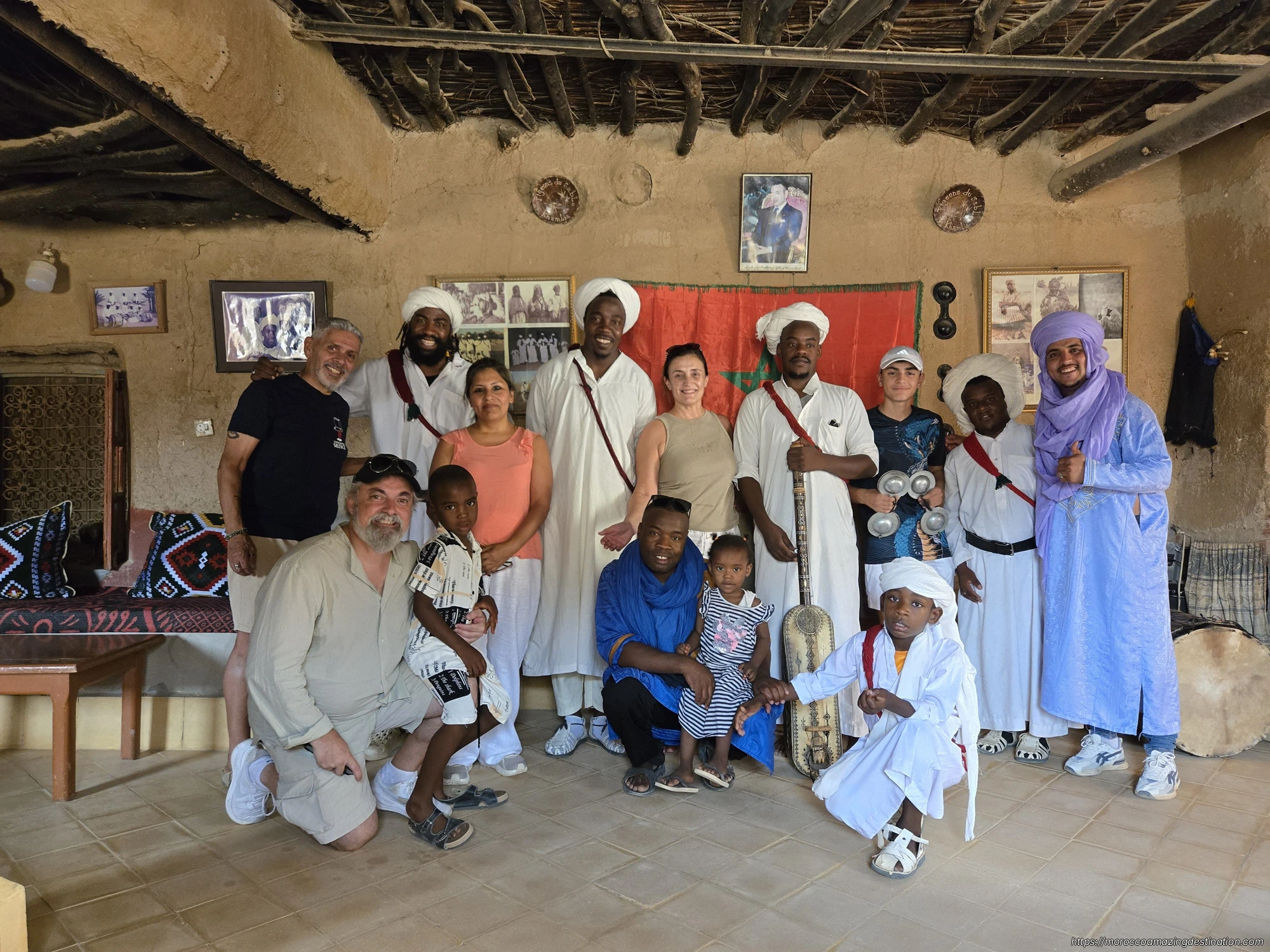
The most visible Sub-Saharan presence in Morocco is the Gnawa community. Originating primarily from West Africa — including what is now Mali, Senegal, Niger, and Guinea — the Gnawa were brought north as slaves, soldiers, and traders from the 11th century onward. Over time, they developed a distinctive spiritual and musical tradition that blends Islamic Sufism with West African ritual.
Gnawa music, with its hypnotic rhythms, deep bass guembri lute, and call-and-response vocals, has become one of Morocco’s most celebrated cultural exports. The annual Gnawa World Music Festival in Essaouira draws visitors from around the globe and showcases this uniquely Moroccan-African heritage.
The Gnawa are not the only connection. The Almoravid dynasty, which ruled Morocco and much of West Africa from the 11th to 12th centuries, maintained deep political, economic, and familial ties across the Sahara. Marrakech and Timbuktu were linked not just by trade caravans but by shared scholars, religious practices, and populations.
Genetic Evidence of Sub-Saharan Ancestry
Genetic studies have detected Sub-Saharan African maternal lineages (mitochondrial DNA haplogroups L) in approximately 20% to 25% of Moroccans, with higher frequencies in southern regions closer to the Sahara. The Y-chromosome evidence is lower — around 5% to 10% — suggesting that the historical gene flow across the Sahara was mediated disproportionately through women, consistent with the social patterns of slavery and intermarriage.
What Genetic Studies Reveal About Moroccan Ancestry
Modern population genetics has transformed our understanding of Moroccan origins, replacing speculation with data. Multiple large-scale studies converge on a consistent picture:
| Ancestral Component | Approximate Contribution | Primary Associated Markers |
|---|---|---|
| Amazigh (Berber) | 60–75% | E-M81 (Y-DNA), U6, H1 (mtDNA) |
| Arab | 10–20% | J-M267 (Y-DNA) |
| Sub-Saharan African | 5–20% | L lineages (mtDNA), E-M2 (Y-DNA) |
| European / Iberian | 3–5% | R1b (Y-DNA), H (mtDNA) |
These figures are population averages; individual ancestry varies considerably by region. Northern Moroccans tend to show higher European and Andalusian genetic contributions, while southern Moroccans and Sahrawis exhibit greater Sub-Saharan African admixture. Amazigh-speaking communities in the High Atlas show the highest frequencies of the E-M81 “Berber marker,” consistent with their long geographic isolation.
Morocco at the Crossroads
What the genetic data ultimately reveals is Morocco’s position as a true crossroads — a place where Africa, Europe, and the Middle East physically meet. The Strait of Gibraltar, the Sahara, and the Mediterranean have been highways of human movement, not barriers. Every empire that touched Morocco — Phoenician, Roman, Arab, Almoravid, Almohad, Andalusian, Ottoman, French, Spanish — left a trace, however faint.
This genetic diversity is mirrored in the cultural richness that travelers encounter across Morocco: the blue-washed streets of Chefchaouen, the Andalusian-inflected classical music of Fes, the Gnawa rhythms of Essaouira, the Berber carpets of the High Atlas, and the cosmopolitan energy of Casablanca. Each is a living expression of a different strand of Moroccan ancestry.
Modern Moroccan Identity: Unity in Diversity
Understanding who Moroccans are descended from ultimately leads to understanding who they are today. The 2011 Moroccan constitution codified the nation’s diverse heritage by recognizing both Arabic and Tamazight (Amazigh language) as official languages — a landmark acknowledgment that Morocco’s identity is fundamentally plural.
In daily life, Moroccans navigate multiple identities with ease. A person might:
- Speak Darija (Moroccan Arabic) at the market, Tamazight at home, and French at work
- Celebrate Eid al-Adha and the Amazigh New Year (Yennayer) with equal enthusiasm
- Trace their paternal lineage to an Arab saint buried near Marrakech and their maternal ancestry to an Amazigh village in the Souss Valley
- Listen to Gnawa music on Friday evenings and Andalusi classical music on special occasions
This layered identity is not a source of confusion or tension for most Moroccans — it is simply what it means to be Moroccan. The country’s official tourism slogan, “Morocco, Land of Light,” could equally be “Morocco, Land of Encounter.” Every visitor who walks through a medina, shares mint tea with a shopkeeper, or watches the sun set over the Sahara is stepping into a story four thousand years in the making.
Explore Morocco’s Living Heritage
If the story of Moroccan ancestry fascinates you, there is no substitute for experiencing the country’s cultural tapestry firsthand. From the Roman ruins of Volubilis to the Amazigh villages of the High Atlas, from the Andalusian medinas of the north to the Gnawa traditions of the south, Morocco’s living heritage awaits.
Recommended Cultural Tours
Dive deeper into Morocco’s rich history and diverse heritage with these carefully crafted tours:
Tangier Marrakech | 15 Days Grand Cultural Tour To Explore Morocco From Tangier — /en/tours/15-day-grand-cultural-tour-explore-morocco-from-tangier
This comprehensive 15-day journey covers all four imperial cities (Fes, Meknes, Rabat, Marrakech), the blue city of Chefchaouen, the Sahara desert with camel treks, and Atlantic coastal cities — immersing you in the full breadth of Morocco’s history and culture.
Unforgettable Morocco Imperial Cities and Desert Tour: 7 Days of Adventure — /en/tours/morocco-7-day-imperial-cities-desert-tour
A perfect introduction to Morocco’s imperial heritage, this 7-day tour explores the ancient medinas of Marrakech and Fes, crosses the Atlas Mountains, and takes you into the Sahara for a night under the stars — connecting you with the landscapes and cultures that shaped Moroccan identity.
Frequently Asked Questions
Who are Moroccans descended from?
Moroccans are descended primarily from the indigenous Amazigh (Berber) people, who have inhabited North Africa for over 4,000 years, with significant genetic and cultural contributions from Arab migrations, Andalusian Moriscos expelled from Spain, Sub-Saharan African populations through trans-Saharan trade, and to a lesser extent European influences from the French and Spanish protectorate periods. Genetic studies confirm that the Amazigh ancestry forms the largest component of the modern Moroccan gene pool.
Are Moroccans Arab or Berber?
Moroccans are both Arab and Amazigh (Berber), with the majority of the population having mixed ancestry from both groups. The indigenous Amazigh people make up the oldest ancestral layer, while Arab migrations beginning in the 7th century brought Islam, the Arabic language, and additional genetic diversity. Most Moroccans today identify culturally with both heritages, and the 2011 constitution recognizes both Arabic and Tamazight as official languages.
What genetic studies have been done on Moroccan ancestry?
Multiple genetic studies have analyzed the Moroccan population's DNA, revealing a complex mosaic. Research shows that the predominant Y-chromosome haplogroup is E-M81, associated with Amazigh origins, alongside J-M267 linked to Arab migrations. Mitochondrial DNA studies show Eurasian, North African, and Sub-Saharan lineages. Overall, studies confirm Morocco sits at the crossroads of Africa, Europe, and the Middle East, with Amazigh ancestry forming the largest ancestral component.
Do Moroccans have Andalusian or Spanish ancestry?
Yes, many Moroccans — particularly in northern cities like Tetouan, Chefchaouen, Tangier, and Fes — have Andalusian ancestry through the Moriscos, Muslims and Jews expelled from Spain between the 15th and 17th centuries. These communities brought their architecture, music, cuisine, and craftsmanship, leaving a lasting mark on Moroccan culture. Some families still preserve keys to their ancestral homes in Andalusia as a symbol of this heritage.